Your Brain Starts Declining Earlier Than You Think. New Research Shows What Protects It.
You're 37. You walk into a room and forget why. You lose a word mid-sentence, the one that was right there a second ago. You re-read the same paragraph three times because nothing sticks.
You tell yourself it's stress. Too many tabs open (in the browser and in your head). And maybe it is. But there's another possibility you should know about, because researchers just confirmed it with almost 50 years of data.
Your body and brain started declining two years ago. And you didn't notice.
Your physical peak was probably age 35

A 47-year longitudinal study from Karolinska Institutet tracked several hundred men and women from ages 16 to 63, measuring fitness and strength repeatedly in the same people across nearly five decades. Their conclusion, published in the Journal of Cachexia, Sarcopenia and Muscle in December 2025: physical ability peaks at age 35, then declines regardless of activity level.
That's worth sitting with. Regardless of activity level. Whether you run marathons or sit at a desk, 35 is the inflection point.
"It is never too late to start moving," said lead researcher Maria Westerstahl. "Our study shows that physical activity can slow the decline in performance, even if it cannot completely stop it."
People who became active in adulthood improved their capacity by 5-10%. Not a reversal, but a meaningful slowdown. The difference between aging like a sedan with regular maintenance and aging like one that's been parked in a field.
But the real story isn't your muscles. It's your brain.
The largest exercise trial for cognitive decline just reported its results

The EXERT study is the biggest Phase III clinical trial ever conducted on exercise in adults with mild cognitive impairment. Published in *Alzheimer's & Dementia* in 2025, it enrolled 296 sedentary older adults with amnestic mild cognitive impairment, the kind that often progresses to dementia, and put them through 12 months of supervised exercise, three to four times per week.
Here's what makes this study different from the usual "exercise is good for you" research. They compared two groups. One did moderate-to-high intensity aerobic training. The other did low-intensity stretching, balance, and range-of-motion work. Both groups were also compared against a usual-care control group that did no structured exercise.
The results, summarized by Wake Forest School of Medicine:
Both exercise groups maintained stable cognitive function over 12 months. The control group declined. Both exercise groups showed reduced brain volume loss in the prefrontal cortex and other Alzheimer's-associated regions. The control group kept shrinking.
Read that again. Even the low-intensity group, the stretching and balance group, showed less brain shrinkage than the people who did nothing.
"Even low-intensity exercise may slow cognitive decline in at-risk older adults," said lead author Aladdin Shadyab, Ph.D. Laura Baker, the principal investigator, called it "the largest rigorous clinical trial of exercise ever conducted in adults with mild cognitive impairment."
For context: roughly 16% of people with amnestic mild cognitive impairment progress to dementia each year. That's the population this study targeted. And exercise, even gentle exercise, held the line.
Brain training on top of exercise cuts dementia risk by 25%

In February 2026, NPR reported on the ACTIVE trial, an NIH-funded study that followed 2,802 older adults for 20 years. Participants who completed 8 to 10 one-hour cognitive speed-training sessions showed approximately 25% lower rates of dementia diagnosis over two decades.
Twenty years. Twenty-five percent less dementia. From about 10 hours of training.
"We now have a gold-standard study that tells us that there is something we can do to reduce our risk for dementia," said Marilyn Albert, professor of neurology at Johns Hopkins University School of Medicine.
Henry Mahncke, a neuroscientist and CEO of Posit Science, compared the mechanism to learning to ride a bike: "You can learn to ride a bike in about 10 hours of training... you will still have a bike-riding brain."
The implication is straightforward. Exercise protects brain structure (EXERT). Cognitive training protects brain function (ACTIVE). Combine them and you're running the best defense available against cognitive decline.
Which raises an obvious question: what kind of exercise also trains your brain?
BJJ is exercise and cognitive training at the same time

Most exercise is physical. You run. You lift. You pedal. Your heart rate goes up, your muscles get stressed, and the benefits are real but primarily mechanical. Even the metabolic benefits of BJJ versus traditional cardio are worth understanding if you're evaluating what to add to your routine.
Brazilian Jiu-Jitsu is different, and I don't say that because I run an academy in Madison, WI. I say it because every round of live sparring is a real-time problem-solving exercise.
You're pinned. Your partner is controlling your hips with their knee. You need to figure out which frame to build, which direction to shrimp, whether to go under or over, and you have about two seconds before they advance to a worse position. You fail. You reset. You try a different sequence. You recognize a pattern from last Tuesday's drill and execute it before your conscious mind even processes what happened.
That's pattern recognition, spatial reasoning, strategic planning, and rapid decision-making under physical stress. The exact cognitive skills that the ACTIVE trial's speed training was designed to sharpen. Except you're also getting the cardiovascular and musculoskeletal stimulus that the EXERT trial proved protects brain volume.
Every roll is a brain workout and a body workout compressed into the same five minutes. I don't know another activity that does both simultaneously.
Why this matters if you're 30-45 and sitting at a desk

The Karolinska data says your physical decline started at 35. The EXERT data says exercise (even light exercise) slows brain shrinkage. The ACTIVE data says cognitive training reduces dementia risk by 25% over 20 years.
So what are you doing right now?
If you're like most professionals I talk to, you're sitting 8-10 hours a day. You're mentally exhausted but physically stagnant. Your brain is working hard on spreadsheets and Slack messages and strategy decks but getting zero of the physical stimulus it needs to maintain its own structure.
The brain fog you're experiencing at 37 or 42 isn't just stress. It might be the early signal of a brain that isn't getting what it needs.
I'm not trying to scare you. The research is actually encouraging. The EXERT trial showed results with three to four sessions per week. The ACTIVE trial showed lasting effects from roughly 10 hours of training total. You don't need to become an elite athlete. You need to start.
What a first week looks like
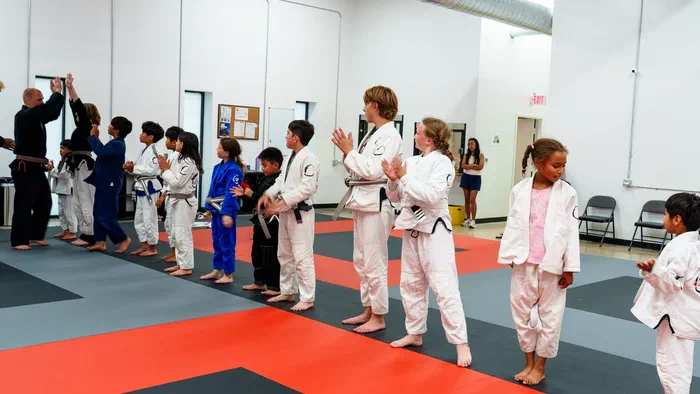
At Journey BJJ in Madison, your first class goes like this: you learn to move on the ground, you drill a technique with a partner, and by the end of the hour you're sweating and your brain is firing in ways it hasn't since you played a sport in college. Nobody expects you to be good. Everybody remembers being new.
By the second class, your body remembers what it feels like to be challenged. By the third, your brain starts recognizing patterns. The fog clears a little. Not because of some mystical martial arts experience, but because you gave your prefrontal cortex something real to work on.
We have a class schedule built around working professionals. Morning, lunch, and evening options. Your first week is free.
The Karolinska researchers proved that after 35, the clock is running. The EXERT researchers proved that exercise slows it down. The ACTIVE researchers proved that cognitive training compounds the effect.
Brazilian Jiu-Jitsu in Madison is both at once. Come see for yourself.
Book an intro class or meet Coach Alex.
Sources
- Karolinska Institutet — Long-Term Study Reveals Physical Ability Peaks at Age 35 — Journal of Cachexia, Sarcopenia and Muscle (2025)
- SciTechDaily — Scientists Track Human Fitness for Nearly 50 Years and Discover When Physical Aging Really Starts (2025)
- Shadyab et al. — EXERT: Exercise in Adults with Mild Memory Problems — Alzheimer's & Dementia (2025)
- Wake Forest School of Medicine — Even Light Exercise Could Help Slow Cognitive Decline in People at Risk of Alzheimer's Disease (2025)
- NPR — Brain Training and Exercise Cut Dementia Risk Over Two Decades: Results from the ACTIVE Trial (2026)
- Brain health
- Aging
- Cognitive health
- Research
Ready to Start Your Journey?
Choose the option that works best for you
Call to book: +1 (608) 416-1140