America's Loneliest Generation Is 30-44. Here's What Nobody's Telling Them.
You probably don't think of yourself as lonely.
You have a wife, maybe kids. Coworkers you get along with. A group chat that sends memes. You're not sitting alone in a dark apartment. You're busy. Swamped, actually. Between work and the kids and the house and whatever your phone is doing to your attention span, you barely have time to feel anything, let alone lonely.
But here's what the data says about people exactly like you.
A 2024 Harvard survey found that adults aged 30-44 report the highest loneliness rates of any age group in America. Twenty-nine percent said they feel lonely "frequently" or "always." Not occasionally. Not once in a while. Frequently or always.
That's not a soft number. That's roughly one in three people in your age bracket walking through life feeling disconnected from the people around them.
And it's getting worse. AARP's 2025 national survey found that 40% of U.S. adults now report loneliness, up from 35% in 2018. Men report higher rates than women (42% vs. 37%), a reversal from seven years ago. Men are also more likely to report having zero close friends: 17% compared to 13% of women.
Read that again. Nearly one in five men say they have no close friends.
This isn't just sad. It's dangerous.

In 2023, the U.S. Surgeon General issued a formal advisory declaring social disconnection a public health crisis. The comparison he used: loneliness carries a mortality risk equivalent to smoking 15 cigarettes a day. Greater than obesity. Greater than physical inactivity.
That sounds dramatic until you see the cardiovascular research.
A meta-analysis in the Journal of the American Heart Association pooled data from 19 studies and found that social isolation and loneliness raise your risk of coronary heart disease by 29% and your risk of stroke by 32%. This isn't one small campus study. It's decades of longitudinal research pointing the same direction.
The APA's 2025 Stress in America survey found that 94% of highly lonely adults report at least one physical symptom of stress: headaches, fatigue, muscle tension. Among the loneliest respondents, 65% reported feeling depressed and 60% reported anxiety.
And an Emory University study published earlier this year looked at over 64,000 adults across 29 countries. They found that middle-aged Americans are lonelier than older adults. The U.S. was one of only two countries where that pattern held. In most of the world, loneliness decreases as you move through middle age. In America, it spikes.
So: the loneliest generation in the loneliest wealthy country on earth.
Why this is happening to you specifically

The Harvard survey asked people why they thought loneliness was increasing. The top three answers:
- Technology replacing in-person interaction (73%)
- Not enough time with family (66%)
- Being overworked (62%)
Look at that list. That's a description of a working professional in their thirties or forties. You commute. You sit in meetings. You come home, eat dinner, put the kids to bed, and scroll your phone until you fall asleep. Somewhere along the way, the friendships you had in college or your twenties faded. Not from conflict. From logistics.
Adult male friendships are especially fragile because men tend to build bonds through shared activity, not conversation. When you stop playing on a team, stop training together, stop doing something physical alongside other people, the relationships dry up. You end up with plenty of acquaintances and no one who'd notice if you disappeared for two weeks.
This is the part nobody's telling you: being busy and being connected are different things. You can be surrounded by people all day and still be profoundly isolated.
What actually fixes it (hint: not an app)

The Surgeon General's advisory included a concept borrowed from the UK healthcare system: "social prescribing." Instead of only treating the symptoms of isolation (depression, anxiety, chronic disease), doctors prescribe community. Join a group. Show up regularly. Do something with other people.
The problem is, most of the options are terrible.
A rec league softball team that meets twice a month? Not enough frequency. A CrossFit box? Parallel suffering, but you're still essentially working out alone in a crowd — and most people quietly stop showing up within months. A men's group? Good luck finding one that isn't awkward or preachy. A bar? Alcohol is a depressant, not a community builder.
What works, according to the research, is structured, recurring, in-person activity that requires genuine interaction with other people. Something where you can't just show up with headphones and zone out.
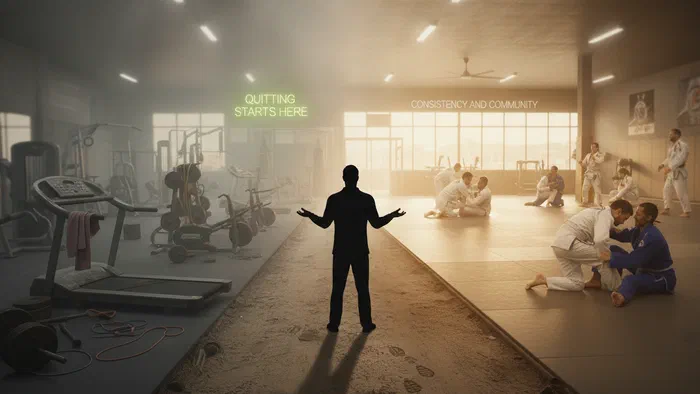
Brazilian Jiu-Jitsu checks every box.
Why BJJ works when other things don't

Every class requires a training partner. You can't drill an armbar alone. You can't practice a guard pass without someone underneath you. From the first minute of your first class, you're touching another human being, making eye contact, communicating, cooperating. That sounds like a small thing until you realize how many hours a week most men spend without any physical contact at all.
The schedule forces consistency. Classes at our academy in Madison, WI run multiple times a week, same time, same place. You see the same faces every Tuesday and Thursday. You learn their names. They learn yours. Within a month, people ask where you were if you miss a session. That kind of low-key accountability is exactly what adult friendships need to survive: a reason to keep showing up.
The shared struggle builds trust fast. When someone has you in a chokehold and you have to problem-solve your way out of it, or when you're both exhausted and drilling the same technique for the fifteenth time, something happens that small talk at a barbecue can't replicate. You build the kind of bond that men used to get from military service, team sports, or manual labor. Not from talking about your feelings. From doing something hard alongside someone else.
And the physical benefits map directly onto the health risks we just talked about. The American Heart Association's research links isolation to cardiovascular disease. BJJ is one of the most demanding cardiovascular workouts you can do. You're addressing the loneliness and the heart disease risk in the same hour.
"But I'm not a fighter"

Nobody who walks through our door is. The accountant who trains at 6 AM isn't a fighter. The software developer who comes to the noon class isn't a fighter. The dad who brings his kid to the youth program and decided to try the adult class isn't a fighter.
They're people who got tired of doing everything alone. The solo gym sessions. The treadmill with earbuds. The routines that keep you fit but leave you feeling exactly the same.
What I've watched happen over five years of coaching at Journey BJJ in Madison is this: a guy walks in nervous, doesn't know anyone, probably overthinking it. Two weeks later he's got three training partners he texts about technique. Two months later he's staying after class to roll extra rounds because he doesn't want to leave. Six months later his wife tells me he's a different person. More patient. More confident. Less stressed.
That's not because he learned to fight. It's because he found a place where people know him and expect him to show up.
The uncomfortable truth

Loneliness won't fix itself. It gets worse over time. The AARP data shows lonely adults spend an average of 7.3 hours per day alone, compared to 5.6 hours for the general population. Isolation breeds more isolation. The longer you wait, the harder it gets to break the cycle.
The Harvard researchers found that 73% of Americans blame technology for the loneliness epidemic. Ironic, then, that most "solutions" are apps. Meditation apps. Fitness apps. Social apps. Another screen between you and another person.
The fix for loneliness isn't digital. It's showing up somewhere, in person, on a regular schedule, and doing something real with other people.
If you've been feeling like something's off, like you're going through the motions but nothing quite connects, you're not broken. You're not weak. You're experiencing what one in three American men your age is experiencing. The data is clear. The health consequences are real.
But so is the solution.
Come try a class this week. The first week is free. You'll meet Coach Alex. You'll roll with people who felt exactly the way you feel right now, before they walked through the same door.
Nobody's going to judge you for being new. They're going to be glad you showed up.
Sources
- Harvard Graduate School of Education — What's Causing Our Epidemic of Loneliness and How Can We Fix It? (2024)
- AARP Public Policy Institute — Loneliness and Social Connections National Survey (2025)
- U.S. Surgeon General — Our Epidemic of Loneliness and Isolation: Advisory on the Healing Effects of Social Connection (2023)
- Hakulinen et al. — Social Isolation and Loneliness as Risk Factors for Coronary Heart Disease and Stroke — Journal of the American Heart Association (2023)
- American Psychological Association — Stress in America 2025: A Nation Divided by Loneliness (2025)
- Emory University — Middle-Aged Americans Are Lonelier Than Older Adults, Cross-National Study Finds (2025)
- Loneliness
- Social connection
- Mental health
- Community
Ready to Start Your Journey?
Choose the option that works best for you
Call to book: +1 (608) 416-1140