Why 80% of Gym-Goers Quit (And the Simple Fix Most People Miss)
Every January, gyms across Madison fill up with people chasing the same goal: get in shape this year. By February, 80% of them have already quit.
You probably know this story. Maybe you've lived it. You sign up, show up for two weeks with genuine enthusiasm, then life happens. Work gets busy. The alarm goes off and the couch wins. Nobody notices whether you made it to the gym or not.
Here's the thing most people miss: willpower isn't the problem. The system is.
The 95% Solution Hiding in Plain Sight
A 2025 NPR feature highlighted research that's been quietly revolutionizing how high performers approach their goals. The data is striking: when you commit to someone that you'll do something, you have a 65% chance of following through. But when you have a specific accountability appointment with that person? Your success rate jumps to 95%.
Read that again. Same goal. Same person. The only difference is having someone who expects you to show up.
Dr. Gail Matthews at Dominican University tested this with 267 participants from businesses across the United States. People who wrote down their goals, shared them with a friend, and sent weekly progress updates were 33% more successful than those who kept their goals to themselves. The accountability piece wasn't optional—it was the engine.
Why Traditional Gyms Set You Up to Fail
Think about the typical gym experience. You walk in, scan your card, and... that's it. Nobody knows your name. Nobody cares if you came yesterday or last month. The treadmill doesn't ask where you've been.
But the isolation is just the beginning. Traditional gyms fail you in ways you might not even recognize until you've already quit.
No structure. You walk through those doors with no plan. Maybe you wander to the bench press because it's open. Maybe you do some curls because you saw someone else doing them. Thirty minutes later, you leave feeling like you didn't really accomplish anything—because you didn't have a framework for what "accomplishment" even looks like.
Decision fatigue. Every single visit requires you to decide what to do, how many sets, what weight, what order. By the time you've figured out your "workout," you've already burned through the limited willpower you had after a long day at work.
No feedback loop. Are you doing that exercise correctly? Are you making progress? Is that pain normal or a warning sign? You have no idea. There's no coach watching. No training partner to say, "Hey, try adjusting your grip." Just you, guessing.
Intimidation everywhere. Equipment you don't know how to use. Unspoken gym etiquette you're apparently violating. That feeling of being watched and judged by people who seem to know what they're doing. Most people don't quit because they're lazy—they quit because the environment makes them feel incompetent.
Zero social connection. Headphones in. Eyes down. Everyone isolated in their own world. You might be surrounded by fifty people and still feel completely alone. Nobody learns your name. Nobody notices your progress. Nobody cares if you never come back.
Month-to-month limbo. No milestones. No progression system. No belts, no levels, no clear path from where you are to where you want to be. Just an endless treadmill (literally) with no finish line beyond some vague notion of "get fit."
This isolation isn't a feature—it's a bug. Research shows group fitness participants have a 56% higher retention rate than solo exercisers. The people who stick around are the ones who train with others. That's not a personality trait — it's a design choice, and it's why discipline-based systems outperform motivation-based ones.
A 2015 study in JAMA Internal Medicine found something fascinating: when one partner in a relationship makes a healthy change, the other partner is significantly more likely to follow. Men were more likely to start exercising when their partner did too. The researchers called this "behavioral concordance"—basically, we mirror the people around us.
Social connection isn't just nice to have. It's the mechanism that makes behavior change stick.
The BJJ Difference: Built-In Accountability
Brazilian Jiu-Jitsu operates on a fundamentally different model than commercial gyms. You can't train alone. Every technique requires a partner. Every roll requires someone across from you.
This isn't a coincidence—it's the architecture of the art.
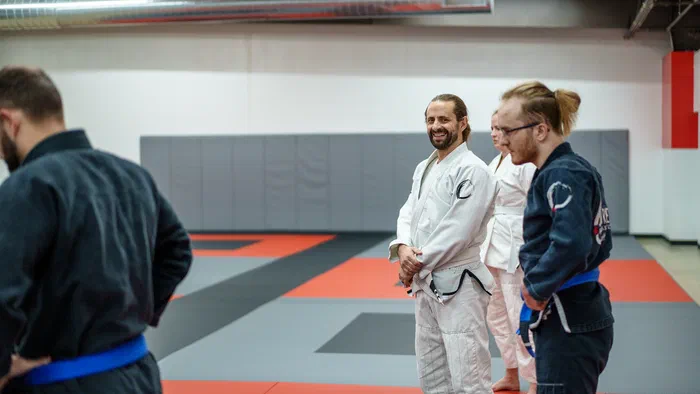
When you start BJJ, you're paired with training partners from day one. These aren't strangers on adjacent machines. They're people who will notice if you skip class. They'll text you if you disappear for a week. They remember what you were working on and ask how it's going.
Research on martial arts and mental health has found that training environments that foster mutual respect and belonging produce significant improvements in wellbeing. A systematic review in Psychology of Sport and Exercise found martial arts training had measurable positive effects on both general wellbeing and mental health outcomes.
The key word in that research is "belonging." You're not just working out near other people. You're part of something.
The 6-Week Intro: Accountability by Design
At Journey BJJ, we don't just hope accountability happens. We engineered it into the structure.
Traditional gyms hand you a key card and say "good luck." We give you a roadmap.
Our 6-Week Intro Program was built specifically to solve the problems that make people quit:
18 classes with a real curriculum. Not random workouts where you wonder what to do next. A structured progression where each class builds on the last. You always know what you're learning and why it matters.
7 accountability check-ins. These aren't optional surveys. They're scheduled touchpoints where a coach sits down with you, reviews your progress, answers your questions, and adjusts your path if needed. Someone is tracking your growth—not just your attendance.
Mentorship from day one. You're paired with an upper belt who guides you through the learning curve. That person remembers being new. They answer the questions you're afraid to ask. They watch out for you in ways a gym membership card never could.
Free uniform (gi) included. No equipment to research. No barrier of "I need to buy stuff first." You show up, we hand you what you need, and you train.
Scheduled class times. No decisions required. No standing in front of a gym full of equipment wondering where to start. You pick the times that work for your life, then you just show up. The structure does the thinking for you.
Here's what this means in practice: within your first six weeks, you'll have had more one-on-one coaching conversations than most gym members get in a year. You'll have a mentor who knows your name, your goals, and your struggles. You'll have a cohort of training partners who started alongside you.
The 95% success rate research talks about "specific accountability appointments." Our 6-Week Intro is 18 of them, built into a system designed to make quitting harder than showing up.
How Accountability Actually Works on the Mat
Let me paint you a picture of what this looks like in practice.
Monday evening at Journey BJJ in Madison. You've had a long day. The couch is calling. But you told your training partner Marcus you'd be there tonight to work on that guard pass you've both been drilling.
Marcus is already warming up when you walk in. "Glad you made it. I've been thinking about that setup we tried last week."
That's it. No grand speech about discipline. Just a friend who expected you and is happy you showed up. The research calls this a "specific accountability appointment." In BJJ, we just call it training.
As Ayelet Fishbach from the University of Chicago explains, "People have been working in groups from the beginning of time." Accountability buddies work because they tap into something deeply human: we don't want to let people down.
The Compound Effect of Showing Up
Here's where it gets interesting. The accountability doesn't just get you through the door—it creates a positive feedback loop.
You show up because Marcus is expecting you. You train together, make progress, laugh at your mistakes. Next week, showing up feels easier because you have good memories attached to it. Your partners become friends. Missing class starts to feel like missing out rather than dodging obligation.
Studies on peer support and exercise adherence confirm this pattern. Group exercise creates feelings of cohesion that contribute to greater attendance. The more you participate, the more identity you build around being someone who trains. And identity is far more powerful than willpower.
Beyond the Gym: Stress, Purpose, and Real Skills
For adults in Madison juggling careers, families, and the general chaos of modern life, BJJ offers something that running on a treadmill simply can't.
First, there's stress relief that actually works. Rolling requires total focus—you can't think about your inbox when someone is trying to choke you. It's forced meditation wrapped in physical problem-solving.
Second, you're learning practical self-defense. Not theoretical techniques from YouTube, but skills tested against resisting partners night after night. There's a quiet confidence that comes from knowing you can handle yourself.
Third, you become part of a community that extends beyond training hours. These are people who will help you move apartments, celebrate your kid's birthday, and check in when life gets hard. In a world where loneliness has become an epidemic — and adults 30-44 are the loneliest demographic — that matters more than any fitness metric.
What the Research Really Tells Us
Let's bring it back to the data. The statistics on gym failure aren't evidence that people lack discipline. They're evidence that isolated exercise doesn't match how humans actually function.
We're social creatures. We thrive when we're part of a group working toward shared goals. We show up when someone is counting on us. We stick with things that give us belonging, purpose, and meaningful relationships.
BJJ doesn't succeed because it has magic techniques. It succeeds because its fundamental structure—partners relying on each other, learning together, pushing each other—matches what research tells us actually works for long-term behavior change.
Getting Started in Madison
If you've tried the gym thing and it hasn't stuck, this might be why. You weren't missing motivation. You were missing the system that makes motivation unnecessary.
At Journey BJJ, we see this pattern constantly. People walk in skeptical, convinced they're "not athletic enough" or "too old" or "too out of shape." Within a few months, they're hooked—not because they suddenly developed superhuman discipline, but because they found training partners who became friends.
The 95% success rate isn't magic. It's just what happens when someone is expecting you to show up.
Ready to try a gym that's actually designed to help you succeed? Start your 2-week trial—a mentor in your corner, professional coaching, and training partners who'll notice if you skip. No key card and "good luck." Just a system that works.
Sources
- Smart Health Clubs — 100 Gym Membership Retention Statistics
- NPR — The Secret to Doing Hard Things: Accountability Research (2025)
- Matthews, G. — Dominican University: Goal Achievement and Accountability Study (267 Participants)
- JAMA Internal Medicine — Behavioral Concordance: Partner Influence on Healthy Behavior Change (2015)
- PubMed — Systematic Review: Martial Arts Training, Wellbeing, and Mental Health — Psychology of Sport and Exercise
- PMC / NIH — Peer Support, Group Cohesion, and Exercise Adherence
- Accountability
- Retention
- Fitness
- Community
Ready to Start Your Journey?
Choose the option that works best for you
Call to book: +1 (608) 416-1140