Nobody Asks If Sport Boxing Is Good for Self-Defense. Why Do We Ask About Jiu-Jitsu?
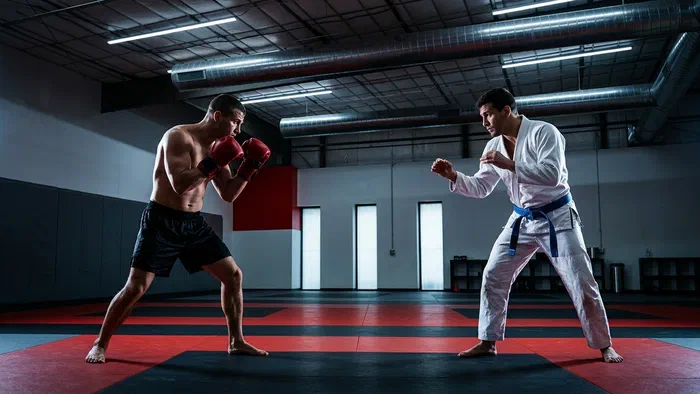
Nobody walks into a boxing gym and asks if sport boxing is good for self-defense.
They just ask about boxing. Boxing is the sport of punching. The sport is the thing.
So why do people walk into a jiu-jitsu gym and ask if “sport jiu-jitsu” is good for self-defense? Like there’s a real version and a fake version.
There isn’t another door. Jiu-jitsu is the sport of submission grappling, the same way boxing is the sport of punching. The split is mostly a marketing trick.
Here’s why it stuck around, and why it doesn’t hold up.
Where the split came from

In 1994, the US Army hired the Gracie family to build a short self-defense course for soldiers. They picked 36 moves and called it “Gracie Combatives.” It worked. The Army got what it needed.
Then someone realized you could sell the same package to busy adults who didn’t want to roll on the mat with a 22-year-old. So “self-defense jiu-jitsu” became a product line , separate from “sport jiu-jitsu.” Two doors. Two price tags.
But even Carlos Gracie Jr., the guy who runs the world’s biggest BJJ federation, doesn’t buy the split anymore . His words: “Sport jiu-jitsu is a perfected form of self-defense jiu-jitsu.” Same family. Same art. One door.
The sport part isn’t a watered-down version. It’s the lab. People test moves against partners who fight back, every class. The stuff that works floats. The stuff that doesn’t sinks. What you’d use in a street fight is just a smaller, more careful slice of what you already train.
The respectful disagreement
Royler Gracie, a real legend, recently said : “On the street, no one knows what belt you are or how many medals you have.”
He’s right about the belt. Wrong about the training.
A street fight doesn’t care about your medals. It cares if you can control a person who’s trying to hit you. That’s a skill. You build it by training against people who fight back. That’s sport.
John Danaher, who’s coached more world champions than almost anyone, makes the point: “No modern jiu-jitsu athlete would be so naive that if they got into a real fight they would roll into legs underneath someone and do this kind of thing. They wouldn’t do that in a street fight – they would just use hopefully basic technique of you know arm bar, get behind him, trip him, get on top and hit him and then strangle him.”

Skilled people change gears for the situation. Sport training builds the gears.
The problem with “too dangerous for sport”
Here’s the move people pull when they want to sell you “real” self-defense BJJ. They say sport leaves out the moves that matter most. Eye strikes. Groin shots. Biting. The stuff “too dangerous” to drill.
It sounds smart. It falls apart the moment you watch someone try to use a move they’ve never drilled against a real opponent.
You can only do under stress what you’ve drilled hundreds of times against people who fight back. The science is clear. Fine motor skills break down around 115 BPM. Complex motor skills break down by 145 BPM. Your heart rate in a real fight is well past both.
What rises under stress is your training. Not your knowledge. Not the move you learned at that self-defense workshop. The reps you’ve put in.
Rory Miller spent 17 years as a corrections officer in a max-security jail in Oregon, ran the use-of-force training for his agency, and wrote Meditations on Violence. He’s seen real assaults, not theory. He puts it plainly: in a real fight, you don’t rise to the occasion. You fall to the level of your training.
So a groin strike you’ve done in slow drills ten times is worthless against a real grappler. A clinch you’ve drilled ten thousand times in sport will fire when nothing else works.
What’s the closest thing to a real fight you can train safely? Hard sparring in BJJ or MMA. There is nothing closer. You can’t practice street fighting on the street. Sport is the lab. The street is the test you don’t get to rehearse for.
Moves “too dangerous” for training become moves “too unreliable” in a real fight. You’ve never felt how they fail. Never seen the counter. Never built the muscle memory under stress. The thing the marketing told you was your secret weapon? You’ve never actually used it.

The evidence cops can’t ignore
Here’s the strongest case, and it’s not from a YouTube debate.
The Marietta, Georgia police department made BJJ part of officer training. Every new hire trains at least once a week during the academy and field training. Then they tracked the data :
- Officers were 59% less likely to use force during arrests.
- 48% fewer officer injuries.
- 53% fewer suspect injuries.
- 27% drop in Taser use.
- A net savings of $40,752 from fewer Worker’s Comp claims.
Local news covered it . The numbers are real.

These cops don’t argue about sport vs. self-defense. They train the sport. They train it against people who fight back. Then they use it on the street, in the toughest real-world job there is.
A 2025 peer-reviewed study backs this up from another angle. Almost a thousand civilians and 744 officers watched different use-of-force tactics. Both groups rated grappling as more fitting and more pro than punches. Grappling looks like control. Striking looks like a brawl.
There’s also a brain-side reason this matters. We wrote about how grappling rewires your threat response so you stop freezing and start solving.
The honest concerns
Sport training has real gaps. Anyone who tells you otherwise is selling something.
Pulling guard on a sidewalk is a mistake. Everyone knows this. You can get stomped. BJJ folks know it too. We train takedowns. If your school doesn’t train takedowns, find one that does. It just doesn’t get the same hours that judo or wrestling give to it. A good sport BJJ player fights to the top. Not to their back.
Eye gouges, groin strikes, and biting aren’t in sport. Also true. But these moves don’t really work without first getting control of the other person. Control is what grappling teaches. A guy who’s been mounted doesn’t get to pick where to bite.
Multiple attackers and weapons are out of scope for almost every martial arts school that exists. Not just BJJ. Walk into a Krav Maga gym, a boxing gym, or a karate dojo. They’re all training for the common case: one person, no weapons. Comparing BJJ to “what about a knife?” is like comparing a daily driver to someone who only sat in a parked car. Wrong frame. We train for the 1-on-1 unarmed fight. That’s the fight you’re likely to be in.
Even the founder of Krav Maga Global trained BJJ to blue belt. Eyal Yanilov said it on the record in 2024: he picked it up during the pandemic, earned his blue belt with a stripe, and admits real attackers grapple too. He’s not saying BJJ is broken. He’s saying you need to handle the ground. For a deeper look, we wrote about Krav Maga vs. BJJ .
A good Madison BJJ gym will talk about all of this with you, in plain words.
Back to UFC 1

In 1993, the very first UFC was built to settle this exact debate. Which martial art works in a real fight?
The first UFC had only three rules: no biting, no eye-gouging, and no groin strikes. That’s it.
Royce Gracie weighed 178 pounds. He didn’t look scary. He won the whole tournament with sport grappling. Not a special street version. The same moves his family had been testing in tournaments for decades.
That was the test. Sport beat the alternatives in something as close to a real fight as you can safely run. That’s why UFC 1 mattered. It was the laboratory.
So when somebody asks if sport jiu-jitsu is good for self-defense, the honest answer is: that’s like asking if boxing is good for self-defense . Yes. Because that’s what it is.
Just train
The honest takeaway isn’t “pick the right type of BJJ.” It’s: train. Get on the mat. Roll with people who fight back. The line between sport and self-defense jiu-jitsu dissolves the first time you actually try to control another person. Or fail to. That’s the information no YouTube debate can give you.
If you’re in Madison and curious how this feels in real life, come try it. Our 2-week intro is $49 and includes a free uniform. You can claim a spot in our intro for less than the cost of a bad night out. Or book a free chat with a coach first. Ask questions before you step on the mat. Worried about being out of shape? We addressed that in a separate post on getting in shape before BJJ . Short answer: no.
The sport is the training. The training is the answer.
- Bjj
- Self defense
- Sport bjj
- Madison
- Adults
Ready to Start Your Journey?
Choose the option that works best for you
Call to book: +1 (608) 416-1140