PE Was the Joke Class. Turns Out It Might Have Been the Most Important One.
PE was the joke class.
You remember. Running the mile was what you did to kill time between math and lunch. The kids who were good at gym were jocks, and everyone else dunked on it. The grade didn’t matter. Everyone passed. If you forgot your gym shoes you sat on the bleachers, and nobody’s parent got a call. Real classes were math, English, maybe science if your teacher was mean. Gym was optional in the way that flossing is optional — technically required, spiritually ignored.
Then we grew up. And the research caught up.
Over the last ten to fifteen years, a stack of peer-reviewed studies has quietly reframed what was actually happening in that gym. The grade we all laughed at was tracking something the report card didn’t know how to value. Here are three things the gym class we blew off was actually measuring:
Healthspan and lifespan. A 40-year study followed 4,808 young adults and found that fitness in your twenties predicted how long you’d live. Every one-minute improvement on a treadmill test in your twenties cut your risk of early death. The kid who was good at the mile run was buying themselves years of life, not that anyone told them.
Alzheimer’s and brain decline. A 2025 Nature Medicine study named physical inactivity as the biggest thing you can change to lower your Alzheimer’s risk. Uh, what?
Going from inactive to even “some exercise” cut dementia risk by about 20 percent. Being active early in life may delay roughly a third of dementias worldwide. The benefits start early, not at 65.
Raw intelligence. As if the above isn’t enough reason, how well a young kid moves their body predicts how they do in school — separate from what IQ tests measure. Coordination between both sides of the body — the kind you build by climbing, grappling, and crawling — is strongly linked to the kind of thinking that lets you solve brand-new problems . A large review in Frontiers in Psychology connects fine motor skill to visual processing and focus. Motor-skill training improves attention and memory. The kid who could skip in kindergarten wasn’t just coordinated. They were loading mental horsepower.
Turns out the grade we all laughed at might have been the most load-bearing class on the schedule. And the bill is coming due.
So when parents today watch their 10-year-old miss the monkey bars, land flat, and shrug — they’re right to feel something. Because the peer-reviewed data says kids today move worse than we did. Measurably. Across countries. In centimeters.
What 30 years of testing actually found

In 2018, researchers in Australia published one of the cleanest comparisons we have. They ran the standing broad jump — a basic test of whole-body power — on 2,257 kids in 1985 and 4,794 kids in 2015. Random school sampling. Same age groups. Same methods.
The results, published in the Journal of Science and Medicine in Sport :
- Boys 9 to 11: 4.5 cm shorter jumps than their 1985 counterparts
- Boys 12 to 15: 7.6 cm shorter
- Girls 9 to 11: 8.5 cm shorter
- Girls 12 to 15 lost 9.3 cm — nearly four inches of explosive power in a single generation.
That’s Australia. Now stack it.
In the United States, a big review of grip strength studies pulled data on more than 2.2 million children from 1967 to 2017. Same conclusion: measurable decline that stretches across decades. Kids today literally grip weaker than their grandparents did at the same age. Then, in 2023, the American Heart Association issued a scientific statement reporting that only about 40 percent of U.S. youth meet healthy heart-and-lung fitness benchmarks, and that peak aerobic capacity — basically, how hard a kid can breathe and pump oxygen when pushed — has dropped across six decades on every test used: the PACER, the 1.5-mile run, and the 12-minute run.
Japan has tested its kids every year since 1964. The Ministry of Education’s long-term dataset shows a peak around 1985 to 1987, then a steady slide. One number to sit with: 11-year-old boys threw a softball 34.0 meters in 1980. By 2021, the same test, same age, dropped to 25.4 meters. A 25 percent collapse in throwing power in one generation. Girls dropped 26 percent in the same window, from 20.5 meters to 15.2 meters.
Different countries. Different instruments. Same direction.
Your child, statistically, is likely the weakest version of their age cohort in recorded human testing history. That’s not hyperbole. That’s what the data says.
A 2023 analysis in the Journal of Teaching in Physical Education tracked fundamental movement skills — FMS for short, the basic motor building blocks like jumping, throwing, catching, hopping, and balancing — across U.S. children from 1985 through 2019. From 1985 to 2000, young kids mostly held the line. Then around 2000, something flipped. Six to ten year olds started slipping. And the part most people miss: the three to five year olds started slipping too — kids who have not had time to specialize, not had time to quit a sport, not had time to “choose esports over gym class.” The baseline itself is dropping. A 2024 review of studies in PMC confirmed the long-term decline across five decades of research.
What the national scorecard actually says

If you want the one-number summary, the 2024 U.S. Report Card on Physical Activity for Children and Youth , released by UNC Gillings and Children’s Mercy in October 2024, gave American youth overall physical activity a D-minus. Unchanged from 2022.
Only 20 to 28 percent of kids ages 6 to 17 hit the recommended 60 minutes of movement per day. That percentage has been falling for eight years. We are not stalled. We are sliding.
Here in Dane County, I don’t have an MMSD-specific dataset to point at — that gap is real. If your kid has come home with a PE fitness test result and you’re wondering what it means, I’d genuinely like to see it. The coaches I work with in Madison youth programs feel the change. Kids who should be able to catch a ball, can’t. Kids who should be able to skip, don’t quite know how.
But wait — what about climbing gyms and skateboards?

Fair pushback. Kids today do things my generation didn’t. Boulder Madison is packed on weekends. Skate parks are full. There’s a whole generation learning YouTube parkour in the backyard.
So maybe the old tests just aren’t measuring the right things?
The research says no, or at least not enough to rescue the trend. Climbing assessments do show gains in kids who climb a lot . Esports improve fine motor control and reaction speed in narrow ways . That’s a real finding — reaction time and precision improve on screen-specific tasks. But it doesn’t transfer to catching, falling, or moving through three-dimensional space. Being good at one thing isn’t the same as moving well in general. A kid who’s strong on the climbing wall still has to be able to catch a softball thrown at their chest, sprint for a bus, or fall without hurting themselves. Those are separate skills, and they’re the ones slipping.
Some parents push back a second way. They’ll point at the travel-team pipeline and argue that even if the average is dropping, the kids who are IN the system are better than ever. The claim: we’re producing elite athletes earlier, and the averages look bad because the inactive kids drag them down. The worry is that measuring “the kids who quit” makes the trained kids look worse than they are.
If that were true, we’d see stable or rising scores in the active kids with decline concentrated in the inactive tail. Instead, the decline is across every age band studied, including preschoolers who haven’t specialized in anything. This is a baseline problem, not a tail problem.
Why this matters more than it sounds

Losing four inches on a standing broad jump doesn’t feel like a civilizational emergency. It sounds almost funny.
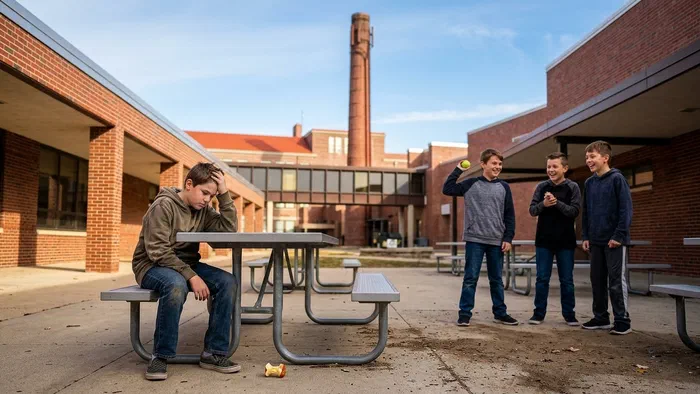
But fundamental movement skills are the soil everything else grows in. A kid who can’t balance well doesn’t just fall off curbs. They sit out of tag. They get picked last. They start avoiding recess games because they already know they look clumsy. By age nine or ten, a lot of them have quietly self-selected out of physical play altogether.
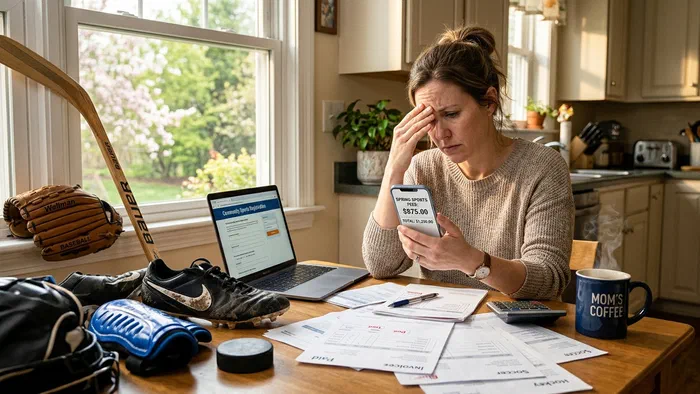
Then youth sports signups open, and the try-out culture finishes the job. This is the story I wrote about in the youth sports dropout crisis — the AAU travel team, the spring registration fees, the coach who keeps the 12 best eight-year-olds and cuts the rest. The kids on the bottom half of the motor-skill curve don’t just underperform. They get filtered out. And the filter gets tighter every year.
Here’s the part that keeps me up. Awkward kids become awkward adults.
A kid who feels clumsy at nine often carries that body-shame into their twenties and thirties. They end up living inside their head instead of their body. They default to “I’m not athletic” the first time a friend invites them to pickup basketball or a yoga class, and the invitations eventually stop. Humans evolved to MOVE. We were built to run, climb, grapple, fight, and dance. A body that has never been trusted doesn’t just cost you athletically. It costs you in social confidence, the willingness to take small physical risks, and the willingness to say yes to physical invitations. That’s where a big chunk of the adult loneliness conversation actually starts. On the playground. The year a clumsy kid stopped raising their hand.
Then the long tail. The same Nature Medicine study I mentioned in the intro — it’s not just a healthspan story. Physical activity is the single biggest thing you can change to lower your Alzheimer’s risk, science has now shown, and the things that work start in childhood, not at 65. The kid who builds the movement habit at eight is protecting a brain sixty years out. The one who doesn’t — isn’t.
Proprioception — your body’s sense of where its parts are in space — doesn’t come back on its own. You have to train it. Your inner-ear balance system, which tells you which way is up when you tumble, is the same. These systems build through play and physical challenge in childhood, or they don’t build well at all.
What parents can actually do (no “set goals” nonsense)

Here’s the part of most articles where the advice gets soft. Not today. The research on this is pretty clear. Five things, in order of how much they seem to matter:
1. Get daily baseline movement into the floor of your kid’s day. Not structured sports. Just movement. Walks to school. Scooting to the library. Unsupervised yard time. The UNC report card ties the D-minus directly to the loss of this background activity layer. Screens matter here, but as a symptom of the displacement, not the villain of a morality tale. Your goal is not to demonize the iPad. Your goal is to get 60 cumulative minutes of their day off the couch.
2. Pick activities with no gatekeeping. This is the quietest killer in youth athletics. A kid who can’t kick a ball will get cut from travel soccer at eight. A kid who can’t run fast will ride the bench in basketball. The American Academy of Pediatrics, along with the American Medical Society for Sports Medicine and the American Orthopaedic Society for Sports Medicine, has issued a joint position recommending that kids delay single-sport specialization until age 14 or later. Their reasoning: early specialization increases overuse injuries, burnout, and dropout, while multi-sport kids develop broader athletic bases and have lower injury rates. I wrote about how this plays out in Madison’s spring signup season — the AAP guidance is hard to follow when every league pressures eight-year-olds to pick a lane. Look for activities that don’t cut anyone.
3. Prioritize individual progress over team standing. This one deserves its own beat. For a kid who has already absorbed the message “I’m not athletic” by age eight — and many have — a visible, personal path of progress is often the first time they have a real reason to disagree with that identity. Belts. Stripes. Climbing grades. Reps on the pull-up bar. Concrete proof that they are no longer the kid they were last month. This isn’t motivation. It’s identity reconstruction. Team-ranked kids quit when they look around and see themselves below the middle. Kids who progress against their own past self stay because the scoreboard is their own past self.
4. Choose full-body, multi-direction movement. Running is one direction. Cycling is one direction. Throwing a baseball is pretty much one direction. Movement that asks kids to push, pull, rotate, brace, roll, and fall — all on the same day — is where real motor skill lives. Gymnastics does this. Dance does this. Grappling does this.
5. Quit the all-or-nothing frame. If your kid is nine and below average on broad jump, you haven’t lost anything. Motor skills can be trained at any age. The data is depressing in aggregate but not locked in at the individual level. You can move the needle fast if you start.
Where BJJ fits in this picture — and why OTs are quietly recommending it

Here I have to be honest about what the research does and doesn’t support.
There’s no head-to-head study comparing Brazilian Jiu-Jitsu against other programs for low-coordination kids. I’d love one. It doesn’t exist yet. So take what follows as a mechanism plus a growing clinical signal, not proof.
Here’s the signal. Occupational therapists — the clinicians who help kids build motor skills — are quietly prescribing BJJ for kids who can’t catch a ball or coordinate their limbs. Not because it sounds cool. Because grappling is legitimate motor-skill therapy dressed up as martial arts.
This is happening in specific places, with published support:
- Australia. Occupational Therapy Australia resources explicitly point clinicians toward BJJ for motor-skill-delayed children. They cite three things that stack into every class: body awareness feedback, both-sides-of-the-body coordination, and being able to stay calm under physical pressure.
- Peer-reviewed research on autism spectrum kids. A 2024 Frontiers in Neurology review found BJJ improved social interaction, coordination, motor skills, and sensory regulation in children on the spectrum. Why it works, according to the authors: lots of physical pressure and contact that tells the body where it is, co-regulated contact with another person, and repeating the same movement patterns over and over.
- Adaptive martial arts as an OT lens more broadly. Practitioners writing in Martial Journal describe how martial arts settings deliver the same kind of balance and body-awareness input that OT clinics struggle to recreate.
The honest gap: I couldn’t find U.S.-published OT-BJJ case studies or head-to-head trials. It’s a real hole in the literature. The clinical signal is there — in Australia, in peer-reviewed autism research, and in the broader adaptive-martial-arts community — but the American clinical research hasn’t caught up yet.
Mechanically, the fit is strong. Grappling is whole-body learning by doing, through body contact and feeling. You push, you pull, you brace, you tumble, you get flipped upside down, you learn to fall. Every class stacks body awareness, balance, both-sides-of-the-body coordination, and staying calm under physical pressure. That’s four separate systems, trained at once, in the same hour.
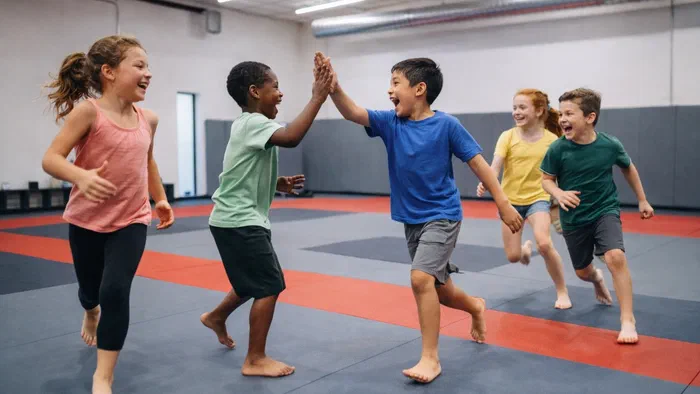
It also clears most of the gatekeeping that cuts weaker movers out of youth sports. There are no tryouts. There is no minimum size. There is no athletic baseline required to start. A 50th-percentile jumper can learn an armbar. A 20th-percentile jumper can earn a stripe. Kids who start early build the base they didn’t get at recess.
And the belt system is doing something most parents don’t see until months in. It’s giving kids — especially the ones who’ve quietly filed themselves away as “not athletic” since second grade — a visible, personal path forward. No cuts. No benching. Just the next stripe. For a lot of these kids, that path is the first athletic identity they ever build. The broader list of what BJJ does for kids covers the discipline and confidence piece. The focus and attention research covers the cognitive side. But the motor piece is the one nobody writes about, and I think it might be the most important.
For the local picture — schedules, ages, what a first class actually looks like — our complete guide to kids martial arts in Madison breaks it down.
The timing, for Madison families
It’s late April. The school year ends in about six weeks. If you’re an MMSD parent, you’re in the middle of the summer-activity scramble right now — camps filling up, rec league signups closing, grandparents asking what the kids are doing in July.
This is the window. Summer is when the baseline either builds or evaporates. The kids who spend June and July in unstructured physical challenge come back to August ahead of where they started. The kids who spend it on a couch don’t.
Our Kids 2-Week Intro is $49 and includes a free uniform ($100 value). Two weeks of classes, no commitment, no tryout. If your kid has never grappled, that’s fine. If your kid has been cut from something recently, that’s exactly who this is built for.
Start the Kids 2-Week Intro — $49
You don’t need the data to justify it. You noticed the monkey bars thing. Trust that.
- Kids bjj
- Motor skill decline
- Madison
- Youth sports
- Kids martial arts
Ready to Start Your Journey?
Choose the option that works best for you
Call to book: +1 (608) 416-1140