Your First Month of BJJ: What to Expect
You signed up for BJJ. Now you’re lying in bed wondering if you’re going to embarrass yourself in front of strangers.
Almost every adult walking through our door in Madison is thinking the same thing. They just don’t say it out loud.
And it’s not just embarrassment. Plenty of adults walk in worried they’ll get hurt, or that they’re too old for this, or too out of shape to even try. Those fears are normal too.
Here’s what your first month actually looks like. Not the polite version.
The fear is the point
Most articles about starting BJJ focus on what to wear and how to tie a belt. That’s the easy part.
The hard part is that BJJ is the only workout where strangers will put you in uncomfortable positions, and you have to keep showing up anyway. No amount of YouTube prep fixes that. You just do it, feel weird, and come back. The skill you’re building here is learning to sit with discomfort and come back. Each class, the weirdness shrinks a little. That’s the whole game.
If you’re stalling because you’re worried about looking dumb in front of people, that’s the real block. Name it. Then come in anyway.
Week 1: your first class

You’ll show up ten minutes early because you don’t know where to change or where to put your stuff. Your coach will show you the way. We have people whose job is to keep new students from feeling lost.
Here’s how Journey runs class, and why it looks different from most schools:
| What | Most schools | At Journey |
|---|---|---|
| Warmup | 20 minutes of calisthenics that rarely tie to the day’s lesson | None. We jump straight into technique so we cover more ground |
| Technique | One move, then you’re on your own | At least two chained techniques, because the first move rarely works |
| Sparring | Open free rolling with no guarantee you’ll practice what you just learned | Positional sparring with concrete goals and reset points when you get out of position |
There’s a reason we build class this way. Skill sticks when you solve problems against a real, resisting partner — not when you memorize moves in isolation (Woods et al. 2020 ). Watching videos and drilling in the air feel productive, but live practice is where the learning actually lives.
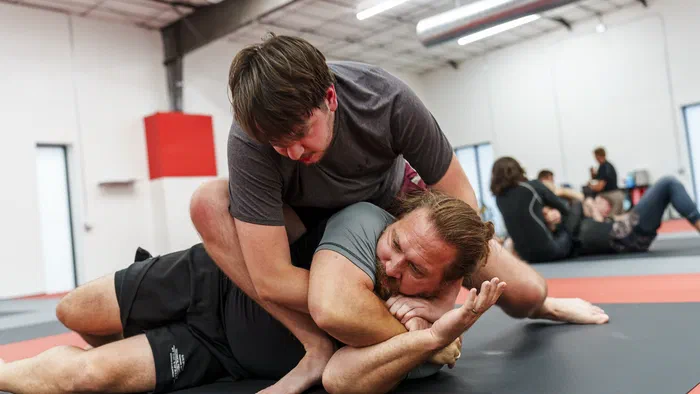
You’ll be confused. You’ll forget the move thirty seconds after drilling it. That’s normal. Your brain is learning a new language.
Weeks 2 and 3: the soreness and the wall

Week 2 is when your body files a complaint. Muscles you didn’t know you had will speak up. Your forearms, your neck, the sides of your ribs. This fades. After about two weeks of showing up, your body adapts and the soreness drops off sharply.
What doesn’t fade as fast is the mental wall.
Around class four or five, most people hit a moment where they think, “I’m bad at this. Everyone else gets it. Maybe this isn’t for me.” This wall shows up on schedule for almost every new student, and it has nothing to do with whether you’re actually bad at BJJ. It’s the gap between where you are and where you thought you’d be.
Here’s the thing your talking brain doesn’t know: your body is already ahead of it. An hour after drilling a move, you may not be able to describe it — but put you in the position and something comes out. As an instructor, I get asked questions I can’t answer from memory; I put my body in the spot, and the answer arrives. Two tracks, different speeds. And when you sleep after class, your brain quietly replays what you practiced and you wake up better than you went to bed (Conessa et al. 2023 ). You’re learning while you feel stuck.
Everyone who trains for a year has crossed this wall. The only move is to keep showing up. If quitting is calling your name, we wrote about that here .
What about getting hurt?

Here’s the honest answer: injuries in BJJ are rare, and the ones we do see follow a pattern you can mostly avoid.
A few things that help:
Get cleared by a doctor if you’ve had a major injury. Not optional. If you’ve had a bad knee, a surgery, a herniated disc — go see your doc before you step on the mat. Then tell your coach.
Foam roll your upper body and back before you start. The beginners who get hurt are almost always the tight, tense ones. A supple back and loose shoulders handle awkward positions way better than stiff ones. Ten minutes a night with a foam roller before you start, and a few minutes after class, goes a long way.
Consider elbow and knee sleeves. Some new students get a tennis-elbow flare-up from holding a partner’s body weight the wrong way. It passes once you learn to frame (think of it like holding a plank with your arms), but sleeves bridge the gap while your body figures it out.
We can’t promise zero risk. Nobody honest can. But the pattern is predictable, and most of it is in your hands.
Week 4: the first real sign you’re learning

You probably won’t submit anyone in your first month. That’s fine. That’s not the goal.
The first sign you’re actually learning looks like this: someone tries to pass your guard, and instead of freezing, you do something. Maybe it’s a hip escape. Maybe it’s a frame. You don’t win, but you don’t panic.
Survival comes before offense. Every single time.
Once you stop panicking, the rest builds fast. You start seeing patterns. You start remembering what class felt like last week. That’s when people fall in love with it.
What to wear, bring, and do
For your first class, wear athletic clothes. Shorts without zippers or pockets, a t-shirt. No shoes on the mat. Bring water. Bring flip-flops for walking to the bathroom. Clip your nails. That’s it.
If you sign up for our 2-week intro, you get a free uniform (gi) so you’re set after class one. No shopping, no guessing on sizes.
Between classes, don’t watch four hours of instructional videos. Rest. Drink water. Stretch a little. Your job in month one is to show up, not to study.
The thing nobody tells you

Tapping is not losing. Tapping is information.
When you tap, you’re saying “I learned something.” The person who taps a hundred times in their first month learns ten times faster than the person who refuses to tap and gets hurt.
Ego is the slowest learner in the room. Leave it at the door. You’ll be tapping your training partners within a year.
This is also why BJJ rewires how your brain handles threat . You practice being in bad spots, staying calm, and finding a way out. It carries over.
You don’t have to do this alone

If mental friction is what’s stopping you, meet a coach before your first class. Not a sales pitch. A real conversation about what you’re nervous about and whether BJJ fits your life.
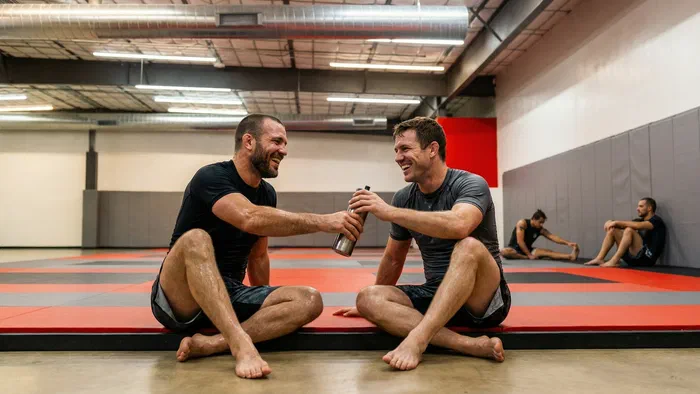
Most of our new adult members are busy professionals in their 30s and 40s. Some haven’t worked out in years. Some are former athletes. Most are nervous on day one and laughing by day ten.
Still deciding between gyms in town? This guide walks through what to look for . And if you want to know why group training beats the solo gym, we covered that here .
What to do this week
- Pick a start date. Put it on your calendar. A vague “soon” never becomes a class.
- Book a free coach consult if nerves are loud. Ten minutes of honest talk beats a week of overthinking.
- Clip your nails and find your shorts. Remove the small excuses.
- Tell one person you’re starting. Saying it out loud makes you show up.
- On day one, ask the coach one question before class. It breaks the ice.
BJJ is weird, humbling, and one of the best decisions most of our members say they’ve ever made. The first month is the hardest. After that, you’re just a person who trains.
Book a free coach consult and we’ll talk through what your first class will look like before you set foot on the mat.
- Bjj beginners
- First class
- Adult bjj
- Madison
- Brazilian jiu jitsu
Ready to Start Your Journey?
Choose the option that works best for you
Call to book: +1 (608) 416-1140