Netflix's Lord of the Flies Showed Parents What Boys Without Structure Become. Boys Already Know.
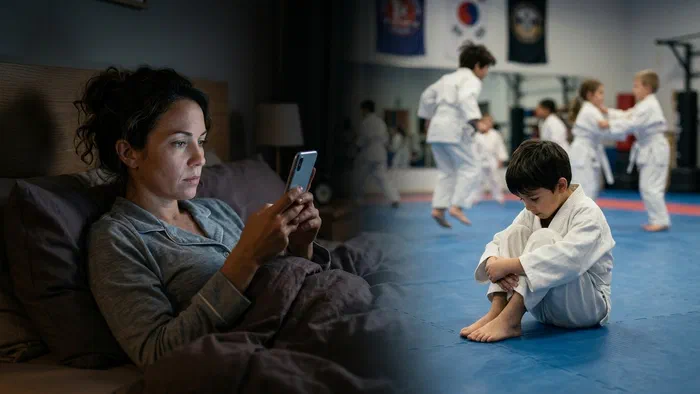
A boy sits on the couch on a 75-degree Madison afternoon, phone in hand, head down. His mom asks how school was. He shrugs. She asks if anything’s bothering him. He shrugs again. Two months ago, he would have told her. Last week, he told his best friend that crying is for losers.
She doesn’t know where he picked that up. He doesn’t really know either.
On May 4, Netflix put out a four-part Lord of the Flies. Jack Thorne wrote it. Marc Munden directed it. It’s the old story: boys on an island, no adults, hierarchy by force. Thorne told Rolling Stone he wrote it now on purpose. “As a society, we’re having a conversation right now about boys,” he said. “We’re losing a generation of boys, and we’re losing it because of the hate they are ingesting.”
If our post on Netflix’s Adolescence and what actually protects kids was about how boys get pulled into bad ideas online, this one is narrower. It’s about what happens on the schoolyard, in the group chat, at lunch. And what fills the void when nothing else does.
The show is the literary version of what’s already happening

The plot is famous. Boys crash on an island. With no adults, they form a hierarchy. The strongest run it. The kindest get crushed. The smart kid who keeps trying to organize a fair system ends up dead.
It’s a 70-year-old book. It’s also a documentary about what a thousand American boys reported in a survey last summer.
In July 2025, Common Sense Media put out a study called “Boys in the Digital Wild.” They asked 1,017 U.S. boys ages 11 to 17. Seventy-three percent run into “what a man is” content online: clips telling them who’s strong, who’s weak. Nearly one in four sees a lot of it.
Here’s the part that stopped me. Nearly two-thirds of the boys weren’t searching for any of it. The algorithm just handed it to them.
So when a parent says, “My kid would never look that stuff up,” they’re probably right. It doesn’t matter. The phone serves it like ads.
What the steady drip does to a boy

The same study tracked what happens to boys who get a lot of this content versus boys who get very little.
Boys with high exposure are nearly four times more likely to believe that sharing worries makes them look weak: 40 percent versus 11 percent. They’re more likely to hide hurt feelings from friends, 50 percent versus 30. They’re more likely to skip talking about feelings at all, 67 percent versus 53.
That’s the part that should worry a parent more than any single Andrew Tate clip. Not the politics. The shutting-down. A boy who learns that being honest about feeling bad makes him look weak is a boy who stops telling you anything.
The loneliness numbers follow the same shape. Boys with high or moderate exposure report being lonely at 29 to 30 percent. Boys with low exposure, 18 percent. Low self-esteem shows up in 14 percent of high-exposure boys, versus 5 percent of low-exposure boys.
These aren’t ideology. They aren’t a culture-war framing. They’re a thousand boys answering questions about how they feel.
Some commentators argue the “boys in crisis” framing is overhyped. Fair enough. Call the framing whatever you want. The self-reports are still there.
How the content lands: “shock value” becomes a norm

A small UK study by Haslop and colleagues, published in Social Media + Society in 2024 , sat down with 13- and 14-year-old boys to ask what they thought of Andrew Tate’s content. About half of them held supportive views. But the more interesting finding was how they engaged with it.
They treated it as a joke. Shock value. Funny clips. They knew it was outrageous. They shared it anyway, because the outrageousness was the point.
That’s how this stuff gets past a parent. It’s not a sermon. It’s a meme. Your son isn’t sitting down to study a worldview. He’s watching a funny clip a friend sent him, then another, then another. The joke becomes a way of talking. The way of talking becomes a pose. The pose becomes how he talks to a girl in his class.
It’s a small sample (twelve boys), so don’t read it as a national survey. Read it as a snapshot of how it works. By the time a parent notices the pose, the joke is the norm.
Why scolding the screen doesn’t work

On May 20, 2026, the U.S. Surgeon General called too much screen time for kids and teens “an urgent national public health concern.” Worse sleep, worse grades, less time moving, weaker friendships. None of it new.
We already wrote about the screen-time research and why “less screen time” isn’t enough as a strategy . The short version: removing something the kid likes isn’t a plan. The plan is what replaces it.
This is where most parenting advice falls apart. The advice says, “Limit screens.” Then the kid has three free hours and no idea what to do with them. The screens come back. The boys still form pecking orders. The strongest still win.
Our take is closer to what some call “sturdy parenting” (warm and close, but the adult is in charge) than to “gentle parenting,” which tries to talk through every choice with a ten-year-old. We wrote about that gap in why gentle parenting is dead and what sturdy coaching looks like in Madison . The short version: scolding the screen is what gentle parenting does when it runs out of moves. Putting a real activity in the kid’s day, with adults in charge, is sturdy.
What actually fills the void

Here’s the part nobody who writes about boys and screens wants to say flat out. Boys want a pecking order. Boys want to test themselves against other boys. Boys want to know where they stand. That’s not broken. That’s eleven-year-olds.
The real question: does the pecking order form with adults setting the rules, or does it form on the schoolyard and the group chat with no one in charge?
A real activity, with a coach and a code, gives a boy a ladder he can actually climb. Not by mocking a smaller kid. By learning a skill, drilling it, testing it on an equal, losing, coming back, winning. The pecking order is real. It’s also fair. Effort moves you up. Cruelty doesn’t.
This is where the research on martial arts and prosocial behavior gets interesting.
A 2008 study in Psychology in the Schools tracked 254 U.S. kids in grades 3 to 5 through a school martial arts program called Gentle Warrior. The boys who went to more sessions got less aggressive over time. They also stepped in more often to help kids who were being bullied. The change in stepping in was fully driven by a change in empathy. The boys felt for the kid getting picked on. So they stepped in.
The girls in the study didn’t show the same effect. The authors said boys may get this benefit in a way girls don’t.
A 2023 trial run in Abu Dhabi schools, published in the International Journal of Sport and Exercise Psychology , put 80 sixth-grade boys through twelve weeks of BJJ, twice a week, versus regular gym class. The BJJ group had fewer mood issues, less hyperactivity, and fewer behavior problems. Almost all the boys (96 percent) said BJJ improved their confidence. Almost 9 in 10 said it cut their anxiety.
The British Psychological Society’s research digest on this put it plainly: martial arts focus on self-control, respect, and handling your emotions. Because of that focus, the odds a kid uses what they learn to hurt someone go down, not up.
That’s what the research keeps finding. The training itself isn’t what changes a boy. The structure around the training is.
What that looks like at Journey

Our kids classes follow a set shape. About 8 minutes of movement and games to warm up. Then 20 to 30 minutes of technique and partner drilling. Then a round of position sparring. Then live rolling at the end. Five classes a week for kids: three in the gi, two no-gi.
It’s not full-contact MMA. There’s no striking. The rules we coach mirror local tournament rules: no slamming, no spiking, no throat attacks, no wild aggression. The first thing every kid learns is how to tap when they’re caught. Tapping isn’t losing. It’s how you train hard without getting hurt. Tapping is required. Being honest about getting caught is required. We wrote a whole post on why tapping is the most underrated skill in youth sports .
The pecking order on our mat is real. Belts, stripes, who can pin who. A new kid finds out fast that a smaller kid who’s been training a year can hold him down. That’s not shaming. That’s the point. It teaches a boy that effort beats size. Respect is earned. The kid who shows up gets better than the kid who showed up once.
And it’s a peer group. Boys train next to boys their age, every class. They build a friend group around showing up, not around what they watch.
Our kids program has run since October 2018 with zero serious injuries. Almost never more than a bruise.
That’s the counter-input. Not a fix-all. Not a save. Just an hour, two or three times a week, in a room where the rules are clear, the adults are in charge, and the boys can test themselves on each other without anyone getting hurt.
For parents wondering what this kind of strength looks like once a boy hits high school and beyond, we wrote about the looksmaxxing trend and what real strength looks like for a young man .
Meet your child’s coach — free, no pressure, no obligation
Three things you can try this week

You don’t have to wait to start. Three things work, even if your kid never sets foot on our mat.
One: ask a different question. Instead of “How was school?” try “Who did you sit with at lunch?” or “Who was funny today?” Specific questions get specific answers. Vague questions get a shrug.
Two: put a real group activity on the calendar this week. Any activity where an adult runs it, the rules are clear, and your kid sees the same other kids each time. Sports, scouts, music, a martial art: the form matters less than the structure. If you’re in Madison and want to see what BJJ looks like for your kid, the form at the bottom of this page books a 30-minute coach meeting. It costs nothing, and you’ll know in five minutes if it’s a fit.
Three: watch the show with your boy if he’s old enough. Lord of the Flies on Netflix is rough; preview it first, since it’s rated for teens. If you watch it together, talk about the moment things tip. Why did Jack take over? Why didn’t Piggy’s ideas land? What would have changed it? That talk does more than a screen-time lecture.
A boy who shrugs at his mom in May can be a boy who tells her about his day by August. Not because she scolded the phone away. Because something else got more interesting.
Book your free Meet the Coach session at Journey BJJ in Madison, WI
- Kids bjj
- Madison
- Masculinity
- Parenting
- Lord of the flies
- Screen time
Ready to Start Your Journey?
Choose the option that works best for you
Call to book: +1 (608) 416-1140