Looksmaxxing Sells Boys a Lie About Strength. Here's What Actually Builds It.
There is a TikTok genre right now where teenage boys hit themselves in the face with hammers. They call it bone-smashing. The idea is that if you bruise your jaw enough times, it will heal back wider, sharper, more masculine.
It does not work. It cracks bones.
On April 3, 2026, TikTok finally pulled the community-guideline trigger and started removing bone-smashing content. By that point, TIME reported that searches for “looksmaxxing” and its sibling trends were running at 1.9 million per day, with bone-smashing and “mewing” videos pulling more than 250 million views combined. A whole subculture was watching boys hurt themselves in pursuit of a jaw.
I run a Brazilian Jiu-Jitsu gym in Madison, WI. This piece is for two kinds of readers. If you are a parent of a teenage son who has gone a little quiet about his phone lately, you should know what is on his feed and why it is hooking him. And if you are an adult who has started to feel that your shape or your looks have quietly become a limit on how you walk into a room, at work or at the kid’s school pickup, this is for you too. The same engine is running underneath both situations.
The trend is not really about jaws. It is about a feeling boys and young men want and cannot find.
What looksmaxxing is actually selling

Looksmaxxing started as skincare and gym tips on YouTube. It mutated. The pipeline now runs from “drink water and lift” to mewing (pressing your tongue to the roof of your mouth) to chin straps to peptide injections to facial-bone trauma.
Dr. Larry Wolford is a maxillofacial surgeon with 40 years on the job. He has seen the trend show up in his ER. “Hitting your face with a hammer doesn’t trigger productive remodeling,” he writes. “It produces contusions, microfractures, soft-tissue damage, and — in a growing number of reported cases — genuine facial fractures requiring emergency maxillofacial repair.”
The boys doing this are not stupid. They are misapplying a real principle. Bones do thicken when you load them; engineers and orthopedists call this Wolff’s Law. But the law describes steady, repeated force, the kind your skeleton sees when you carry weight or grapple a person heavier than you. It does not describe getting hit with a hammer. Wolford is blunt about it: bone-smashing “misapplies Wolff’s Law, which describes controlled physiologic loading, not blunt-force trauma.”
So why are 1.9 million people a day searching for this?
NPR ran a piece on May 1 that landed on the answer. “Looksmaxxing is pushing boys and young men to take extreme and dangerous measures — like taking steroids or getting elective surgery — to achieve their goal,” the report says. Doctors are seeing a spike in body-image behavior in adolescent boys that ends in eating disorders, body dysmorphia, and worse.
A 2025 study of 1,553 young men, reported by Medical Xpress , found that boys who watched a lot of muscle-focused social content had higher rates of muscle dysmorphia. That is the obsession with being too small, no matter how much you train. The Lancet Child & Adolescent Health flagged the same pattern in late 2025 : muscle dysmorphia in boys is rising, and it travels with disordered eating, steroid use, and suicidal thinking.
This is not a vanity story. This is a mental-health story dressed up in selfies.
The despair pipeline has a face now

There is an influencer who goes by Clavicular. His real name is Braden Eric Peters. The Intercept profiled him last week . He started with cosmetic looksmaxxing tips. Then steroids. Then peptide injections you cannot legally get from a pharmacy. Then meth, allegedly, to suppress appetite. Then a hospital. Then a civil suit. YouTube took his channel down.
The reporter put it cleanly: “Clavicular did not invent male despair, but he has certainly monetized it to his own great success.”
That is the pattern. The money is not in the jaw. The money is in convincing a 16-year-old boy that he is broken in a specific way that only a paid product can fix. Then upselling. The cosmetic stuff is the gateway.
In February 2026, Congress signed off on the first federal Office of Men’s Health in over twenty years . Mental health is named alongside the usual list. That is not a coincidence. The state caught up to the trend a few months too late.
The thing boys actually want

Here is what nobody on TikTok will say out loud: the boys and young men chasing a sharper jaw do not really want a sharper jaw. They want what they think a sharper jaw will give them. Presence. Calm. The sense that when they walk into a room, they belong there. That if something went sideways, they could handle it.
You cannot buy that. You cannot inject it. You build it.
I want to be careful here. Wolford himself notes that some young people drawn to looksmaxxing genuinely have jaw or airway issues that need a real medical eval. That is fair. There is a difference between getting a sleep study and hitting yourself with a hammer. The point is not “stop caring about your face.” The point is that the feeling boys are chasing is not a face thing. It is a competence thing.
This is the part where Brazilian Jiu-Jitsu in Madison, WI does something the mirror cannot.
What earned strength looks like

A research review on martial arts and mental health, hosted at the NIH , is consistent across studies. People who train martial arts report higher self-esteem, higher confidence, and more optimism. The interesting part is that practitioners describe finding out their physical and mental limits “extend beyond their perception.” Translation: they find out they are tougher and more capable than they believed.
You do not get that from a screen.
In a BJJ class, a 140-pound purple belt will calmly pin a 200-pound newer student. He is not stronger in the bench-press sense. He has spent two years learning leverage, timing, and how to breathe when somebody is on top of him. This is the part you cannot fake. You either submit your training partner, or you don’t. The feedback is immediate, honest, and external. Nobody on TikTok is voting.
This is the part of training that rewires how a person carries themselves. There is real science behind why pressure-tested practice builds calm under stress; we wrote about it there . The short version: you spend enough hours in controlled chaos and your nervous system stops panicking. That shows up in your posture. It shows up in your voice. It is the thing the jaw guys are reaching for.
It also shows up in the friendships. The men’s loneliness problem is real, and we have written about it before . On a mat, you cannot fake who you are for an hour while a stranger tries to choke you. People bond fast.
A thirty-something accountant walking into our gym for the first time does not look like a fighter. He looks tired. Three months later he looks different. Not because he got a jawline. Because he spent an hour a day, three times a week, learning how to stay calm while a stranger pinned him. He sleeps better. He stops scrolling at 11pm. He starts eating lunch like a person.
That is the version of “presence” that holds up.
The honest counter-argument

Here is the obvious pushback: isn’t BJJ just another self-improvement subculture? Same kind of feedback engine, different aesthetic?
No. And the difference matters.
Looksmaxxing is talking to a mirror. The judge is your phone camera and a comments section. The “win” is approval from people you will never meet, and the mirror gives you back whatever you ask for. That is what a closed loop looks like: you, your reflection, and nothing in the world to push back on you. Brazilian Jiu-Jitsu is talking to a person. The judge is a 200-pound human being who is trying very hard to escape your hold. You cannot lie to that. You cannot filter that. You cannot buy a peptide for that. That is what an open loop looks like. The world is in the conversation, and it pushes back.
There is also the version of the gym that turns into a stage: mirrors, selfies, a workout shaped around how it looks instead of what it does. BJJ is the opposite. Nobody is watching. You are too busy trying not to get tapped.
The other pushback: boys and young men should be allowed to care about how they look. Of course. Lift weights. Eat food. Sleep eight hours. Drink water. That is fine. That is not the trend that is hurting kids. The trend that is hurting kids is the part where they stop trusting their own face.
What to do this week

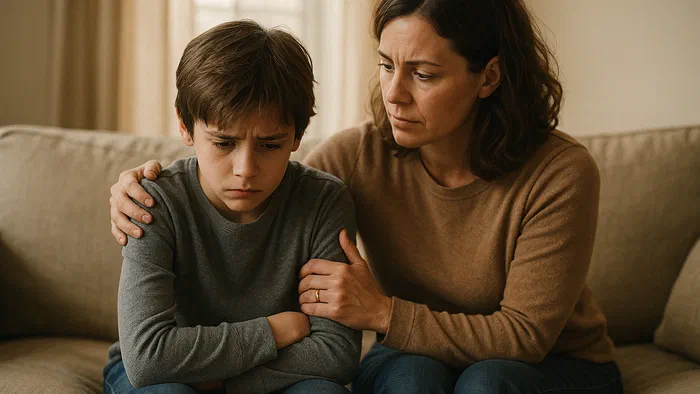
For the parent reading this: ask your son what he watches at night. Not in an interrogation way. In a curious way. The data is clear that what they watch shapes how they see their body. You do not have to ban anything. You have to know.
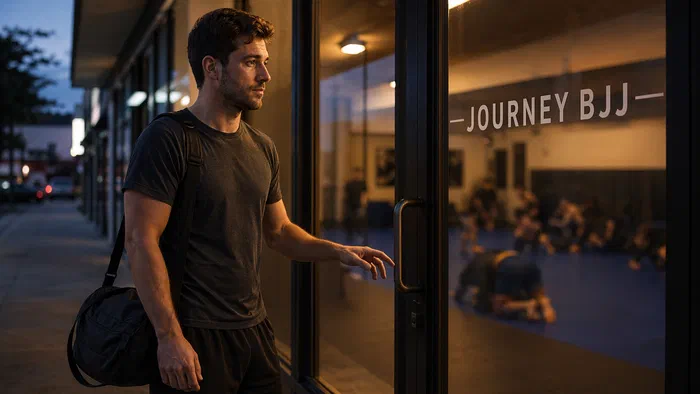
For the adult reading this: you are not behind. You are not too old. You are not the wrong shape. The ladder of “presence” you keep imagining starts on a mat with a stranger, not a mirror. We get this question a lot, and the answer is in this short piece .
If you want a sense of what showing up actually feels like, we wrote that one too .
If you are local to Madison, WI, you can come try our adult Brazilian Jiu-Jitsu program . Two weeks, $49, free uniform, no long-term commitment.
The strength boys and young men are chasing is real. The shortcut is not. Pick the one that holds up under pressure.
- Looksmaxxing
- Mental health
- Bjj
- Strength
- Parenting
- Madison
- Masculinity
Ready to Start Your Journey?
Choose the option that works best for you
Call to book: +1 (608) 416-1140