Draw Your Childhood Map. Then Draw Your Kid's.
Grab a napkin. I’m serious. A napkin, the back of a receipt, whatever’s near you.
Draw the map of everywhere you were allowed to go alone when you were nine.
Take your time. There was the creek behind the Hendersons’ where you weren’t supposed to go but went anyway. The gas station with the spinning rack of candy, two blocks past the stop sign. The shortcut through the gap in the fence that cut ten minutes off the walk to your friend’s house. The one yard with the dog you knew to give a wide berth. You learned which side of the street to walk on by getting chased exactly once.
Now mark the hours. A Saturday in summer where you left after breakfast and nobody, not one adult, knew exactly where you were until you turned up hungry. Four unaccounted-for hours. And that was just a normal day. Nobody worried. Nobody had a phone to check.
Got the map? Good. Hold onto it.
Now draw your kid’s.
Where do they go alone? Not “with you ten feet behind.” Alone. The driveway. Maybe the cul-de-sac. The mailbox, if you’re feeling bold.
Here’s the part that stops me cold every time. The second map fits inside the first map’s backyard.
You’re not imagining it, and you’re not the problem

If that hit you somewhere, you’re not being dramatic. The ground actually shifted under our feet, and we have the receipts.
In 1969, 48% of American kids walked or biked to school . By the early 2000s it was under 16%, and it has stayed low since. A generation ago, kids started getting real independence, walking somewhere by themselves, around age 9. Now the average is 11 or older. When researchers ask parents whether they’d let a 9-to-11-year-old walk or bike to a friend’s house alone, only about a third say yes.
So why did the map shrink? Here’s the uncomfortable answer: because shrinking it was the rational move.
This isn’t about parents getting soft. Parents got investigated. Real ones. A mom lets her kid walk to the park, a neighbor calls it in, and suddenly there’s a case file. It happened often enough that more than a dozen states passed “Reasonable Childhood Independence” laws. Those basically say letting your kid walk to the store is not neglect. (Quick note for Madison families: Wisconsin hasn’t passed one of those, so this isn’t legal advice, just context.)
And on May 12, 2026, a bipartisan bill landed in Congress. It’s called the Promoting Childhood Independence and Resilience Act, sponsored by Reps. Blake Moore, Jennifer McClellan, and Virginia Foxx. Reason covered it the next day . The whole point of the bill is to draw a line: neglect is putting your kid in real danger, not letting them out of your sight for an afternoon.
Sit with that for a second. We needed an act of Congress to make it okay for a kid to walk to school. You didn’t shrink the map because you’re anxious. You shrank it because the culture would have come for you if you didn’t. The villain here was never you.
The other graph moved too

While the map was shrinking, something else was climbing.
The share of kids diagnosed with anxiety went from 6.9% in 2016 to about 10.6% in 2022, for ages 3 to 17, according to the National Survey of Children’s Health . Zoom in on teens 12 to 17 and it’s higher: 16.1% diagnosed. That’s about 1 in 6, closer to 1 in 5 girls and 1 in 8 boys. Up roughly 61% since 2016.
Land those numbers and then let them sit. I’m not going to pile on more.
Here’s the timing that I can’t stop thinking about. Anxiety tends to show up around age 11, on average. The wiring for it starts forming earlier, around 7 or 8. And there’s a real jump right at that 6th-to-7th-grade line.
Which is exactly when we now START handing kids a little independence.
Read that again. We deleted the practice years. The window where a kid used to get small, low-stakes reps at handling the world, the lost candy money, the wrong turn, the scary dog, the figuring-it-out, that window now opens right as the pressure spikes. We took away the training wheels and the hill at the same time.
Now I have to be straight with you

Here’s where a lot of articles would tell you the shrinking map caused the anxiety, slam the laptop, and call it a day. I’m not going to do that, because it isn’t honest, and you’d smell it.
So let me show you the actual fight.
The “lost independence is THE cause” argument comes mostly from one tight circle of people. Peter Gray, Jonathan Haidt, Lenore Skenazy, and Daniel Shuchman co-founded a nonprofit called Let Grow together in 2017. They’re smart, they care, and a lot of good parents follow them. But their flagship “independence therapy” study had four kids in it and no comparison group. Their anchor paper, published in the Journal of Pediatrics in 2023 , is a review of other research, not proof of cause.
The phone theory has the same problem from the other side. The biggest dataset on screens and teen wellbeing, published in Nature Human Behaviour in 2019 , found that screen time explains about 0.4% of a teenager’s wellbeing. The lead researcher, Amy Orben, put it plainly: if you told her how many hours a teen spends on a screen, she couldn’t predict their wellbeing worth a darn. (Screens matter some. They’re not the whole story. We’ve written a whole post on that, so I’ll leave it there.)
And the lazy take, “it’s just more diagnosis, kids are fine,” dies on one fact. Emergency room visits for self-harm went up too. Questionnaires don’t send a kid to the ER. So the rise is real, even if the cause is a brawl.
Now the part that matters for you.
Here’s the turn: the researchers who fight the loudest about why it’s happening all agree on what protects kids. A sense of control over your own life. Real, earned competence. And practice facing hard things that are still doable. Peter Gray says it about as plainly as anyone: if a kid believes something bad can happen anytime and there’s nothing they can do about it, that’s a deeply anxious way to live. (Psychologists call that low “locus of control,” fancy words for “I have no say in what happens to me.”)
So here’s the freeing thing. You don’t have to wait for the scientists to settle the cause. The protective factor is already settled. Give kids a sense of control, real skills, and manageable challenge. Everybody in the room agrees on that part. That’s a move you can make on a Tuesday.
Give the territory back, in small pieces

You can start handing back the map this week. None of this costs anything. None of it requires us.
Hand your kid $10 and send them into the store for milk and bread while you wait in the car where you can see the door. Let them order their own food at the counter while you stand back. Let them walk the last block to school by themselves. You can trail behind once, then peel off. Leave them home alone for 40 minutes while you run an errand. Let them ride to a friend’s house and call you when they get there.
Each one is a small, survivable rep. The kid handles something. Nothing terrible happens. And a quiet thing builds inside them: I can do hard things.
That’s the whole game. Not one big leap. A hundred small ones.
The mat is one structured version of this

Everything above is free and BJJ-free, and I mean that. But once you start looking for places where a kid gets to struggle a little and come out the other side, a Brazilian Jiu-Jitsu class is one of the cleanest ones I know. It’s basically controlled independence with a coach ten feet away.
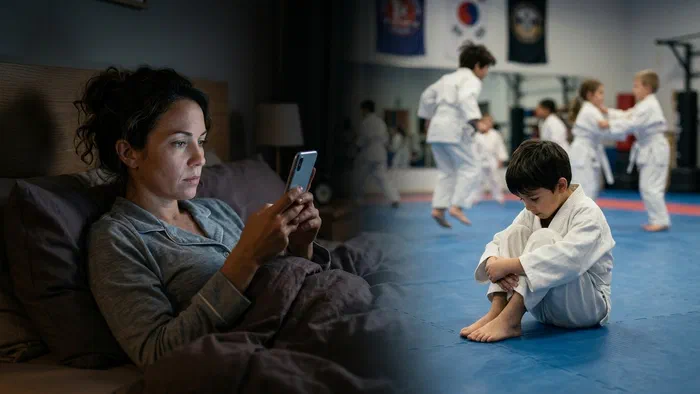
Picture a Tuesday night in our kids class. A nine-year-old gets flattened under side control. Pinned, an older kid’s shoulder pressing into them, stuck. Their first instinct is to look up at the coach. Help me.
The coach doesn’t rescue them. On purpose.
Instead the coach reminds them of the frame, the way you wedge your forearms in to make space, and the kid figures it out. They build the frame. They escape, or they tap, reset, and go again. Tapping isn’t losing here. Tapping is failing safely, a dozen times a night, in a room built for exactly that. By the end of class that kid has been stuck and gotten unstuck more times than they get to in a whole month of regular life.
I’m not going to overclaim the science, because I just spent a whole section refusing to do that. Here’s the honest version. Anxiety is up, that’s real. A sense of control and competence protect kids, nobody disputes that. A BJJ class delivers those reps every single week, and you get to watch it happen from a folding chair ten feet away. The unstructured-play version of this is just as valuable. The American Academy of Pediatrics said as much in its 2018 report “The Power of Play” . The mat is one version with a coach, a curriculum, and a parent watching.
For a kid who came in shy, that’s the whole transformation. Not a tougher kid. A kid who’s been stuck and figured out it’s survivable, and who walks out a little more sure they can handle the next thing.
If you want the bigger picture on this, we pulled it together in our complete guide to kids martial arts in Madison . And if you’re nervous about what a first class even looks like, totally normal, here are the six things every parent worries about first . We’ve also written about why kids can’t move the way their parents could and what summer break does to an already anxious generation .
Three things to try this week

You don’t need us to start. Try these, in this order:
- Do the map exercise tonight. Draw yours, then your kid’s, side by side on one page. You’ll feel it. That feeling is the point. It tells you how much room there is to give back.
- Pick one small rep and run it this week. The $10 store trip. The last block to school alone. The 40 minutes home by themselves. One thing. Let it be a little uncomfortable for both of you.
- Find a place where they struggle on purpose. Sports, scouts, a chore with real stakes, anything where the adult doesn’t swoop in. Our kids Brazilian Jiu-Jitsu program is built around exactly that, but the principle works anywhere.
That’s it. The map your kid grows up with is something you draw, one small handoff at a time. You don’t have to redraw the whole thing today. You just have to add one street.
If you want to see what “struggle on purpose, coach ten feet away” looks like in person, come watch a class. Our kids program is right here in Madison, and in 8 years we’ve never had a child get more than a bruise. The first step is a 2-week intro: $49, free uniform, and your kid gets to be stuck and unstuck a few times in a room built for it.
- Kids bjj
- Childhood independence
- Kids anxiety
- Madison
- Parenting
Ready to Start Your Journey?
Choose the option that works best for you
Call to book: +1 (608) 416-1140