Sitting All Day Is Quietly Making You Clumsier. Here's the Fix.
The doorframe you clipped this morning, the easy catch you fumbled: some of that clumsiness has a cause, and it’s your chair. Sitting all day quietly makes you worse at controlling your own body, and researchers can measure it happening in under an hour. In a 2020 study in the Journal of Exercise Rehabilitation , healthy young adults held a hunched phone posture for just 40 minutes. Their neck’s sense of its own position dropped in a way the researchers could measure. The good news: it came back once they moved. The part that should get your attention: 40 minutes did it.
That “sense of where your body is” has a name. Proprioception. It’s how you touch your nose with your eyes closed, or catch yourself when someone bumps you on a crowded bus. Tiny sensors sit inside your muscles, tendons, and joints. They report your body’s position back to your brain a few hundred times a second. Your brain uses those reports to make small, constant corrections you never notice.
Sitting all day quietly starves those sensors. And most of us sit a lot more than we think.

Wait, how much are we actually sitting?
More than any generation before us. The U.S. Bureau of Labor Statistics found that in 2025, workers spent 44.9% of the workday sitting . Software developers sat for about 97% of it. That’s nearly the whole day in a chair, and it doesn’t count the drive home or the couch after.

When your head drifts forward of your shoulders like that, physios call it forward head posture. Hold it long enough and your position sensors get lazy. The 40-minute study proved the effect shows up fast. Now stretch that over years of workdays.
What sitting actually does to your body’s radar
Your position sense follows a simple rule: use it or lose it. Tasks that challenge it keep it sharp. Tasks that don’t let it fade.
You might already feel the early version of this. That half-second of clumsiness stepping off a curb. A tweaked lower back from reaching for something at an odd angle. Feeling stiff and vaguely “out of your body” after a long day at the screen. None of it is dramatic, and it’s easy to write off as getting older or being tired. But part of what you’re feeling is a body that’s gotten worse at tracking itself.
Sitting also tightens the muscles that feed those sensors. A 2026 study in Karya Journal of Health Science looked at 57 sedentary young adults, ages 18 to 27. The ones with tighter hamstrings, the classic result of chair-shaped hips, made bigger errors when asked to sense the position of their own knee without looking. Tight from sitting, and their knee’s radar got fuzzier.
Here’s the honest part. If you’re 32, this is not a falling crisis. You are not about to topple over. What you have is a small deficit, forming quietly, that adds up over time. A 2025 study in GeroScience found that sitting too much amplifies the ankle position-sense decline that comes with age. Their words: age-related loss of proprioceptive acuity appears to be amplified by physical inactivity. Translation: the bill comes due decades later, and sitting makes it bigger.

So the move isn’t panic. It’s this: the deficit is cheap to reverse now and expensive to ignore. The same sense that feels pointless at 32 is the one that keeps you off the floor at 72, and you’re training it, or losing it, today. If you’ve been telling yourself you’re too old to start something new, read this first .
Why your treadmill won’t fix this
Here’s the trap. You already work out, so you assume you’re covered. You’re probably not.
Steady cardio and weight machines move on fixed, predictable paths. A treadmill belt goes one way. A leg-press sled runs on rails. Your body knows exactly what’s coming, so your position sensors coast. They only get sharp when the task is unpredictable, when you have to react and correct on the fly.

The good news is that this stuff responds fast to the right training. A 2025 trial in BMC Musculoskeletal Disorders split 99 young adults into groups. The group that added position-sense drills to their neck exercises beat the exercise-only group on balance, posture, and joint-position sense, and not by a little (p<0.001). Your radar is trainable. It just needs the kind of challenge a chair, a treadmill, and a leg press never provide.
Where grappling comes in (and where it doesn’t)
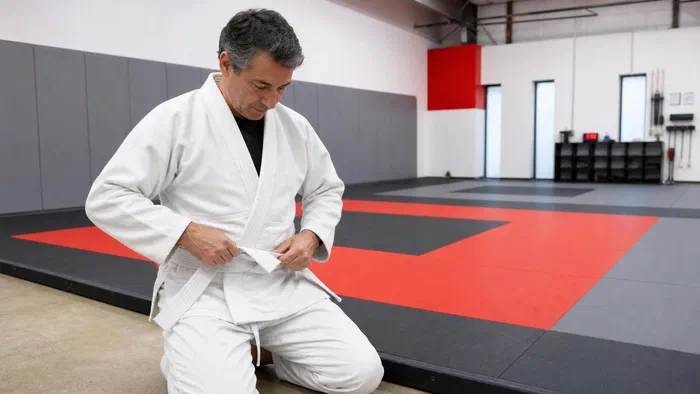
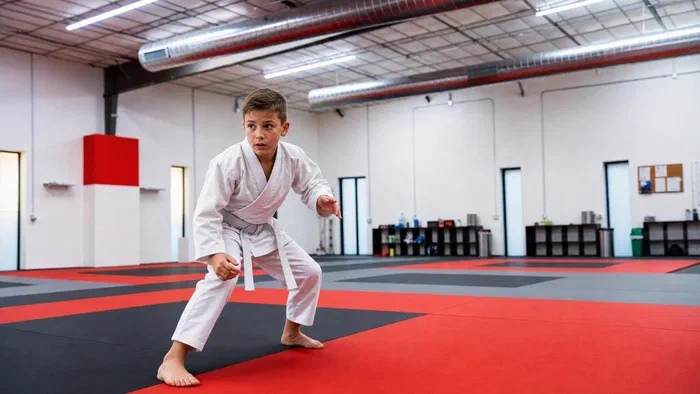
Grappling means wrestling on the ground with a partner who is actively resisting you. Brazilian Jiu-Jitsu, the grappling art we teach , is one long exercise in exactly the thing your desk erased: reacting to force you can’t predict.
Think about what your body does in a live roll. Your partner shifts their weight, and you correct. They post on a leg, and you adjust your base. They pull you off balance, and you catch it. Every few seconds, another correction, and none of it scripted. Wrestling and grappling rank among the most balance-demanding things people do. The demand maps neatly onto what position-sense training is supposed to do.
And it hits the joints your desk hits hardest. When a partner off-balances you, your hips, knees, and ankles have to fire in a split second to keep your base. Those are the same stabilizers that switch off during eight hours in a chair. A treadmill never asks them to react. A resisting human asks them to react constantly.
I want to be straight with you here. No study proves Brazilian Jiu-Jitsu fixes desk-worker proprioception. Nobody has run that trial. What we have is the mechanism: your position sensors get sharp through unpredictable, reactive correction, and few activities pile on more of that than grappling a resisting human. The mechanism points one way. It’s a strong bet, not a proven cure.
In a real class, that reactive work is built in. At Journey, adult classes move from cooperative drilling into positional sparring and live rolling. That’s a lot of position corrections for a body that spent the day in a chair.

The honest counter-argument
Grappling is not the only way to do this, and I’d be selling you something if I pretended it were.
Single-leg balance drills work. Yoga works. Wobble boards and stability work all train your position sense too. The real difference is what they ask of you. A wobble board challenges one joint on a predictable surface, at a pace you set. Grappling asks your whole body to react at once to a partner who is actively trying to move you.
So why grappling over a drill you could do at home? Two reasons. First, you’ll actually keep doing it. Almost nobody does their wobble-board homework three times a week for a year. People do show up to roll with their friends, because it’s a game, not a chore. Second, the demand is real. A resisting partner throws unpredictable force at you the way life does, which a balance board never will.

The board is simpler. The mat is more like the real world, and you’ll actually keep going back. Pick based on which one you’ll still be doing in six months. If you like the idea and want to train in a way that lasts, this piece on training for the long haul is a good next read.
Three things to try this week
You can start today, no gym required.

Brush your teeth on one leg. Switch legs halfway through. It’s two free minutes a day, and standing on one foot forces the position sensors in your ankle to work. Wobbling means it’s working.
Reset your posture every 30 minutes at your desk. Stand up, roll your shoulders back, and stack your chin over your shoulders instead of out in front. A phone timer handles the reminding.
And if you want the reactive version, the kind a balance board can’t fake, come grapple. Our adult program is built for people who haven’t done anything like this since gym class. New here? Here’s exactly what to expect on day one so nothing catches you off guard.
You don’t have an athlete’s schedule. You have a Tuesday at 6pm and a body that’s been in a chair since 8am. That’s enough to start.
- Adult bjj
- Proprioception
- Balance
- Desk workers
- Brazilian jiu jitsu madison
Ready to Start Your Journey?
Choose the option that works best for you
Call to book: +1 (608) 416-1140