The Kind of Exercise That Builds Your Kid's Focus Isn't Cardio
The Kind of Exercise That Builds Your Kid’s Focus Isn’t Cardio
Here is the finding that surprised me. In a 2025 study, kids who did coordination-based exercise ended up with sharper focus and better self-control than kids who just ran around or played team sports. Same amount of time. Same sweat. The difference was what their brains had to do while they moved.

That study followed about 426 children, ages 7 to 12, for 36 weeks. The researchers split them into four groups. One group did coordination drills. One did steady cardio, the running-and-heart-pumping kind. One played team sports. One did nothing new. Then they measured each child’s focus, memory, and self-control.
The coordination group won. Not by a hair, either. You can read the full study in Scientific Reports if you want the details.
So if you’re a parent in Madison staring at a list of fall activities, this matters. Let me walk you through it.
First, what we mean by “focus”
Scientists have a name for the mental skills we’re talking about: executive function. Think of it as your kid’s inner CEO. It’s the part of the brain that sets a goal, blocks out distractions, holds back an impulse, and changes the plan when things go sideways.

It breaks into a few pieces, and they’re worth knowing by plain name:
- Holding information in mind while using it. Like remembering a two-part chore, or working through a math problem with several steps.
- Resisting an impulse. Not blurting out the answer. Not grabbing the phone during homework.
- Switching gears. Trying one approach, and when it flops, calmly reaching for another.
Those skills predict how well a kid does at school better than IQ does. And here’s the good news for parents: unlike height or eye color, you can train them.
Why coordination beats plain cardio
For years the advice was simple. Get your kid moving, get the heart rate up, and the brain benefits will follow. That’s half right. Cardio does help the brain. But newer research shows it’s not the heart rate doing the heavy lifting. It’s the thinking.

Running on a treadmill is repetitive. Your body knows the next step before you take it. Your brain can basically check out. Coordination-based movement is the opposite. You have to notice what’s happening, pick an option, and adjust in real time. That constant problem-solving is what lights up the brain.
A 2024 review in Frontiers in Psychology backs this up. It looked across many studies and found that mentally demanding exercise builds focus more than repetitive exercise does. Part of the reason is a brain-growth protein, sometimes called BDNF, that helps brain cells form new connections, and hard-thinking movement seems to boost it. Movement-skill training, the coordination kind, had the strongest effect of everything they reviewed.
This is what the developmental research from scientists like Adele Diamond has said for a while. Kids’ focus improves most when an activity actually challenges that focus, not just their lungs.
Grappling is coordination in its purest form
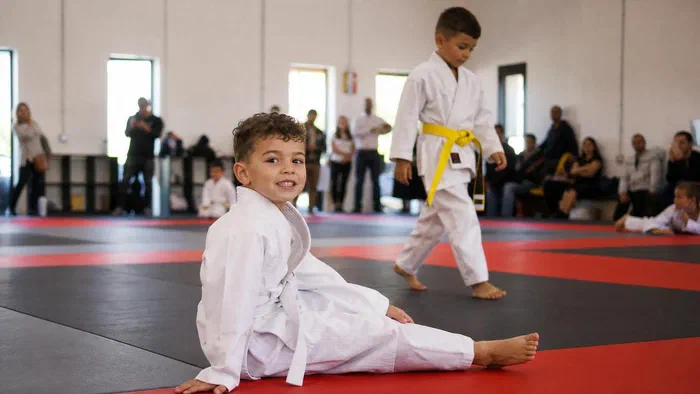
Here’s where it clicks for us. Brazilian Jiu-Jitsu is coordination training with a live, thinking partner.
Picture a kid on the mat. Their partner shifts weight, just slightly. The kid has to notice it in a split second. Then choose between two responses. Then hold back the urge to just muscle out of it. Then do the right move. All in about three seconds. And they’ll do it dozens of times in a single round.

That’s every skill on the list, firing at once. Notice, choose, wait, adjust. A kid tries one escape, it fails, and they instantly switch to another. That’s cognitive flexibility under real, friendly pressure, which is exactly the mental gear-switching the study measured.
There’s a second study worth mentioning. Researchers looked at 847 young martial-arts practitioners , average age around 13. Kids who trained more showed less aggression. And the biggest reason wasn’t the fighting skills. It was better self-control. Roughly two-thirds of the calming effect ran through self-control.
One more detail worth noting: the style didn’t matter. Taekwondo, kickboxing, traditional arts, all similar. The training does the work, not the label.
The honest part
I want to be straight with you, because that’s how trust works.
Both of these studies were done with kids in East Asia. That doesn’t mean the findings won’t hold for a kid in Madison, but we can’t promise they transfer perfectly. More research in more places would help. The martial-arts study also can’t prove cause and effect on its own, since it’s a snapshot in time, not a controlled trial.

And cardio isn’t useless. Not even close. Running, biking, swimming all carry real, well-documented benefits for the body and the brain. Coordination has an edge, not a monopoly.
One more thing. BJJ isn’t magic. It’s a great example of coordination training, not the only one. Dance demands it. So do gymnastics, rock climbing, and complex ball sports like soccer where a kid reads the field and reacts. What matters is real-time thinking plus enough novelty that the brain can’t coast. If your kid loves ballet, ballet is doing good work. Pick the thing they’ll stick with.
We happen to think grappling is one of the best versions, because the puzzle changes every second and a coach is right there guiding it. But we’d rather you choose well than choose us.
What you can try this week
You don’t need to sign up for anything to use this. Here are three things any parent can do starting now.
Add a “react” rule to play. Instead of just kicking a ball back and forth, call out a color or a number your kid has to respond to mid-play. Make their brain choose, not just move. Five minutes counts.
Pick activities with a live opponent or a changing puzzle. When you’re weighing fall options, ask one question: does my kid have to think and adjust in real time, or just repeat a motion? Both are fine. But if focus is your goal, lean toward the thinking one. This is the same idea behind building real physical literacy in kids instead of just burning energy.
Watch for the small wins. Better focus shows up quietly. A kid who finishes a two-step instruction without a reminder. Who sits with a hard homework problem a little longer. Who loses a game and shakes it off. Those are executive function growing.

If a live-thinking activity sounds like what your kid needs, our kids Brazilian Jiu-Jitsu program in Madison is built around exactly this. Small problems, solved fast, over and over, with coaches who keep it safe and fun. Every kid on our mat gets these benefits, and competition is completely optional.
If you’re curious how this compares to the usual “just get them moving” advice, we dug into why jiu-jitsu works the body differently than cardio , and into what the focus research says for kids who struggle to sit still . And if you’ve noticed your own kid moves less smoothly than you did at their age, you’re not imagining it .
Want to see it in person? Our Kids 2 Week Trial for $49 includes a free uniform and two weeks of classes. Come watch a kid’s brain get to work.
- Kids bjj
- Kids focus
- Executive function
- Coordination
- Brazilian jiu jitsu madison
Ready to Start Your Journey?
Choose the option that works best for you
Call to book: +1 (608) 416-1140