The Women's Self-Defense Industry Is Selling You a Fantasy
About 70% of women who survive a sexual assault report freezing — not fighting, not fleeing. Their body locked up (Yadav & Herres, 2026 ). And every weekend, in some hotel or church basement, a self-defense seminar tells a room of women that when the moment comes, one hard shot will set them free.

That promise is a lie. It’s the kind of lie that gets people hurt.
We’re going to take that lie apart, one piece at a time. Then we’ll show you what works.
The lie that’s getting women hurt
The pitch sounds clean. Disrupt the attack. Strike the eyes, the throat, the groin. Create distance. Get out. You’re free.
It doesn’t work that way. Look at pro fighters. In the heaviest UFC weight class, where the punches are biggest, the knockdown rate is about 1.56% of strikes thrown . Middleweight is 1.41%. Welterweight is 1.09%. These are full-time athletes, in their physical prime, throwing with bad intent at trained opponents — and 98 of every 100 punches don’t drop the other guy.

Now picture a 140-pound woman. No fight camp. Adrenaline shaking her hands. One shot, in shoes, on concrete, against a 200-pound man already on top of her plan. She hits him. He doesn’t fall. He gets mad. He closes, grabs her, takes her down. That is the actual sequence.
Striking has its place. So does running, screaming, a weapon, an emergency call — anything that creates space. But when a strike fails to drop the attacker (and the data says it usually does), the next phase is the clinch and the ground. The honest pitch isn’t “don’t strike.” It’s be ready for what happens when striking doesn’t end the fight.
You can’t buy capability in a weekend
The other big lie is that one Saturday workshop can save your life.
A short class teaches you what to do in words. “If he grabs your wrist, twist toward the thumb.” Psychologists call that explicit knowledge — facts and rules you can say out loud. The other half is implicit knowledge — what your body does without thinking, the kind that survives panic, sweat, and a 175-bpm heart rate. Decades of research show that under stress, the explicit half collapses first (Hardy, Mullen & Jones, 1996 ; DeCaro et al., 2011 ).
A four-hour class can only deposit the explicit half. A script you say to yourself. The implicit half — the part that actually fights — takes hundreds of hours against people who fight back.
Heart rate climbs past 145 and fine motor skill drops off a cliff. Above 175 you lose hearing, your sight tunnels, your hands shake. Rough averages, not hard limits — but the pattern is real.
A community-center workshop hands you a script. The street rips that script up before you finish the first line.
Why your nervous system isn’t on your side
Most self-defense marketing sells “fight back” like it’s a switch you can flip. Your body doesn’t have that switch. Not by default.
When a threat shows up, your brain runs a sequence. Freeze first. Then maybe flight. Then fight. If all of that fails, your body shuts down — the limpness survivors describe as “I couldn’t move.” Karin Roelofs’s Royal Society review puts it plainly: freezing is not weakness. It’s an active brake your brain pulls before it picks what to do (Roelofs, 2017 ).
Training rewires that sequence — but only the right kind. Smashing pads, guttural screams, a coach yelling “you’re a warrior!” — none of that changes how you respond when a real grip closes on your arm. The empowered feeling fades by Tuesday. We’ve written more on how grappling rewires your threat response if you want the deeper dive.
You can’t take a seminar and buy a can of mace and call yourself ready. You’re either trained or you’re not.

Camo pants, groin shots, and other bad advice
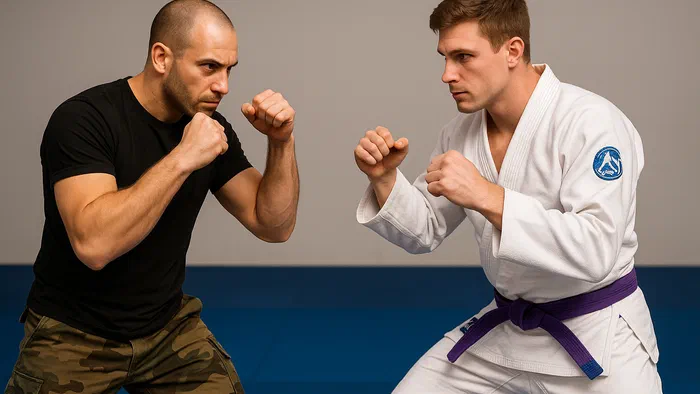
Walk into the average women’s seminar and you’ll see the same playbook. Groin strikes. Eye gouges. A loud “NO!” Maybe a knee to the ribs.
Each piece sounds tough. Each piece falls apart.
Here’s that exact pitch in the wild — grab the testicles, twist, gouge the eyes. This is the genre we’re talking about, and it’s what most women’s classes still teach.
- Groin strikes miss far more than they land. Clothing, angle, and adrenaline all eat the shot. Even Krav Maga schools admit the kick rarely ends a fight . Pain often makes a strong, drunk, or high attacker more dangerous, not less.
- Eye gouges sound like a trump card. In Wisconsin, force has to match the threat. Under Wis. Stat. § 939.48 , going past what the threat justified can cost you the legal right to defend yourself. They also tend to enrage attackers more than disable them.
- Choreographed drills — “I do this, you do that, freeze” — look like training, but the body doesn’t learn what real fights teach. Coaches call live, resisting practice “aliveness.” A recent meta-analysis on motor learning found that varied, mixed-up practice transfers to new situations. Static drills don’t. The reason is simple: rehearsing the same move the same way every rep stores one shallow stimulus-response — a lock that fits exactly one key. Vary the angle, resistance, and pressure, and the brain has to rebuild the skill each rep. That builds a deeper memory that holds up when the moment looks nothing like the drill.
The whole package looks like training and feels like training. It produces almost none of the skill it promises.
Self-defense systems that skip the ground
Striking-first systems share one big blind spot: the ground.
Krav Maga is the biggest brand, but it’s not alone. Tactical and “modern combatives” programs market the same package. So do most generic women’s self-defense workshops at gyms and community centers. So do striking-only Muay Thai and kickboxing classes pitched as self-defense. They all bet on ending the fight before it gets close.
The ground is treated as a side module, not the core. Sit through a year and you’ll throw thousands of punches and almost no armbars. The Krav Maga vs BJJ comparison goes deeper — the short version: striking and grappling are different sports, and most attacks turn into the second one.
If you can’t fight there, you can’t fight.
You don’t want to go to the ground. You’ll go anyway
The standard advice is right, as far as it goes. Stay on your feet. Keep distance. Standing means you can run, and running is the best outcome.
And every honest instructor will tell you the same next sentence: you don’t always get to choose. A bigger person grabs you, drags you, drives you into a wall, lands on top of you. So how often does that actually happen?
You’ve probably heard “90% of fights end on the ground.” That number traces to a 1988 LAPD report that actually said 62% , in the narrow context of cops making arrests. Independent video reviews tell a clearer story. Our breakdown of how boxing matches up against BJJ walks through the data. BJJ black belt Louie Martin watched 154 real street fights on YouTube. He found ground fighting in 73% — and 83% once you exclude sub-10-second knockouts . Dr. Bakari Akil II reviewed 300 fight videos separately and counted a fighter on the ground in 72%. Two analysts, different samples, same answer: most real fights end up on the floor.
Here’s that pattern caught on camera. A female personal trainer is attacked at her own gym, taken to the ground, and held there — more than once.
Same pattern, different scene.
The takeaway isn’t to dive at his legs. The takeaway is that not knowing what to do once you’re there isn’t bravery. It’s a gap. Closing that gap is what grappling does.
A real relationship with danger
A real relationship with danger is not screaming at a pad. It is not a hype circle. It is not a coach yelling “you’re a warrior!” while you punch a vest.
It’s wrestling, on a mat, with people bigger than you. Every week. Feeling exactly how strong an adult man’s grip is. Learning the inch of space you can steal back. Learning what your body actually does when someone has full weight on your chest. Staying honest with yourself about what you can and can’t do.
That honesty is the whole point. It’s the thing no seminar can give you.
You won’t feel “powerful” all the time. You will feel real. And real is what keeps you alive — because the goal isn’t matching a stronger man’s strength. The goal is a skill gap. Most attackers have never wrestled in their lives. The woman who has spent a year on the mat knows things they will never see coming.
What actually works
Two things move the needle. One is free. One takes time.
Awareness. This is the cheap one, and it saves the most people. A classic study had inmates watch silent video of pedestrians and pick targets in seconds, based on how they walked (Grayson & Stein, 1981 ). Eyes up. Phone down in the parking lot. Notice the car that pulled up. The best fight is the one you skip.
Hands-on skill, in a real room. Awareness keeps a lot of trouble away. It doesn’t help once a hand is on your arm. Find a gym that grapples. Show up weekly. Wrestle people who outsize you. Build the answers in your hands and hips long before the night you need them.
Grappling, over time. Most sexual assault is committed by someone the victim knows (RAINN ). It involves grabbing, holding, and going to the ground. The skill set that fits that reality is grappling.
For a sense of the floor: even a structured 12-hour university program with assessment, acknowledgment, and action cut completed rapes by about 46% over a year . Twelve hours of role-play moved the line that much. BJJ goes much further — multi-year practice with people who don’t cooperate, twice a week for as long as you train.
If you’ve thought about starting, you might like our piece on what your first month of BJJ looks like . You’ll laugh more than you’d expect. You’ll learn faster than you’d think.
What to do this week
- Audit one walk. To your car after work, say. Phone in pocket. Eyes up. Notice who’s near you and where the exits are.
- Be honest about your size. If you’re a 140-pound woman, a 200-pound stranger is stronger than you. That’s not weakness. That’s data.
- Get on a mat with bigger humans. Once a week is a start. Twice is real.
- Stop waiting for a magic move. There isn’t one.

Two weeks at Journey BJJ. $49. Free uniform. You’ll roll with women, with men, with people who outsize you. You’ll feel what your body does when you can’t muscle out. You’ll learn the moves that work when someone has you pinned. We also run a combatives and self-defense class for the same reason.
You can’t get serious about defending yourself in a weekend. Two weeks is where serious starts.
Train with us — two weeks, $49
Still on the fence? Send a question first. We’ll answer it straight.
- Womens self defense
- Bjj madison
- Self defense myths
- Womens bjj
- Krav maga
Ready to Start Your Journey?
Choose the option that works best for you
Call to book: +1 (608) 416-1140