What Happened When Police Departments Started Training Jiu-Jitsu
The St. Paul police department in Minnesota started teaching its officers Brazilian Jiu-Jitsu in 2014. Over the next six years, the department tracked 2,845 use-of-force incidents. Officer strikes dropped 68%. Use of force overall fell 37%.

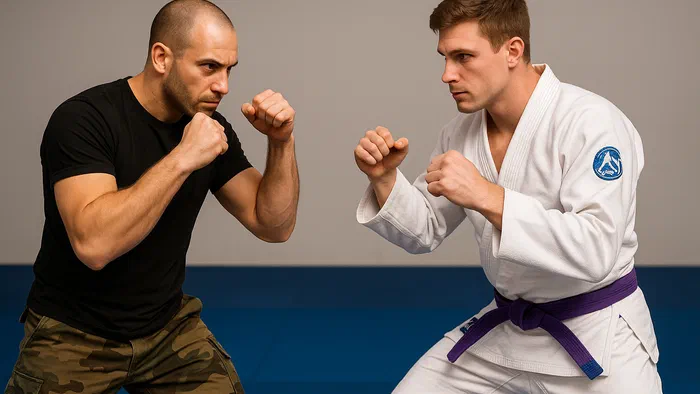
Use of force is the police term for the physical stuff during an arrest: grabbing, striking, a Taser, pepper spray. Brazilian Jiu-Jitsu is grappling. Think wrestling with control holds, not punching. The whole idea is to take someone down and pin them, not hurt them.
Those St. Paul numbers come from the department’s own records. They are not a peer-reviewed study, meaning outside scientists never checked the math. But St. Paul is not a one-off.
Over the past decade, departments across the country have run the same experiment. Some kept careful data. One famous case fell apart under a second look. And the most rigorous test of all is happening right now.
Here is what actually happened, case by case. The evidence is more interesting than the sales pitch.
The St. Paul case: a decade of data
St. Paul built its program slowly. Recruits went from 80 hours of defensive training to 120. The curriculum, called “Response to Resistance and Aggression,” leans on leverage and positioning.
It leaves out armbars and neck restraints on purpose. Officers drill it in pairs. New recruits are required to train, and veterans come back for refreshers every few months.

The reported results, measured across those 2,845 incidents, are hard to wave off. On top of the 68% drop in strikes, Police1 reported more.
Pepper spray use fell 51%. Taser use fell 39%. Suspect injuries fell 44%, and officer injuries fell 25%.
The money moved too. The city paid $2 million to settle one misconduct case in 2017. By 2020, the entire year’s settlements came to $5,000.
These totals bounce around year to year, though. They were back up to $70,000 in 2021. Chief Todd Axtell kept it plain: “It’s been good for our community and our officers.”
That is the strongest single case, because it runs a decade deep. Now for the one everybody has heard of.
Marietta, Georgia: the famous one, and the honest caveats
Marietta launched its program in September 2019 under Major Jake King. The department brought in a black belt, Humberto Borges, to teach it. New recruits had to train. Veteran officers joined later.
Then Marietta compared roughly 18 months before the program to 18 months after. Officer injuries during arrests dropped from 29 to 15, a 48% fall. The share of use-of-force incidents that sent a suspect to the hospital dropped from 65% to 31%.
Taser use fell from 77% of incidents to 54%. The city estimated it saved about $67,000 in workers’ comp claims the first year.

King’s reasoning was blunt: “It may be lawful but it looks awful when police have to strike citizens.”
Here is where a lot of BJJ blogs stop. I am not going to. An independent look changed the picture.
The Marshall Project found that injury rates among arrested people “remained virtually identical, regardless of officer training.” That cuts against the hospitalization story. You can read their full report here .
A researcher named Pete Blair pushed harder. Marietta had no control group. A control group is a matched set of officers who skip the training. That way you can tell what actually caused the change.
Blair also flagged the confounds. COVID lockdowns and the 2020 protests both hit the same window. The department sees fewer than ten use-of-force events a month, so small random swings can look huge . His verdict: the analysis “does not prove that the implementation of the BJJ program caused the decreases.”
Read that fairly. It does not mean the training failed. It means one department grading its own homework cannot settle the question. Which is exactly why the next case matters.
Colorado Springs: the study that will actually test it
In September 2024, Colorado Springs rolled out grappling training for its whole force. What makes this one different is the price tag and the referee.
The department won a $1.3 million grant from the National Institute of Justice, the research arm of the U.S. Justice Department. The money funds a three-year study run with an outside group, the Police Executive Research Forum. It uses a real design with real comparisons, the kind Marietta lacked. You can see the grant record here .

The push came from the officers themselves. A 2022 report found that 80% of Colorado Springs officers wanted more hands-on and de-escalation training. De-escalation just means calming a situation down instead of forcing it.
Results are not expected until 2026 or 2027. When they land, this will be the first study rigorous enough to say whether grappling causes the drop or just travels alongside it. Worth the wait.
New York: a safer way to hold someone down
In 2024, the NYPD started training officers with Rener Gracie, from a famous jiu-jitsu family. He began with about two dozen officers and a plan to fold the method into the academy.
The technique is the interesting part. Gracie built a restraint called “SafeWrap” that holds a suspect on their side instead of face-down. As he told Police1 , it uses “no joint lock, no pressure point, no chokehold and no compression of lungs or diaphragm.” That is why he calls it “the safest method of two-on-one restraint that has ever existed in law enforcement.”

No published outcome data yet. But it shows where this is heading: not just fewer punches, but smarter holds.
The pattern is bigger than a few cities
Zoom out and the trend fills in. A nonprofit called Adopt-a-Cop BJJ, started by former Navy SEAL Mitch Aguiar, pays for officers’ gym memberships until they earn a blue belt.
The program cites 48% fewer injuries to officers who train through it. Treat that one gently, though. It comes from a BJJ-community outlet, not an independent study.
The shift is even reaching agencies that never grappled. After a cadet died during a boxing exercise, the Massachusetts State Police ended its boxing program and began weighing grappling as the replacement. Colonel Geoffrey Noble called it “a paradigm shift,” built around “control, de-escalation, and minimal use of force.”

The reason keeps repeating in the National Sheriffs’ Association’s own white paper : real fights end up close, and often on the ground. Striking rewards whoever is bigger. Grappling rewards whoever has better position and stays calm. That is the whole case, in one sentence.
What this means if you are not a cop
You do not run a department, and you are not trying to arrest anyone. So why should any of this land for a regular adult in Madison?
Because it is a clean, costly experiment in what holds up when a real situation goes bad. Trained pros, choosing on data and lawsuits, keep reaching for the same tool: control on the ground, not striking. If you have never seen how a smaller person controls a bigger one, this is what jiu-jitsu actually is .
That logic maps onto everyday life better than a punch does. A shove at a bar, a grab in a parking lot, a drunk relative who will not let go. None of those call for a punch. They call for staying upright, staying calm, and controlling the moment until it passes.
We compared strikes and control head to head in Krav Maga versus BJJ . We covered why sport control still works on the street in this piece on sport BJJ and self-defense .
Here is the honest tie to Madison. There is no police jiu-jitsu program here that I know of, and I am not going to invent one. But the control-based grappling these departments are adopting is not some special police course.
It is the everyday curriculum at any solid civilian academy. Same holds, same positions, same calm-under-pressure practice. The mats are open to regular adults, not just officers.

What you can do with this
If the police data made you curious, three small moves this week.
Watch one real class before you decide anything. Not a highlight video. A regular session, live, in person. You want to see people your size and age drilling control and laughing between rounds.

Ask one question when you visit: “Can I try this against someone who is actually resisting?” Live resistance is the whole point. It is how the St. Paul and Marietta officers built real skills. It is also how you find out what works for your body.
Pick a place you can reach twice a week. A skill you touch once a year is a skill you do not really have, and that is true for cops and for you. If you want a checklist for picking a gym, we wrote how to choose a BJJ gym in Madison .
At Journey BJJ in Madison, WI, our adult classes skip the warmup. You go straight into technique, drilling, then live practice, in a beginner-friendly room. If you want to test control-based grappling for yourself, try two weeks for $49 with a free uniform. Come see whether the thing that changed how police train can do something for a regular Tuesday.
- Self defense
- Brazilian jiu jitsu
- Police training
Ready to Start Your Journey?
Choose the option that works best for you
Call to book: +1 (608) 416-1140