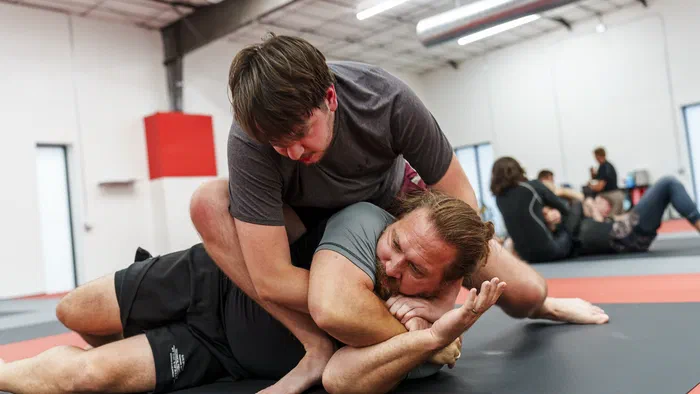
BJJ Rule Sets Explained: IBJJF, ADCC, and How Other Grappling Arts Compare
The rule set drives the action
Here is the one idea that explains everything you see on a grappling mat: the rule set drives the action and the specialization. Change the rules, and the same fighters look like a different sport. Same bodies, same training, same coaches — different game.
The cleanest example is the heel hook (a leg attack that twists the foot to put pressure on the knee). At ADCC — the no-gi superbowl — heel hooks are legal at the pro level and have been since the modern era of the event. At IBJJF — the rule set most BJJ gyms train under — heel hooks are banned in the gi at every belt, and only allowed in no-gi for brown and black belts since 2021. (IBJJF rule book , ADCC rules ) Same submission. Banned in the IBJJF gi at every belt. Hunted as the primary finish at ADCC. That one rule difference creates two different sports under one umbrella name.
If you are thinking about training Brazilian Jiu-Jitsu, it helps to know why. The rule set tells you what the action will look like, what is legal, and what your first year on the mat will feel like. Here is the plain-language version.
IBJJF rules — the big one most BJJ matches use

The International Brazilian Jiu-Jitsu Federation (IBJJF) sets the rules used at most BJJ tournaments worldwide. If you train at a normal BJJ gym, this is often the rule set your gym is preparing you for — though some no-gi-focused academies build their curriculum around ADCC instead.
Match length grows with your belt. White belts go 5 minutes. Blue 6, purple 7, brown 8, black 10. The idea is that higher belts can handle a longer fight.
Points reward control. You score by improving your position:
- Take the fight to the ground (a takedown): 2 points
- Reverse from the bottom to the top (a sweep): 2 points
- Move past the legs to a side pin (a guard pass): 3 points
- Sit on the chest (the mount): 4 points
- Take the back with both feet hooked in: 4 points
- Drive a knee into the belly while pinning: 2 points
Here is a quick walk-through of the IBJJF point system in plain English:
You have to hold each position for 3 seconds for it to count. No drive-by tagging.
The safety ladder is the big one. New students cannot do every move on day one. White and blue belts cannot heel hook (that knee-twisting leg attack), cannot reap the knee (twist the leg in a way that loads the knee joint), cannot do scissor takedowns (a flying leg-scissor that has hurt people for decades), cannot do jumping guard (leaping at an opponent and wrapping the legs around them to pull them down — the impact has caused enough knee injuries that IBJJF banned it for white, blue, and purple belts), and cannot crank the neck. Brown and black belts get more freedom — they can heel hook in no-gi matches, but never in the gi. The neck-cranking moves and the spinal-twisting move some people call a twister stay banned at every belt. (IBJJF rule book )
What an IBJJF match looks like: one or both fighters sit to guard (a guard pull, where instead of taking the opponent down they sit down on purpose to start fighting from their back), the bottom person attacks sweeps, the top person tries to pass. Most matches are decided on points, not submissions. It looks technical, patient, and a little chess-like. If you want a deeper read on the difference between IBJJF sport rules and the older self-defense roots of BJJ, we wrote a piece on that here .
ADCC — the no-gi superbowl

ADCC is the most prestigious no-gi grappling tournament on earth. It runs every two years. The biggest names in the sport build their year around it. The rules are wildly different from IBJJF, and that difference is the whole point. (Official ADCC rules )
The first half has no positive points. In a finals match, the first 10 minutes are negative-points-only. You can lose a point — for example, if you drop to your back to play guard, you eat a -1 penalty. But you cannot score positive points yet.
That one rule changes everything. In IBJJF, sitting to guard is free. In ADCC, it costs you. So fighters open ADCC matches with cautious wrestling and hand-fighting. They are scared to engage the wrong way. The match looks slow and tense at first.
Then the second half flips the switch. Positive points unlock, and the action explodes — usually into leg attacks.
Heel hooks are legal at the pro level. That is the second huge difference. The leg attack that is banned across the IBJJF gi side is fully open at ADCC. (ADCC rule summary ) When the inside heel hook is locked in at the pro level, it has one of the highest finish rates of any submission in no-gi grappling — which is why ADCC specialists built their entire systems around it.

What an ADCC match looks like: slow, careful first half. Hand-fighting and feinted shots. Then somebody finds a leg, the legs tangle, and the next 90 seconds is a frantic scramble to finish a heel hook before the other person counters.
Grappling Industries — the regional weekend tournament

Grappling Industries (G.I.) is the most popular weekend tournament chain in the United States. If you compete locally, this is probably what you sign up for. (G.I. rules )
The format is round-robin. Instead of single-elimination, you face every other person in your bracket. Lose your first match and you keep going. That makes it beginner-friendly. Most first-time competitors get at least three matches.
Scoring matches IBJJF. 4 points for mount or back, 3 for a guard pass, 2 for a takedown, sweep, or knee-on-belly. Same 3-second hold rule. So if you train at an IBJJF-rules gym, the math feels familiar.
Submission-only divisions are available. No points. The only way to win is to finish. New competitors love these — there is no scoreboard pressure, just you and your opponent trying to make something happen.
One thing G.I. does differently than IBJJF — it loosens the leg-attack ladder a step earlier. At blue belt and above, G.I. allows reaping the knee, toe holds, and calf slicers (a leg compression that pinches the calf around the knee). Those moves stay banned for blue belts under IBJJF. Heel hooks unlock at purple belt and above. So a Madison-area blue belt who competes at G.I. has more legal leg attacks than the same competitor at an IBJJF tournament. (G.I. rules )
The rest of the safety ladder still applies. Neck cranks and twisters stay banned at every belt. Scissor takedowns are out. The leg-attack window is just open a step earlier than IBJJF.
Gi vs no-gi — what changes when the jacket comes off

Most BJJ schools train both. The rules behind each are different enough that they almost feel like different sports.
In the gi, the jacket is a weapon. You can grip the collar, the sleeves, the lapel, the belt, the pant cuffs. That gives you control options no other grappling art has. The pace is slower. Submissions like the lapel choke and the sleeve choke — where you grip your own sleeve and use the wrist of that arm like a noose around the opponent’s neck, tightened by extending the arms — only exist because the jacket exists.
In no-gi, the slip factor changes everything. No collar grips, no sleeve grips. You hold the body, the wrists, the head, the legs. Sweat makes everything slippery. The pace is faster, the scrambles are wilder, and leg attacks become a much bigger part of the game. (See our no-gi page for how we run no-gi at Journey.)

Most beginners pick the gi for technique-building and add no-gi later. Both make you better. They reinforce each other.
How other grappling arts compare

People sometimes ask whether they should train BJJ, judo, sambo, or wrestling. The rules tell you what each will feel like.
Judo. Senior matches are 5 minutes. The goal is a clean throw — the Japanese word for it is ippon, which means a perfect throw on the back. A throw with speed, force, back contact, and control ends the match instantly. Direct leg grabs are banned as a primary attack — they get a penalty (called a shido). Leg grabs as a counter or as a follow-up to a thrown attack are allowed. Leg locks are banned. Submissions are limited to arm locks and chokes. (IJF rules )
What it looks like: explosive grip-fighting, big throws, almost no ground work. If you want a deep dive on how this stacks up against BJJ, we wrote a full breakdown of BJJ vs judo here .
Sambo. A Russian grappling art with a jacket (called a kurtka or sambovka), similar to judo but with leg locks fully legal. Chokes are banned entirely in sport sambo. So the ground game is all arm locks and leg attacks. A throw to the back from a standing finish ends the match. Sambo calls it Total Victory. (FIAS rules )
What it looks like: explosive throws, then if it goes to the ground, a quick leg-lock scramble. Short and violent.
American folkstyle wrestling. This is what high schools in the United States compete in. Three two-minute periods. Takedowns were worth 2 points until the 2024 rule change — now they’re 3. Escapes are 1, reversals 2. No submissions of any kind. (NFHS rules )
What it looks like: a fast takedown battle, then top control, then the bottom person fights to escape. Repeat. No guard, no submissions, no rest.
American freestyle wrestling. What you see at the Olympics. Two three-minute periods, with a 30-second break in between. Takedowns are typically 2 points; certain variations (like back-exposure on the way down) score more. Exposing the opponent’s back to the mat (called exposure) earns 2 points. Leg attacks aren’t just legal — they’re the engine of the sport. No submissions. (UWW rules )
What it looks like: explosive leg shots and constant back-turning attempts. The action almost never stops.
What this means if you are looking at gyms in Madison

The rule structure is also the curriculum. Journey trains under IBJJF rules. Most competitive BJJ schools do. That means our beginner classes follow the safety ladder above. White belts learn the moves that are safe and effective at white belt. They do not get exposed to the riskier leg attacks until they have built the base to handle them.
That is on purpose. You learn to control before you learn to twist. You learn to pass before you learn to finish. The result is that adults walk in with no experience and walk out, a year or two later, as blue belts with real technique under pressure.
If you want help picking the right gym, our guide on how to choose a BJJ gym in Madison walks through the questions to ask. And if you are wondering what your first 30 days will actually feel like, we covered that here .
We are pure BJJ — no kickboxing, no karate, no buffet of arts. (That is the Journey difference. ) The trade-off is that we do one thing very well, and our schedule is built for working professionals.
Come see for yourself
Reading rules is fine. Feeling the difference is better.
If you want to talk to a coach before you commit to anything, the easiest first step is a free conversation. No pressure, no sales pitch. Just questions and answers and a tour.
- Bjj rules
- Ibjjf
- Adcc
- No gi jiu jitsu
- Bjj vs judo
- Madison wi
- Brazilian jiu jitsu madison
- Grappling
Ready to Start Your Journey?
Choose the option that works best for you
Call to book: +1 (608) 416-1140