A Third of Lockdown-Born Kids Are Behind on One Thing. Nobody Tests for It.
A study of 205 children born in England during the first COVID lockdown found that about one in three is behind on a single skill. Their motor skills were normal. Their speech was fine. One thing was off, and no school in Madison or anywhere else screens for it.
The skill is executive function. Most of these kids have no diagnosis. Nobody has ever flagged them. On paper they look completely fine.

What executive function actually is
Executive function is three things working together. Holding a plan in your head. Stopping your first impulse. Switching strategy when the plan fails.
That’s it. It isn’t intelligence. It isn’t behavior. It isn’t how sweet or how wild your kid is.
Here’s why it hides. A kid can be smart, kind, funny, and well liked, and still lose the thread halfway through a two-step task.

Report cards don’t measure it. Reading screeners don’t catch it. There’s no state test for whether she can change course when plan A stops working.
The lockdown study found the gap only by comparing each child against that same child’s own reasoning ability. These kids reasoned just fine, then scored below where that reasoning said they should. You’d never see it from the outside.
What the research actually says
Three groups of researchers looked at three separate groups of kids. They found the same thing.
The first is the BICYCLE study, out this month in Archives of Disease in Childhood. A team at City St George’s, University of London followed 205 kids born in England between March and June of 2020. About a third were rated as having executive function needs .
Motor skills came in right where they should for age. Language was fine overall. Only the talking side of it lagged, and only a bit. The gap was narrow.
The researchers were blunt about the limits, so I will be too. There was no matched group to compare against. The scores came from a parent survey, not from testing each child. And about three quarters of the parents held a college degree, which runs high.
That last one cuts the way people don’t expect. A better-off group likely makes the real effect look smaller than it is.

The second study came out of Massachusetts in March. Harvard and UC Berkeley teams tracked more than 3,100 kids ages 3 to 11 and published in Child Development . Growth in this skill slowed after 2020 and stayed low through 2023. By the end, these kids were tracking about a full year behind what earlier research would have predicted.
It slowed in every income group, not just low-income homes. It’s one state, so read it that way.
The third looked at a whole different set of kids in Tulsa, Oklahoma, in the journal Developmental Psychology. This team tested 667 low-income kids face to face, with standard attention and switching tasks, at eight points from 2018 to 2023. These kids lost roughly 11 to 12 months of growth in this skill while schools were closed.
Two separate groups of kids, a thousand miles apart, tested in different ways, same rough number. That’s what makes this hard to wave away.

The part that should get your attention
Schools reopened. Growth restarted. That’s the good news.
Then comes the number I keep coming back to. In the Tulsa group , once kids were back in class full time, growth picked up again at only about a quarter to a third of the old pace. Call it 65 to 74 percent slower than before.

A gap that big, closing at that speed, does not close on its own. Not on the timeline a childhood gives you.
One fair catch: that was a single district with very long closures and all low-income homes. It isn’t every school in America. But it’s the clearest look we have at what happened once the doors opened again.
What actually helps, and the honest size of it
Now the part most gym blogs skip.
The best number for kids with no diagnosis comes from a 2024 review in Frontiers in Psychology . It pooled 23 trials covering 2,857 healthy kids ages 4 to 16, all doing sport that made them think while they moved.
The effect was real, and it was small. Not life changing. A nudge.
The strongest results landed on the “stop your first impulse” piece. Holding things in mind looked weaker. Switching plans didn’t clear the bar at all.
The studies also disagreed with each other sharply. The authors flagged that themselves and told readers to go slow with the numbers.

You may have seen much bigger numbers. They usually come from studies of kids with ADHD.
A 2023 review in Frontiers in Public Health pooled 59 studies. Sports where you have to react to a live opponent beat drill-style sport by a wide margin for impulse control. Every kid in that sample had ADHD.
A long taekwondo study in 2019 found very large effects, again all in teens with ADHD. Those are ADHD findings. They are not what to expect for a kid with no diagnosis.
We covered that ADHD research in depth in an earlier post . If your child has a diagnosis, start there. This post is about the other kid, the one nobody flagged.

One class does nothing
I want to be plain about this, because it cuts against my own interests.
A 2025 review in Mental Health and Physical Activity pooled 15 studies on one-off bouts of exercise in preteen kids. The effect on thinking skills was basically zero. The authors also saw signs that weak results went unpublished, which is a polite way of saying the field buried its failures.
Everything that did show a benefit ran for weeks. The rough shape of the evidence is three sessions a week, sustained over six weeks or more.

So no, your kid does not walk out of one class different. Anyone who tells you otherwise is selling.
The part almost nobody says out loud
Here is the honest state of the evidence on Brazilian Jiu-Jitsu.
There are zero published studies on jiu-jitsu and executive function in kids. Not weak ones. Not small ones. None.
The only jiu-jitsu and brain paper I could find is a 2025 pilot study of ten adult men doing virtual reality reaction tasks.
The authors wrote, in their own words, that “the VR tasks used in this study do not measure executive function, anticipation, or higher-order cognitive control.” Ten grown men. Reaction time. Not the thing.

Second gap: nobody has tested sport as a fix for this gap. The lockdown studies just describe what happened. The exercise studies were run on other kids for other reasons. No one has joined the two with a real trial.
I could have left both of those out. Most gym ads cite “research” and never name a source. Saying what hasn’t been tested is the whole point of this post.
Our hunch, labeled as a hunch
So why do I still think grappling is worth a look? Because of what a class asks of a kid, not because of a study that proves a thing.
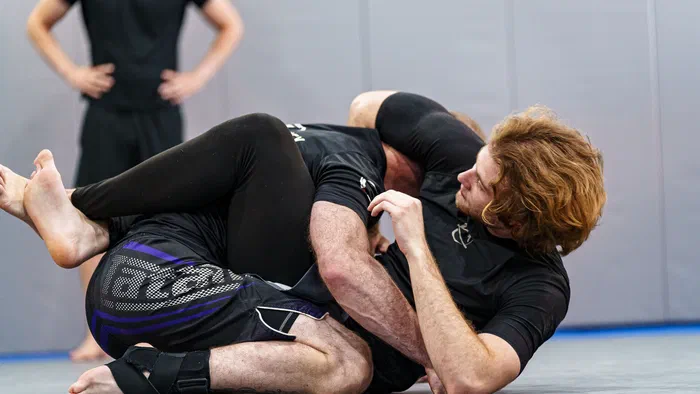
A round of jiu-jitsu is a plan meeting live resistance. Your kid picks a grip. Another child takes it away, right now, on purpose.
He has to swallow the first panic response, drop the plan, and choose a different one. Then it happens again. For an hour.

That is the same react-to-a-live-opponent shape that did best in the ADHD research. Whether it carries over to a kid with no diagnosis and a lockdown gap has never been tested.
Here’s what would have to be true for the hunch to hold. It would take real reps, three times a week over months, not one drop-in. Any gain would most likely land on impulse control, the one area where the proof is steady.
And the size would look like the small nudge from the healthy-kids research, not the big ADHD numbers.
That’s an honest bet, not a promise. If you want the sure-footed version of this case, we made it about a different skill in January . On this one, the proof doesn’t earn that tone yet.
Three things you can try this week

Watch one instruction. Give your child a two-step task with no reminders. “Put your shoes by the door, then bring me your water bottle.” See whether step two survives.
Notice what happens when a plan fails. A Lego set, a lost game, a knot that won’t come out. Does he adjust, or does he stall? That moment tells you more than a report card.
Put him in something with a live opponent three times a week. It doesn’t have to be jiu-jitsu. It has to be hard to predict, so his brain keeps having to re-plan. Drills alone are the version that fell short.
If you want to see what a class asks of a kid
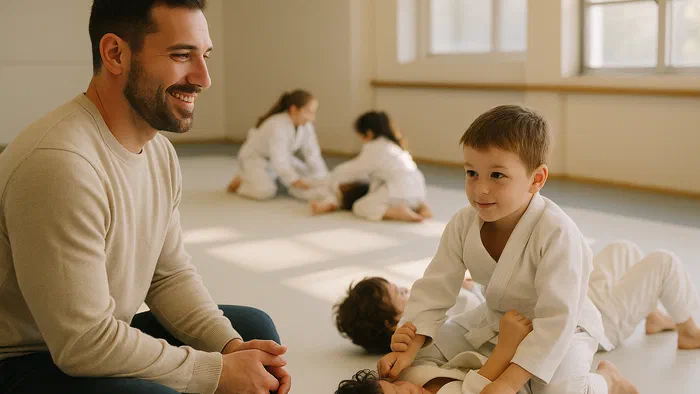
Our kids Brazilian Jiu-Jitsu program in Madison, WI runs late afternoons, Monday through Friday. Class opens with a short warmup, then technique and drilling, then positional sparring, then open rolling.

The 2-week intro is $49 and comes with a free uniform. Two weeks sits well below any dose the research has looked at, so I won’t pretend it’s a fix. It’s a window. Come watch what your kid does when his plan gets taken apart and he has to find another one.
If you’re weighing whether it’s the right age or the right fit, we’ve written about starting early and about coordination over cardio for focus .
- Kids
- Child development
- Research
- Executive function
Ready to Start Your Journey?
Choose the option that works best for you
Call to book: +1 (608) 416-1140