Boxing Is Booming. Here's Why I Still Recommend BJJ.
Boxing is having a moment. A big one.
Netflix streamed Katie Taylor vs. Amanda Serrano to 74 million viewers last summer. Jake Paul turned celebrity boxing into a cultural industry. IBISWorld pegged boxing gym revenue at $1.6 billion in 2025, growing nearly 7% year over year. Your Instagram feed is probably 40% heavy-bag clips right now.
And honestly? Boxing deserves the attention. It’s a legitimate workout, the barrier to entry is low, and Madison has a growing boxing scene – Madison Boxing Gym on Odana Road, Romero’s Boxing School at East Towne Mall, JJ’s Boxing & Wrestling. Accessible, affordable, real instruction. If you’re considering boxing, you have good local options.
So why do I still tell adults to start with Brazilian Jiu-Jitsu ?
Not because boxing is bad. Because when you’re 32 or 38 or 45, choosing a martial art isn’t about which one looks best on a highlight reel. It’s about what your body, your brain, and your life will look like five years from now.
Here’s the honest comparison.
What boxing gets right
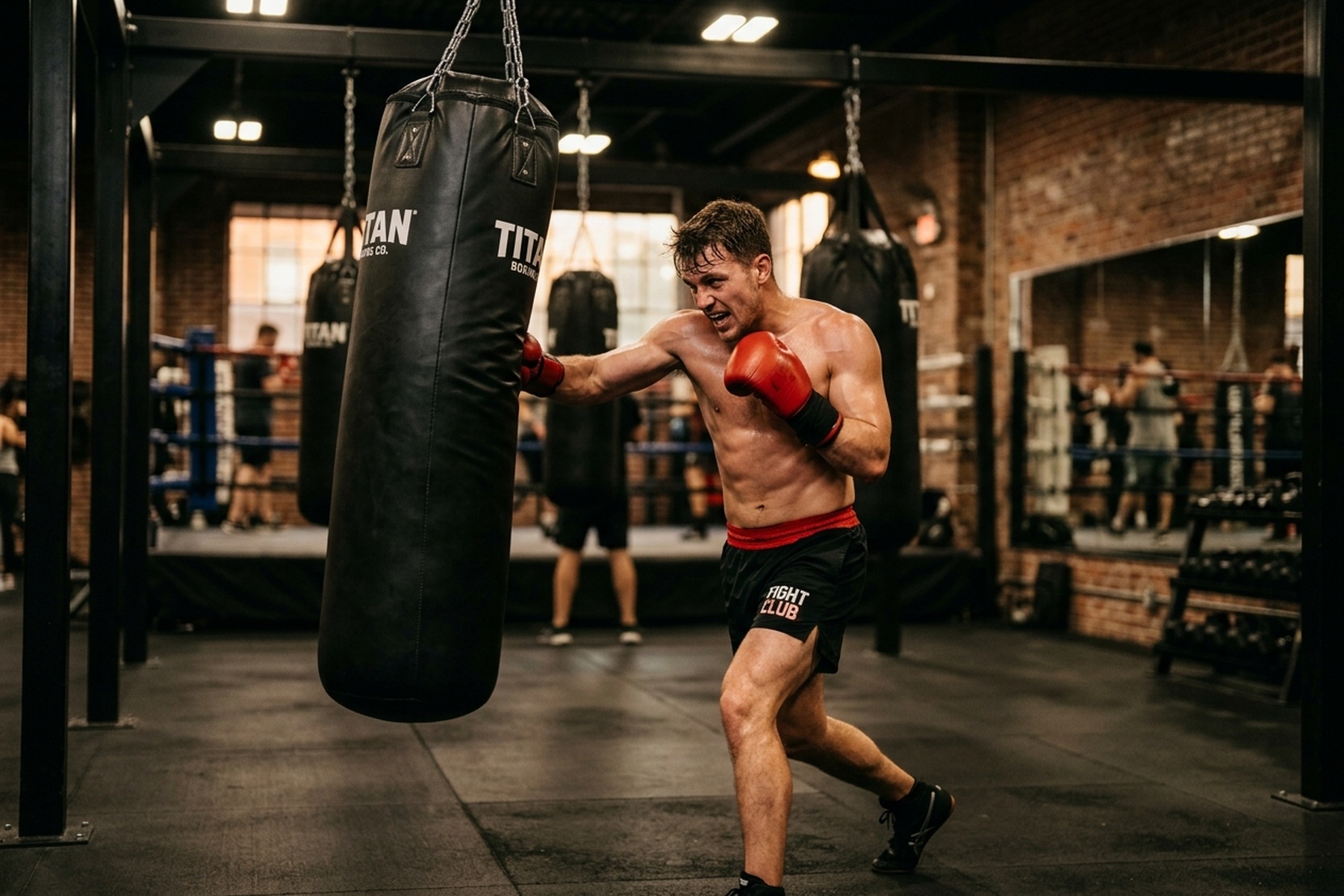
Boxing is a calorie furnace. Sprint-pace rounds on a heavy bag will gas you faster than almost anything else in a gym. The numbers: boxing burns roughly 700 to 900 calories an hour. BJJ ranges from 500 to 1,000 depending on intensity. At comparable effort, they’re roughly equal.
Where boxing has a genuine edge is convenience. Thirty minutes of bag work in your garage, done. No partner needed. Fitness boxing chains like 9-Round and Title Boxing Club have made that even easier – show up, follow the stations, sweat, leave.
But fitness boxing and actual boxing are different things. A 9-Round circuit is scripted. Predetermined stations, predetermined targets. It’s exercise. Fine exercise. But it’s not problem-solving against a thinking opponent. BJJ’s workout is baked into the skill itself. The technique is the exercise.
Five minutes of live rolling – where you spar against a resisting partner – will leave you breathing harder than you expected. And because BJJ uses your entire body (gripping, bridging, hip escaping, inverting), it develops aerobic capacity, anaerobic power, functional strength, coordination, and spatial awareness simultaneously. That translates to other sports, to chasing your kids around the yard, to hauling furniture up a staircase, in ways that punching a bag doesn’t.
Members at Journey BJJ in Madison regularly drop a pant size within three months. Not because BJJ burns more calories – it might not. Because the problem-solving keeps you showing up in month two, when motivation dips and you’d skip a treadmill.
The self-defense question
November 12, 1993. The first UFC event, held in Denver. The matchup that changed martial arts forever.
Royce Gracie, a 176-pound Brazilian Jiu-Jitsu practitioner, versus Art Jimmerson, a professional boxer with a 29-5 record and a Golden Gloves championship. Jimmerson was so confident in his striking that he wore one boxing glove and removed the other – he wanted a free hand just in case, but didn’t believe anyone would get close enough to grab him.
He was wrong. Gracie closed the distance, took Jimmerson down, mounted him, and Jimmerson tapped out in 2 minutes and 18 seconds. The first tapout in UFC history. He never landed a meaningful strike. A world-class boxer, neutralized on the ground in under three minutes by a man who weighed less than him.
That fight proved something that’s still true three decades later: a boxer who ends up on the ground with a grappler has almost nothing to work with. Boxing trains you to hit and avoid getting hit while standing. Genuine skill. But it gives you zero tools for what happens when someone grabs you, tackles you, or pins you against a wall.
Now, you’ve probably heard the claim that “90% of fights go to the ground.” The real number is higher than most critics admit. A black belt named Louie Martin analyzed 154 real street fights from YouTube footage and found that 73% involved ground fighting – and when you exclude quick 10-second knockouts (fights that ended before anyone could close distance), that number rises to 83%. A separate academic analysis by Dr. Bakari Akil II, who reviewed 300 YouTube fights, found that at least one fighter hit the ground in 72% of altercations.
The “90% of fights go to the ground” stat is often cited but the source is fuzzy (LAPD arrest data – cops restraining suspects, not civilian street fights). These independent video analyses put the real number at 72-83%. That’s not a fringe case. That’s the majority.
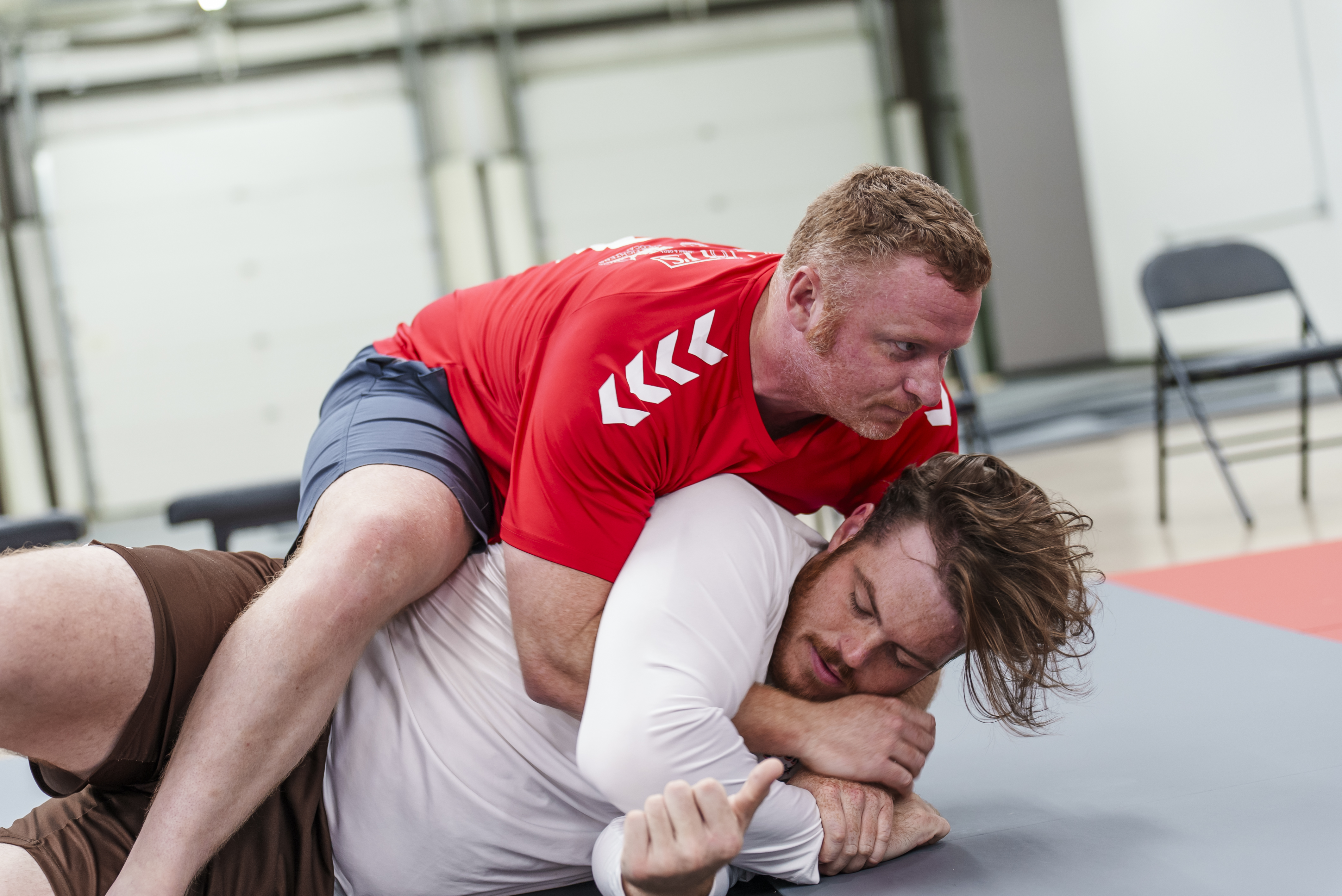
BJJ was designed for exactly that moment . You learn to control another person’s body from every position – on top, on bottom, against a wall. You learn to neutralize a bigger, stronger person without throwing a single punch.
For a 170-pound professional who’s never been in a fight, that’s the gap between having options and having none.
What happens when a boxer fights a jiu-jitsu practitioner?
Statistics tell you fights go to the ground. But what does that look like when a boxer and a BJJ practitioner actually square up?
First, the professional version. Art Jimmerson – 29 wins, Golden Gloves title – wore one boxing glove into the first ever UFC fight. He was that confident in his striking. Watch what happened:
He tapped in 2:18. Never landed a meaningful punch. Now here’s a more casual test: a few young guys on the grass, semi-contact, punches allowed, no referee stepping in to stand them up. Three different BJJ practitioners against a boxer.
Watch it. The pattern repeats.
The reason is structural. A boxer’s power comes from distance and hip rotation behind a straight line. The moment someone grabs them and puts them on the ground, those mechanics vanish. They’re a fish in a tree. A BJJ practitioner doesn’t need distance at all – the clinch and the ground are home. That’s where every technique works best, and it’s precisely where a boxer has zero training.
This isn’t a knock on boxing. In a boxing ring with a referee and rules about clinching, the boxer wins. Obviously. But in an unregulated scuffle where someone can close distance and grab you, the grappler holds a structural edge that skill alone can’t overcome.
One caveat: a boxer who cross-trains takedown defense changes this equation. This is about pure forms – what each art gives you when it’s all you’ve got.
What happens in your brain
Here’s where the conversation gets serious.
A 2020 study in The Physician and Sportsmedicine reviewed 60 professional boxing and MMA fights on video. Researchers found a probable concussion in 47 of 60 bouts. In boxing specifically, physician reviewers judged that 37% of fights should have been stopped earlier than they were. The fighter who sustained the first concussion lost 98% of the time – meaning the damaged fighter kept absorbing shots.
That’s professional competition. Recreational boxing gyms don’t spar at that intensity. But even “light sparring” involves getting hit in the head, repeatedly, over months and years. Research on chronic traumatic encephalopathy shows that repeated subconcussive blows – hits that never cause a diagnosed concussion – still accumulate brain damage over time. Your brain doesn’t need a knockout to get hurt. It needs repetition.
BJJ is pure grappling. No punches. No kicks. No strikes to the head. The most common injuries are joint sprains and strains – fingers, elbows, knees. Those heal. Your brain doesn’t get a second chance .
If you’re a working professional in Madison with a mortgage, kids, and a job that requires clear thinking, the risk calculus is different at 35 than at 19.
A note for parents
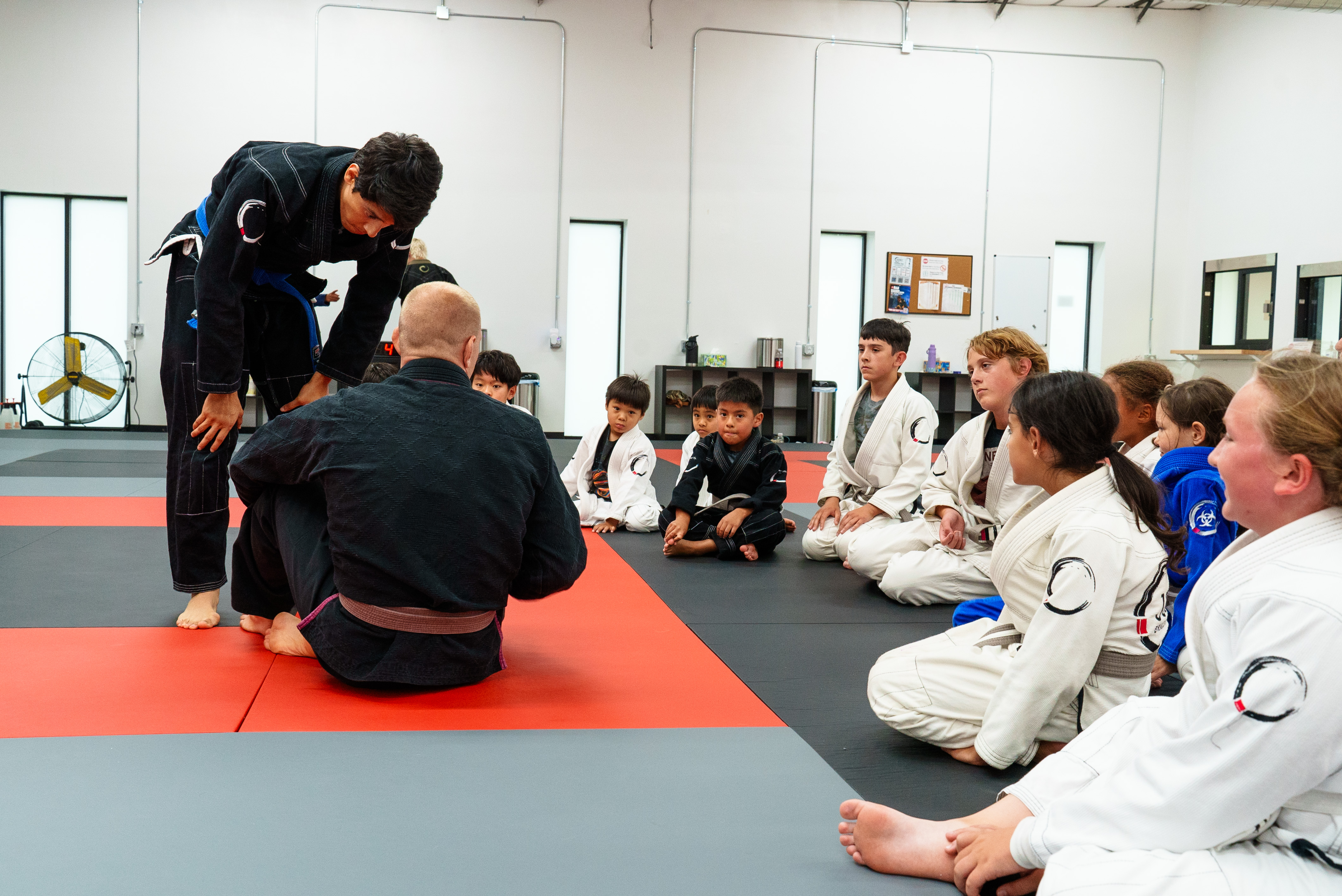
This applies double for children. A developing brain is more vulnerable than an adult one, and the research is sobering: studies published in PMC and consistent with CDC findings show an average loss of 1.62 IQ points per fight-related head injury in boys, and 3.02 in girls. Even recreational sparring accumulates subconcussive blows over time.
There’s the practical side too. A child who knocks another child unconscious – even during controlled practice, even at a sanctioned competition – faces suspension, possible expulsion, legal scrutiny, and psychological fallout on both sides. BJJ teaches kids to control a situation, not escalate it. Submission grappling rewards technique over aggression. A child who trains BJJ learns to restrain, to pin, to stop – not to knock someone out. That distinction matters in a school hallway as much as it does on a competition mat.
The legal reality nobody discusses

U.S. self-defense law doesn’t categorically distinguish a knockout from ground control. Both are subject to proportionality. So this isn’t a legal argument that one art is safer in court. It’s a practical one.
Picture this: you’re at a wedding. A friend’s cousin has had too many drinks and is getting aggressive. Not violent – just loud, grabby, escalating. You need to handle it.
A knockout is wildly disproportionate. Someone hits the ground, the back of their head bounces off concrete, someone calls the police, and you’re standing over an unconscious person at a wedding. Heads that hit concrete can die. You threw one punch to end a nuisance, and now someone’s in the ICU.
Ground control is different. You clinch, take him down, pin him, hold him until he calms down or someone helps. Nobody gets brain damage. Nobody goes to the hospital. The situation ends.
On the street, both arts have value. But BJJ gives you something boxing can’t: a dial instead of an on/off switch. You can hold someone down without hurting them. You can apply a submission as a threat without finishing it. You can control the situation and wait for it to de-escalate.
That flexibility matters because most situations that get physical aren’t clear-cut assaults. They’re messy, ambiguous, and heavily scrutinized after the fact.
Solo training vs. community
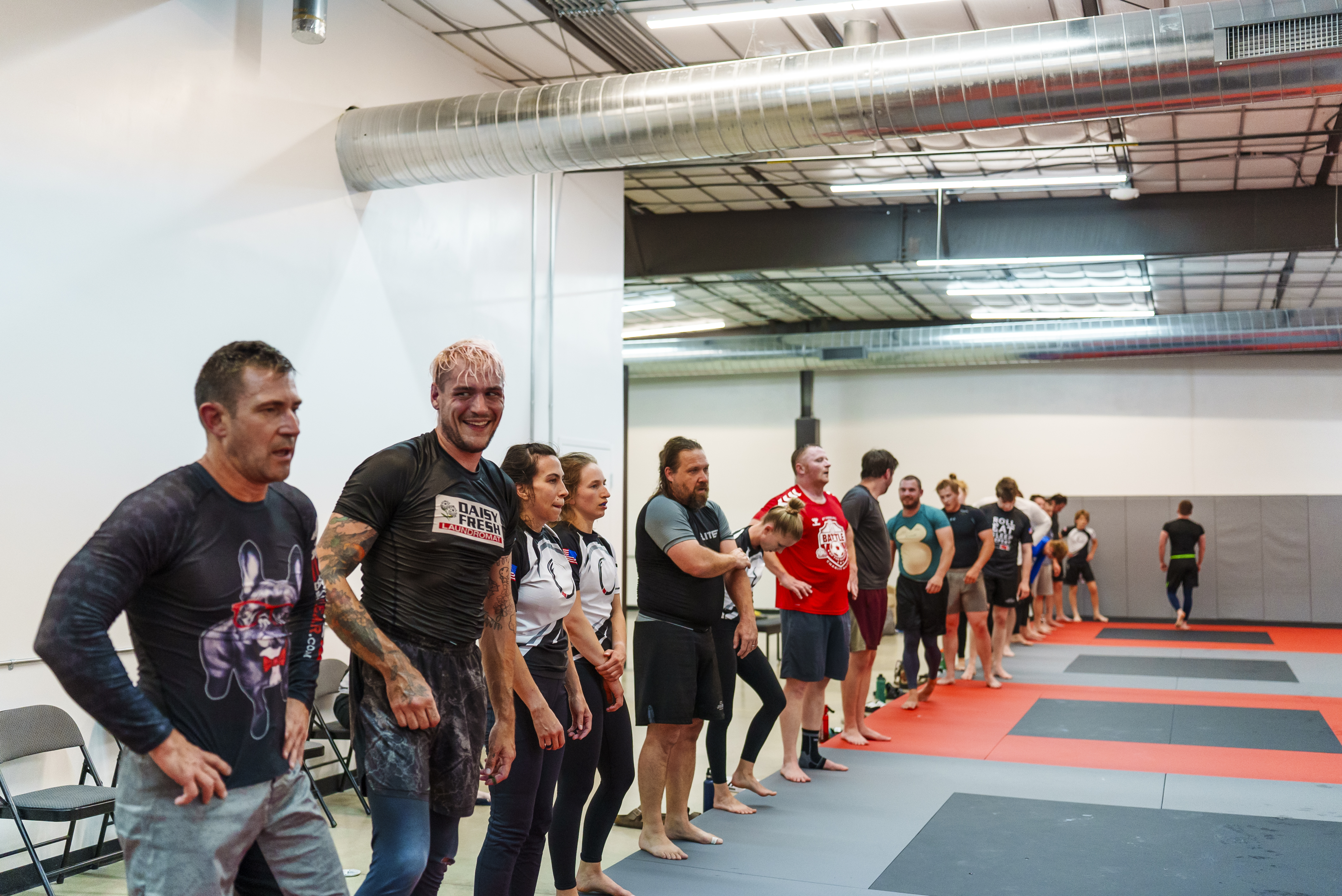
Madison ranks second nationally in physical fitness but 95th in mental health , according to a 2024 Capital Times report. Madisonians are active people. But activity alone isn’t solving the stress, anxiety, and isolation many adults carry quietly.
Boxing is a solid stress release. Hitting a heavy bag after a tough day feels cathartic. But it’s overwhelmingly solo. You, the bag, your playlist, your headphones. Shadow boxing is solo. Bag work is solo. Jump rope is solo. Sparring is the one partnered element, and many recreational boxers avoid it entirely.
Fitness boxing is lonelier still. 9-Round is a solo circuit at your own pace. Title Boxing Club is a group class where you’re hitting your own bag. Nobody depends on you being there. Nobody notices if you stop coming.
BJJ is the opposite. You cannot train alone. Every drill has a partner. Every roll is a physical conversation where you problem-solve together. You can’t zone out. You can’t be anywhere except the mat, right now, reacting to what your partner just did. A 2020 study in the Sociology of Sport Journal identified this involuntary mindfulness as a specific mental health mechanism for men practicing jiu-jitsu. Your brain literally cannot ruminate when it’s busy surviving a guard pass.
And then there’s what happens off the mat. Rolling with someone three times a week builds a relationship that running on parallel treadmills never will. Members at Journey BJJ text each other outside class. They celebrate each other’s belt promotions. They show up for each other’s kids’ birthday parties. That kind of belonging is rare for adults , and it happens here almost by accident. We’ve written about the friendship crisis among men before – BJJ solves it without ever talking about it.
Women: what the data actually shows
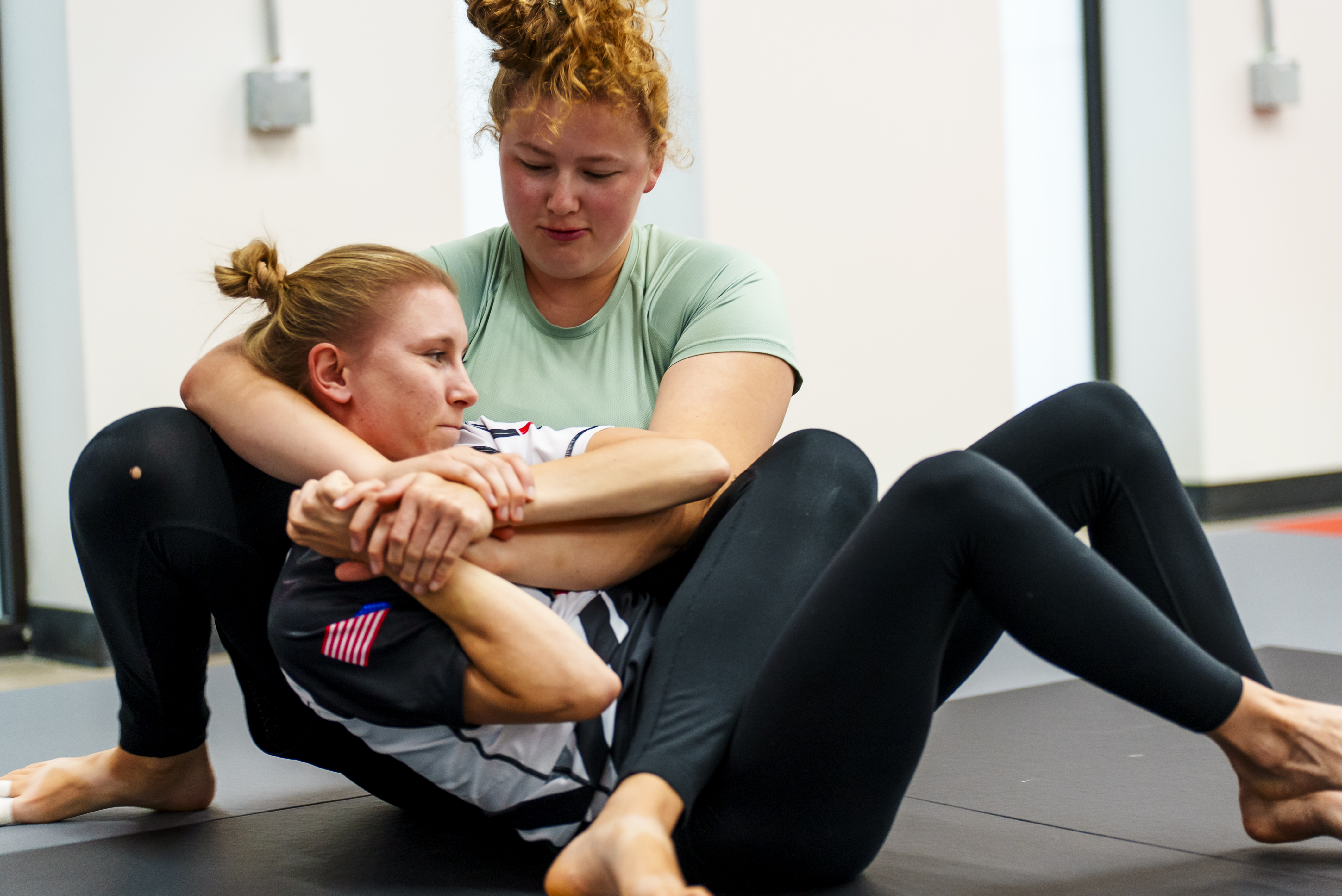
Fitness boxing is growing among women, and for good reason. Title Boxing Club and 9-Round are welcoming, structured, and effective cardio. I don’t have data showing BJJ outpaces boxing for women’s participation. I’d be making that up.
What I can say is what BJJ offers women that fitness boxing doesn’t.
Real self-defense skill. Not “fitness that looks like fighting” but actual technique for controlling someone larger and stronger. Sydney Sweeney trained grappling for six years at a 99% male gym and won her first tournament. The technique is the equalizer, not the size.
Safety during training. BJJ’s tap culture means you can stop any exchange, instantly, with no stigma. In boxing, “light sparring” still means getting hit. In BJJ, the submission is a question: Do you concede? And the answer is always respected. Our women’s BJJ classes are built on this – women training with women, same techniques, same rigor.
Technique that scales independently of weight class. A 130-pound woman who understands frames, leverage, and hip escapes can neutralize a 200-pound untrained man. Not through strength. Through physics. That’s why women who start BJJ tend to stay.
Progression vs. fitness
Boxing’s competitive path narrows fast for recreational adults. You can get good at hitting pads. You can spar. But the progression structure is loose. There’s no widely recognized ranking system marking your development over years.
BJJ has a belt system that takes a decade to complete. White, blue, purple, brown, black – each with four stripes. That’s 20 distinct milestones between your first class and your black belt, every one earned on the mat against people trying to stop you.
For adults who’ve lost the structured accountability they had in school or college sports, that progression is the difference between “I work out” and “I’m building something.” I’ve watched 40-year-olds tear up at blue belt promotions because they hadn’t earned something through pure effort and persistence in years.
Boxing can keep you fit. BJJ gives you a decade-long project with visible progress markers. Those are different propositions, and if you know yourself well enough to know you need external structure to stay consistent, that matters.
The cost
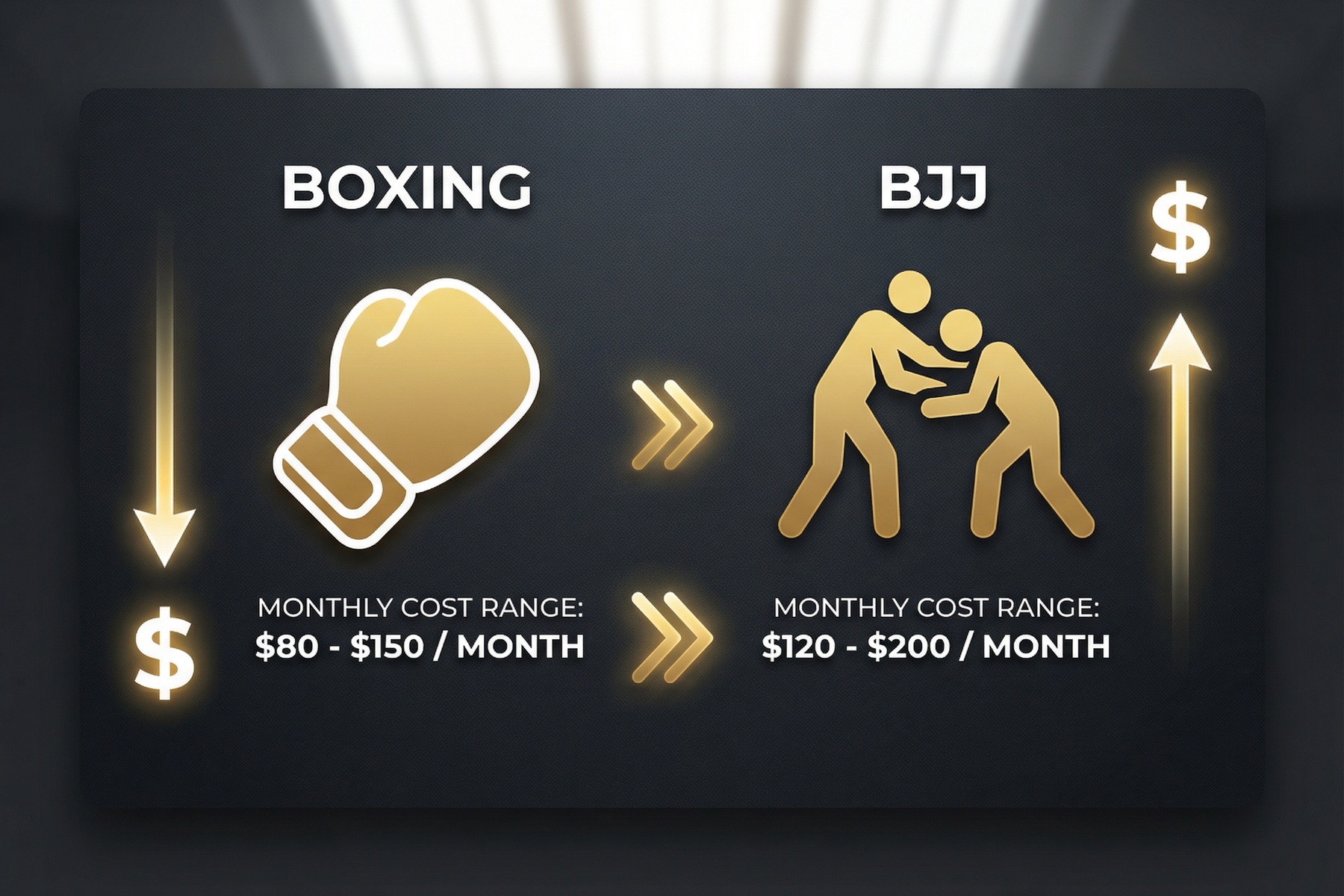
Let’s talk money, because this is Madison and people are practical.
Local boxing pricing (verified 2025):
- Madison Boxing Gym (Odana Rd): $140-$160/month, unlimited classes
- Romero’s Boxing School (East Towne Mall): $10/class or $75/month
- JJ’s Boxing & Wrestling: $15/class with multi-packs available
- Fitness boxing (9-Round style): typically $50-$100/month for scripted circuits
Journey BJJ: roughly $16.50 per class.
Pay-per-class boxing at $10-$15 undercuts BJJ per session. Some unlimited boxing memberships are cheaper per month too. I’m not going to pretend otherwise.
But what are you getting? A fitness circuit is scripted cardio. Romero’s at $10 a class is genuine boxing instruction – real value. BJJ at $16.50 gives you a living skill set that adapts to a thinking opponent, a training community that depends on your presence, and a progression system that spans a decade. The comparison isn’t price per hour. It’s value per year.
The bottom line
I’ve been fair to boxing through this whole piece, and I meant to be. It’s a real workout. It’s a real skill. The people teaching it in Madison are legitimate.
But when someone walks into our academy and asks me which martial art to start with, I can’t sidestep the full picture.
Head trauma is the differentiator I keep coming back to. Every boxing session that includes sparring puts your brain at risk. Not catastrophic, single-event risk – slow, cumulative, subconcussive damage that compounds over years and never fully reverses. BJJ involves zero strikes to the head. Zero. For a working professional whose career depends on cognitive function, whose kids need a parent who’s sharp at 55 and 65 and 75, that’s not a footnote in this comparison. That’s the reason this article exists.
And the gaps go beyond brain safety. BJJ gives you self-defense on the ground, where one in three real fights end up and where boxing gives you nothing – ask Art Jimmerson, who tapped in 2:18 with a 29-5 pro record. It gives you a community where people depend on you showing up, not a solo circuit you can ghost. It gives you legal flexibility – the ability to control a drunk relative at a wedding without putting them in the hospital. It gives you 20 milestones over a decade instead of unstructured improvement. And for women, technique that neutralizes size through physics, not fitness that mimics fighting.
Boxing burns calories. BJJ changes how you handle the rest of your life.
You don’t need to be in shape first. (Seriously. ) You don’t need to know anything. You walk through the door.
Try our intro program – it includes a free uniform. Or if you want to talk it through first, book a free consult with Coach Alex. We’re at Journey Brazilian Jiu-Jitsu Academy in Madison, WI. Come see what the mat feels like.
- Boxing
- Comparison
- Self defense
- Fitness
- Adults
- Madison
Ready to Start Your Journey?
Choose the option that works best for you
Call to book: +1 (608) 416-1140