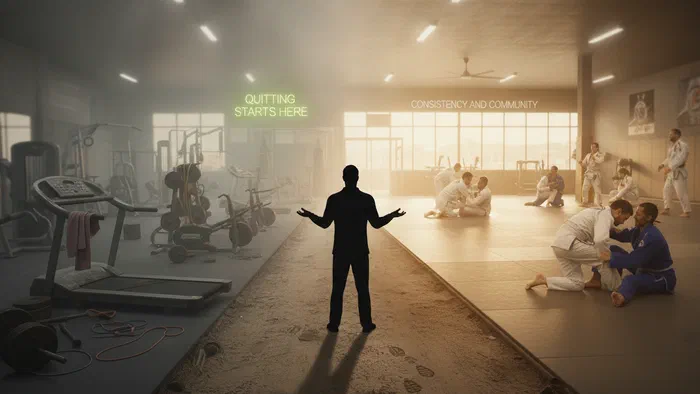
You don't need to find the right thing. You need to survive the hard part of one thing.
You’ve done this before.
You signed up for something. A gym, a running program, a climbing membership, a martial arts class. The first few weeks were electric. You bought the gear. You told your friends. You went three, four times a week.
Then somewhere around month two, the shine wore off. Workouts stopped feeling like progress and started feeling like work. You missed a session, then two. You told yourself you’d get back to it, and maybe you did for a week. Then you quietly canceled.
A few months later, you found something new. And the cycle started over.
If that sounds familiar, you’re not broken. You’re experiencing one of the most well-documented phenomena in behavioral science. Understanding it might be the difference between spending the next decade cycling through activities and actually getting somewhere with one.
The quit point has a name (several, actually)

Researchers across multiple fields have independently identified the same pattern: a predictable moment when learning turns painful and most people bail.
The Gordon Training International model calls it Conscious Incompetence . It’s stage two of four. Stage one is bliss: you don’t know what you don’t know, so everything feels exciting. Stage two is where you suddenly see the gap between where you are and where competent people are. Your confidence craters. Most people interpret this as a signal that they chose wrong.
They didn’t. They hit the part where learning actually begins.
Seth Godin wrote an entire book about this moment. He calls it The Dip : the long slog between starting and mastery. His argument is simple. Winners don’t avoid dips. They push through the right ones and quit the dead ends. The problem is that most people do the opposite: they quit dips (which are temporary) and keep grinding through dead ends (which aren’t going anywhere).
Psychologists studying the Dunning-Kruger effect (where beginners overestimate their ability because they don’t yet know what they don’t know) mapped the emotional trajectory in detail. Beginners start with a confidence spike. Then confidence plummets as they realize the skill’s actual depth, even while their real competence rises. Researchers sometimes call this the Valley of Despair. It’s the gap between feeling good and getting good. Almost everyone who quits does it here.
Your brain is wired to chase the new thing

Here’s what makes this worse: quitting feels productive.
A 2020 study published in eLife found that some participants preferred actual thermal pain over sustained cognitive effort. Sit with that for a second. Physical discomfort was more tolerable than the mental strain of working through something hard. The researchers at McGill University concluded that the brain’s resistance to sustained effort runs deeper than anyone assumed.
Your brain compounds the problem with novelty bias. New activities trigger dopamine surges. Your brain loves novelty because, evolutionarily, exploring new environments and resources kept your ancestors alive. But that same wiring means the brain’s reward response fades as an activity becomes familiar. Psychologists call this hedonic adaptation. The hobby didn’t change. Your neurochemistry did.
So you quit the thing that stopped giving you a dopamine hit and start something new. The dopamine floods back. You feel motivated again. But you haven’t solved anything. You just reset the clock on the same cycle.
The fresh start trap

Behavioral scientists Hengchen Dai and Katherine Milkman identified something that makes this cycle even stickier. In a 2014 study in Management Science , they documented what they call the Fresh Start Effect: temporal landmarks like New Year’s, Mondays, and birthdays create surges in motivation for new goals. People psychologically separate from their “imperfect past self” and feel energized to begin again.
That energy is real. It’s also a trap. Because starting fresh is easier than continuing something uncomfortable. Every restart feels like progress. But if you keep restarting, you keep landing in the same place: the exciting early weeks of something you’ll abandon when it gets hard.
Think about your own history. How many times have you said “this time will be different”? Not because the activity was wrong, but because starting feels so much better than continuing.
What if the problem was never the activity?

Here’s the part that changed how I think about this.
Look at dropout data across activities that have nothing in common. About 80% of gym members quit within five months . Online guitar instruction sees 98% dropout between lesson one and lesson ten. In martial arts, only about 1 in 100 BJJ students who start will earn a black belt. For comparison, 10-30% of karate students and 15-20% of taekwondo students reach their black belt . BJJ has the steepest curve of any major martial art.
The dropout rates are remarkably consistent across all of them. And the only thing they share is this: they all get hard at roughly the same point.
That’s the tell. If the problem were “finding the right activity,” you’d expect retention to vary widely. Some activities would keep people because they’re inherently more enjoyable. Instead, nearly every skill-based pursuit loses most of its participants at the same stage: when conscious incompetence kicks in and the honeymoon dopamine fades.
You didn’t try five wrong things. You hit the same wall in five different activities, and each time you blamed the activity instead of recognizing the wall.
The cost of exploring everything

Decision scientists study something called the exploration-exploitation tradeoff. Exploring means trying new options. Exploiting means committing to what you’ve found and extracting its full value. Research from Princeton and UC San Diego found that people chronically over-explore: we sample too many options and commit to too few, forfeiting roughly 30% of potential value in the process.
Applied to fitness: every time you restart, you pay a switching cost. You lose the skill you’d built. You lose the relationships you’d formed. You go back to square one and re-enter the honeymoon phase, which feels good but produces nothing lasting.
The math is punishing. Five activities, each abandoned at month three, gives you fifteen months of beginner-level experience. One activity pursued for fifteen months puts you past the dip, past the valley, into the phase where training builds real toughness and the compound returns start showing up.
James Clear calls this the Plateau of Latent Potential. Picture an ice cube in a cold room. You raise the temperature one degree at a time. Nothing happens at 26, 27, 28 degrees. The effort looks wasted. Then at 32 degrees, the ice melts. The work was accumulating the entire time. But you only see results after the phase transition.
Most people quit at 31 degrees.
Why community changes the equation

Here’s where this stops being abstract.
A 2025 study in Cognition found that curiosity overrides the urge to avoid hard work. When people genuinely cared about a problem, they willingly pushed through difficulty they’d normally walk away from. The researchers found that engagement, not willpower, is what beats the brain’s preference for the easy path.
Research on what drives lasting motivation points to three conditions that have to be present together:
- You chose it yourself (not forced by a spouse, a doctor’s warning, or a New Year’s resolution you half-believed)
- You can see you’re getting better, even slowly (a stripe on your belt, surviving 30 seconds longer, remembering a technique name)
- You belong to something (people know your name, someone asks where you were last Tuesday)
When all three are in place, people push through hard stretches. When any one drops out, motivation starts to collapse. And the one that drops out most often? Belonging. Because solo fitness loses to community-based training for exactly this reason. Running alone, you might have choice and a sense of progress. But when the dip hits, there’s no one to pull you through. No one notices when you skip a week. No one texts asking where you were.
In a training community, quitting has social friction. Not guilt or pressure. Connection. The people you train with remember your name. Your training partners notice when you miss class. Your coach tracks your progress. That web of small relationships is, according to the research, the single strongest lever for persistence through difficulty.
Four tools for surviving the hard part

I should be straight with you. “Just push through” is incomplete advice. But the research offers something better than a pep talk. There are specific, tested tools that change how your brain responds to difficulty. Here are four of them.
Reframe struggle as learning
This is the foundation. A study of goal structures and perseverance found that when people learn to interpret difficulty as a signal that they’re learning (rather than a signal that they’re bad at it), their persistence measurably improves. Angela Duckworth’s “I CAN” intervention at the Carnegie Foundation attacks a specific false belief: that practice should feel smooth. It doesn’t. Practice feels like grinding. If you’re struggling, that’s the process working. The moment you believe that, you spend more time in deliberate practice instead of running from it.
In BJJ, this clicks fast. You drill a sweep fifty times and it still feels clumsy. Then in a live roll, your body does it without thinking. The clumsiness was the learning.
Call yourself a practitioner, not someone who practices
This one surprised me. Daphna Oyserman’s identity-based motivation research at USC found that when people identify AS something (“I am a jiu-jiteiro”) rather than someone who does something (“I do jiu-jitsu”), persistence increases dramatically. Identity framing makes struggle feel non-negotiable. You don’t debate whether to show up when it’s part of who you are, the same way a runner doesn’t debate whether to run.
Make an “if-then” plan for the moment you want to quit
A meta-analysis in Frontiers in Psychology found that combining mental contrasting (imagining the goal AND the obstacles) with implementation intentions (specific if-then plans) reliably improves goal attainment. In practice: “IF I feel like skipping class because I got tapped fifteen times yesterday, THEN I will text my training partner and say ‘see you at 6.’” The plan has to be specific and daily. One-time intentions fade. Daily if-then rules become reflexes.
Treat community as belonging, not monitoring
Social accountability works, but not the way most people think. It’s not about guilt or someone checking up on you. Research on dropout prevention found that when the hard phase is framed as a shared experience (“everyone here hit this same plateau”), persistence increases. The biggest dropout risk isn’t someone who’s struggling. It’s someone who’s struggling alone without any clarity about why it’s hard. When you know the dip is normal, and you see other people in various stages of surviving their own, the whole experience changes. You stop interpreting difficulty as a personal failing and start seeing it as a community rite of passage .
The dip vs. dead end distinction still matters here. A dip responds to effort: each month, you’re slightly better, slightly more capable. A dead end doesn’t respond no matter how long you grind. Brazilian Jiu-Jitsu is a dip. Every class builds pattern recognition, physical literacy, problem-solving under pressure. A treadmill at a big-box gym can become a dead end: same motion, same stimulus, no skill development, no community to anchor you when it gets tedious. Know which one you’re in.
What this looks like in Madison
If you’re reading this and you’ve cycled through a gym membership, a running phase, maybe boxing , maybe CrossFit, here’s what I’d suggest.
Stop looking for the activity that stays fun. None of them will. Fun is the honeymoon phase, and it ends. What you’re looking for is an activity where the hard part is worth enduring: where you build real skill, other people are in it with you, and discipline carries you after motivation fades .
At Journey BJJ in Madison , we see this pattern constantly. Someone walks in nervous, has a blast for three weeks, then hits the conscious incompetence wall around month two. They’re getting tapped by everyone. The techniques feel clumsy. Their body is sore in new places.
This is the fork. And the people who stay are rarely the most athletic or the most talented. They’re the ones who have a community pulling them forward. A training partner who says “see you Tuesday.” A coach who spots them refining a sweep. Small signals that say: the hard part is temporary, and you’re not going through it alone.
At Journey, the average time to blue belt is 1-2 years. The national average is about 2.3 years . We get students there faster because of structured curriculum and consistent coaching. That’s still a long dip. But the people who make it describe the same thing: somewhere around month six or seven, something clicked. Rolls stopped feeling like drowning and started feeling like problem-solving. They weren’t a different person. They’d survived the part where most people quit.
You don’t need five activities. You need one, and the willingness to stay when it stops being easy.
What to do this week
If this article described your pattern, you have two choices.
The first: try the 2-week intro at Journey BJJ for $49 (includes a free uniform). And no, you don’t need to get in shape first . Come in knowing the first session will be uncomfortable and the second month will be harder than the first. Come anyway. The research says that if you survive months two through six, the returns compound.
The second: if you’re not ready to commit, book a free consult with a coach. Ask questions. Get a sense of whether this is a dip worth entering. No pitch, no pressure.
Either way, stop restarting. The thing you’ve been looking for is on the other side of the hard part you keep avoiding.
- Behavioral science
- Quitting
- Fitness
- Brazilian jiu jitsu madison
- Self discipline
- Habit formation
Ready to Start Your Journey?
Choose the option that works best for you
Call to book: +1 (608) 416-1140