Madison's Spring Registration Opens April 6. Here's What Youth Sports Actually Cost.
MSCR general summer registration opens Monday, April 6 at noon. If you have school-age kids in the Madison Metropolitan School District, you already know the drill: set a phone alarm, open the laptop, hope you land a spot in one of the 150+ weekly camp sessions before they fill.
But this year, before you click “register,” look at a number.
$1,016.
That’s the average American family’s annual spend on a single child’s primary sport in 2024, according to the Aspen Institute’s Project Play 2025 survey . Up 46% from 2019. And here’s the part that really stings: most of these sports are seasonal. You’re paying that for 2-3 months of soccer, a summer of baseball, one hockey season. Not year-round activity. If your kid plays more than one sport (and most do), bump that closer to $1,500. If you live in the suburbs, which most Madison families functionally do, the average climbs to $1,552 per child per year .
Spring is when these decisions get made. You’re choosing what your kid does all summer and, often, which activity carries into next school year. So let’s talk honestly about what things cost and what you’re actually getting for the money.
The youth sports cost explosion

The numbers from Project Play aren’t abstract. They track with what Madison parents tell me every week.
Youth sports in the US is now a $40 billion annual industry . Twice the revenue of the entire NFL. Over the past five years, individual sport costs have spiked hard: basketball is up 105%. Soccer, 69%. Baseball, 68%. And those are national averages for seasonal sports, most running 2-4 months at a time. Competitive club programs in metro areas run higher.
A January 2026 Washington Post investigation followed one Florida family paying $3,000 in annual team fees for club baseball. When they added up travel, hotels, equipment, and private coaching, the real number topped $8,000. Just trying out for some competitive teams cost $50+.
The financial pressure hits home. According to CNBC , 56% of parents worry they won’t be able to afford their kids’ sports next year. Nearly 60% describe youth sports as a financial strain. About one in five parents have gone into debt to keep their child playing.
The costs you don’t see at signup

Registration fees are the door. Here’s where the real money goes, and why so many parents feel blindsided by October:
Travel. Club soccer, travel baseball, competitive hockey. Weekend tournaments in Milwaukee, Chicago, Minneapolis. Hotels, gas, meals on the road. Some families log 15-20 travel weekends per season.
Equipment replacement. Kids grow. A hockey kit that fit in September won’t fit in February. Cleats, shin guards, bats, helmets: the replacement cycle never stops.
Private coaching and camps. Once your kid is on a competitive team, the unspoken expectation is extra training. Hitting coaches, pitching coaches, speed-and-agility clinics. None of it is included in registration.
Tournament entry fees. Separate from team dues. Often $50-$150 per event, several times per season.
Fundraising obligations. Many travel teams require families to sell, volunteer, or pay a buyout fee.
Stack those up and you understand why the gap between the registration fee and the actual annual cost is so wide. Hockey is the starkest example: registration might run $634, but total annual costs hit $2,583 to over $17,000 depending on the level. Lacrosse ranges from $1,510 to $17,500. Even recreational soccer lands around $1,472 once you add gear, indoor winter leagues, and a tournament or two.
An honest cost comparison (BJJ included)

I run a kids’ Brazilian Jiu-Jitsu program in Madison , so yes, I’m biased. But I also believe parents deserve real numbers instead of marketing spin. Here’s what BJJ actually costs compared to the most popular youth sports:
| Sport | Annual cost range | Seasonal or year-round? | Hidden cost drivers |
|---|---|---|---|
| Ice Hockey | $2,583 - $17,000+ | Seasonal (travel required) | Equipment, ice time, travel |
| Lacrosse | $1,510 - $17,500 | Seasonal (travel required) | Equipment, club fees, travel |
| Club Soccer | $1,472 - $10,000+ | Seasonal (travel moderate) | Indoor seasons, private coaching |
| Travel Baseball | $1,500 - $8,000+ | Seasonal (travel heavy) | Showcases, private coaching |
| Brazilian Jiu-Jitsu | $2,350 max | Year-round (local only) | Replacement gi ($89) when kids outgrow theirs |
At Journey, BJJ runs $45/week. If your child trains three times a week, that’s $15 per class. The most a family would pay annually is around $2,350, and that covers 12 full months of training, not a 2-3 month season.
The first gi (the training uniform) is free with our 2-week intro. Belt tests are free. There are no testing fees, no equipment packages, no surprise invoices. When your kid outgrows their gi (and they will), a replacement costs $89. That’s the only additional expense.
If your child wants to compete, local tournaments run $80-100 per event and are usually within an hour’s drive. Competition is always optional and never required for advancement.
The difference isn’t the total dollar amount. It’s what the money covers and for how long.
What the money buys

Three things separate BJJ from most youth sports once you look past the sticker price.
The costs are predictable. Weekly tuition covers everything: classes, instruction, mat time, rank testing. No second invoice in October for a tournament you didn’t know about. No fundraising minimum. No “optional” clinic that turns out to be mandatory if your kid wants to make the A team. You know what you’re paying in April and what you’ll pay in November. Same amount, because it’s the same program running 12 months straight.
There’s no travel requirement. Every class happens at the same location in Madison . No weekend road trips. No hotel blocks. No coolers packed at 5 AM. If your kid wants to compete at a local tournament, that’s their choice. Events are typically within an hour of Madison. Competition is never required for advancement.
Year-round consistency. This is the one that gets overlooked. Seasonal sports stop. The routine breaks. Your kid spends two months on the couch, then starts from scratch in the next season. BJJ doesn’t have an off-season. Your child’s routine stays consistent. Your schedule stays consistent. The skills compound month after month instead of resetting every time a season ends.
What team sports do offer (being honest)

I’d be lying if I said BJJ replaces everything traditional team sports provide.
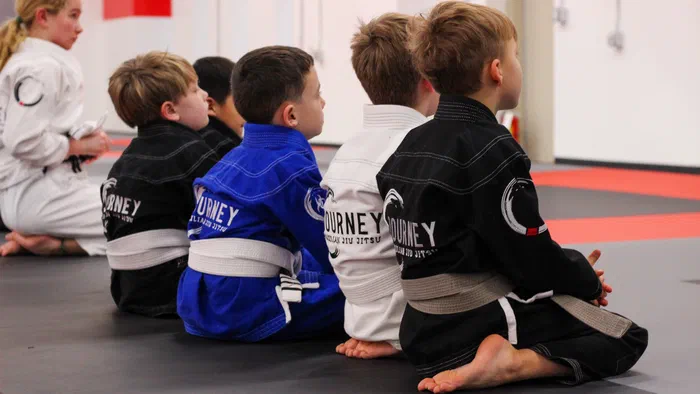
Team sports teach kids how to function as part of a unit. How to cover for a teammate, how to lose together, how to celebrate someone else’s win. Those are real skills. BJJ develops many of the same instincts, just differently. At Journey, kids train together, compete together, and celebrate each other’s promotions. Your child’s training partners on the mat are their team. The matches themselves are individual, but the preparation, the encouragement, the identity? That’s a team. It looks different from a soccer squad, but the bonds are just as real.
There’s also the college recruitment question. Parents of serious athletes think about this. The odds are long for any sport: fewer than 7% of high school athletes play at the college level, and full-ride scholarships are rarer still. But the pathway exists for traditional sports in a way it doesn’t yet for BJJ.
So I’m not telling you to pull your kid from soccer. I’m asking you to compare what you’re paying to what you’re getting, and to consider whether a different kind of activity might fill gaps that seasonal team sports leave open.
The gaps seasonal team sports leave open
Here’s what I see with kids who come to us after years in travel sports. It lines up with what researchers are finding about why 70% of kids quit organized sports by age 13 :
No individual progress measurement. In team sports, a kid can practice all season and never know if they personally improved. Did they get better, or did the team just win more? In BJJ, your child earns stripes and belts through demonstrated skill. You can both see exactly where they stand and how far they’ve come. And they earn those stripes alongside their teammates, who cheer every promotion.
Specialization pressure starting too young. Travel teams increasingly demand year-round commitment from kids as young as 8 or 9. BJJ works the other direction: kids build a broad physical foundation (balance, coordination, body awareness, flexibility) that transfers to any sport they play.
No safe way to handle physical confrontation. Soccer teaches your kid to dribble. Hockey teaches them to skate. Neither teaches them what to do when someone grabs them on the playground. BJJ gives kids practical self-defense skills and the confidence to handle physical situations without throwing punches. That’s a life skill no ball sport addresses.
No protection against the bench. If your kid isn’t the most talented on the roster, they play less. In BJJ, less experienced students often get more attention, not less. Every child trains every class , and the team rallies around the newest members instead of sidelining them.
More Madison families are figuring this out
The trend is clear. According to industry data , 6.8 million American kids ages 6-17 participate in martial arts. Teen participation (ages 13-17) jumped 12% year over year. The kids’ martial arts market hit $1.8 billion in 2023 and is growing at 5.9% annually.
Parents are arriving at the same conclusion the cost data supports: there’s a category of youth activity that delivers individual development, real physical skill, and structured progression without the financial chaos of travel sports.
We see this at Journey. Five years ago, most of the kids walking through our door came from martial arts backgrounds or had parents who trained. Now the majority come from soccer, baseball, and hockey families. Their parents aren’t anti-team-sports. They’re looking for something that complements what their child already does, or replaces an activity that stopped being worth the cost and the calendar chaos. The shift isn’t theoretical. It’s happening in our lobby every week.
If you’re comparing options this spring, we put together a complete comparison of kids’ martial arts programs in Madison that covers styles, pricing, and what to look for. If you’re weighing karate versus BJJ specifically , we wrote an honest breakdown of that too.
Spring is when this decision gets made
MSCR registration opens April 6. Travel teams hold tryouts in April and May. Rec leagues are taking enrollment now. This is the window where Madison families decide what their kids do for the next six months.
If you’re doing the math on youth sports costs and wondering whether there’s an option that’s predictable, year-round, locally based, and doesn’t require spending every weekend in a hotel, you should see what a kids’ BJJ class looks like.
Our Kids 2-Week Intro is $49 and includes a free uniform. Your child trains alongside other beginners while you watch from the viewing area. No contracts. No pressure.
Reserve your child’s spot for $49, or meet your child’s coach first. Either way, do it before spring fills up.
- Youth sports cost
- Madison
- Spring registration
- Kids bjj
- Mscr
Ready to Start Your Journey?
Choose the option that works best for you
Call to book: +1 (608) 416-1140