Men Without Close Friends Jumped from 3% to 15%. The Brotherhood Fix Nobody's Selling.
In 1990, almost every guy had someone to call. A buddy from the team, a neighbor, a college friend who stuck around. When the Survey Center on American Life went looking for men without a single close friend, they found just 3%.
Today that number is 15%. One in five unmarried men say they have nobody.
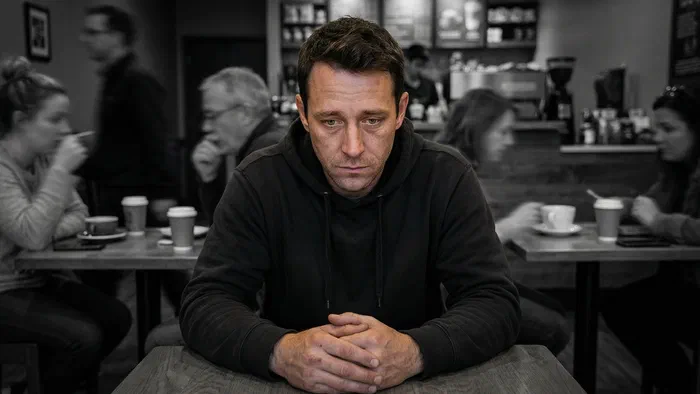
You've probably felt this without putting a name on it. You have coworkers. You have a fantasy football group chat. You might even have a couple guys you grab a beer with twice a year. But when was the last time you called any of them about something real? Something that scared you or kept you up at night?
If you're honest, you can't remember.
This isn't a soft cultural observation. The U.S. Surgeon General declared social disconnection a public health crisis, comparing chronic loneliness to smoking 15 cigarettes a day. A meta-analysis in the American Journal of Epidemiology put numbers on it: a 26% increased risk of premature death. Other research links isolation to a 29% higher risk of heart attack and 32% greater risk of stroke.
Those aren't statistics about hermits. They're about normal guys in Madison, WI who let friendships slide because life got busy.
How we got here

Men bond shoulder to shoulder. Always have. We connect through doing, not talking. Hunting, building, competing, training. The conversation happens around the activity, not instead of it.
That worked fine when activity frameworks were everywhere. Church leagues. Neighborhood pickup games. The bar where everybody knew your name. But those structures have been disappearing for two decades. Harvard researchers found that volunteering dropped from 30% to 23% between 2005 and 2021. Time spent visiting friends fell 37% between 2014 and 2019. Bowling alleys, the original third place, are down 32%.
Remote work killed the last fallback. No more hallway conversations. No more grabbing lunch with the guy from accounting. Your social world shrank to a Zoom grid and a Slack channel, and neither of those count.
Then fatherhood lands. If you're a dad, you already know this part. The calendar fills with soccer games, pediatrician visits, homework battles, bedtime routines. Days go by. Weeks. As one father told PBS, "Sometimes months would go by without seeing a friend." You don't stop wanting connection. You stop having time for it. And because no one teaches men to prioritize friendship the way they prioritize career or family, it just... fades.
The data confirms the drift. In 1990, 45% of young men reached out to friends first with personal problems. Now only 22% do. More men call their parents than their friends. We went from a generation that leaned on each other to a generation that doesn't lean on anyone.
The part nobody likes to say out loud

Here's what makes this tricky. Some researchers argue that men's friendships are "different, not deficient." Men and women score similarly on broad loneliness measures. The gap isn't necessarily about capacity. Most men will tell you privately that they want closer friendships. But saying it out loud — admitting you're lonely, admitting you need people — still feels like admitting weakness.
That's the real knot. Men know how to bond. They just don't give themselves permission to prioritize it. Work comes first. Family comes first. Friendship becomes whatever's left over, which is usually nothing. And the health consequences pile up whether we talk about it or not.
As the Pew Research Center put it: "While experiences with loneliness don't differ much by gender, men seem to turn to their networks less often for connection and emotional support."
Translation: men are just as lonely. They're just worse at doing anything about it.
Why "just hang out more" doesn't work

You already know the standard advice. Join a club. Volunteer. Be more vulnerable. Call your friends more.
It's not bad advice. It's incomplete advice. Because it ignores the mechanism. Men don't bond face to face. We bond shoulder to shoulder. Telling a man to "just open up" without giving him an activity framework is like telling someone to swim without water.
According to the Bumble 2025 Friendship Survey, 52% of adults hadn't made a new friend in the past year. Not because they didn't want to. Because adult life doesn't create the conditions for it. No shared struggle. No regular schedule. No reason to keep showing up.
You need a structure that solves for all three. And I've watched one do it, five nights a week, on the mats at our academy in Madison.
What happens on a mat that can't happen at a bar
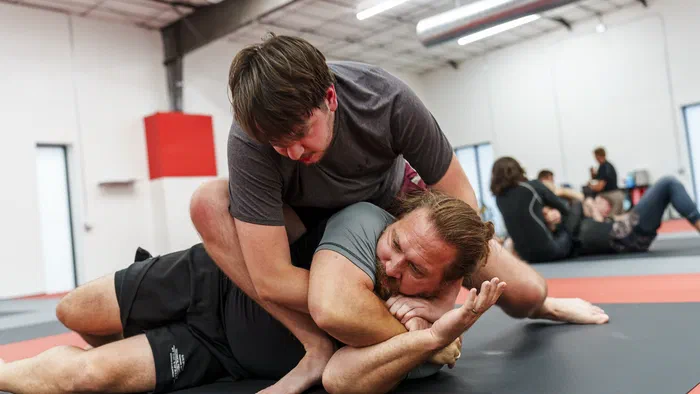
Brazilian Jiu-Jitsu is a contact sport where you spend an hour trying to choke, joint-lock, and pin another person, and they do the same to you. Then you slap hands and do it again. That sounds aggressive on paper. In practice, it's the most accelerated trust-building exercise I've ever seen.
Here's why. Every round of sparring requires you to place your physical safety in someone else's hands. When your training partner has your arm extended in an armbar, you trust them to release when you tap. When you're on top controlling someone 30 pounds heavier than you, they trust you not to crank their neck. This isn't theoretical trust. It's the kind you feel in your bones.
Research from Liverpool John Moores University described BJJ as "therapy of, by, for and through the body," specifically addressing male mental health through physical engagement. Physical contact during training releases oxytocin, the hormone linked to bonding and empathy. You're building chemistry with the people you train with, and that's not a metaphor.
And then there's the schedule. BJJ solves the consistency problem that kills most adult friendships. You don't have to coordinate calendars. You don't have to send the "we should hang out sometime" text that never goes anywhere. You just show up at 6pm on Monday, and the same guys are there. Week after week. Month after month. The friendship develops as a side effect of the training.
We wrote about this in our post on why solo fitness is losing to community training. People who train in groups have a 56% higher retention rate than solo exercisers. The mechanism is connection, not motivation.
What this actually looks like
I want to be specific, because vague claims don't help anyone.
We have a 42-year-old accountant who started at Journey BJJ in Madison eight months ago. He'd never been in a fight. He was 30 pounds overweight and hadn't done anything physical since college intramural basketball. His wife signed him up. He almost didn't come.
Eight months later he's lost 22 pounds. That's the part people expect. Here's the part they don't: he has a group text with four guys from the gym. They send each other technique videos. They went to a UFC fight together. When his dad had a health scare last month, the first person he called wasn't his wife or his brother. It was his training partner.
That kind of bond doesn't happen at Planet Fitness. It happens when you go through something hard together.
Anthony Bourdain started training BJJ at 58. He posted about it more than 80 times on Reddit, called it "an obsession," and credited it with giving him a community he'd never had. He wasn't looking for fitness. He was looking for belonging, and he found it on the mat.
Students on BJJ competition teams have 82% higher retention rates than casual members. That's not because competitors are more disciplined. It's because the team bonds them to each other. They have a reason to keep showing up that goes beyond their own goals. Accountability is the engine that keeps people training long after motivation fades.
Not all "brotherhood" is healthy
I should be honest about something. Not every men's group or brotherhood movement is worth joining. Some reinforce toxic patterns. Some use the language of strength to mask insecurity. Some are just hustle-culture networking dressed up in masculine branding.
What separates a healthy training community from a problematic one is simple: does it make you better toward other people, or does it just make you feel superior to them?
At our academy, the culture is built around mutual respect. White belts roll with black belts. Beginners partner with experienced students who help them learn, not dominate them. The hierarchy is based on skill and mat time, and it keeps everyone honest. You can't fake your way through a sparring round. There's something grounding about that in a world where you can fake almost everything.
We've talked before about why adults 30-44 are America's loneliest generation, and about how exercise works as well as therapy for depression. This piece fits the same picture. The loneliness crisis isn't going to be solved by an app or a self-help book. It's going to be solved by people showing up in the same room, doing something difficult together, and coming back tomorrow.
The math on doing nothing
Here's what happens if you read this and do nothing.
You keep meaning to reach out to that friend from college. You don't. Another year passes. The group chat gets quieter. Your social circle shrinks by one more person. Your stress stays right where it is, or gets worse, because 82% of workers report burnout and scrolling Instagram at 11pm isn't the stress relief you think it is.
Harvard found that Americans with just one close friend aren't any less lonely than those with none. One isn't enough. You need a web of connection, and building that web takes a structure that forces regular, meaningful contact.
The men who train at Journey BJJ in Madison didn't join because they wanted friends. They joined because they wanted to get in shape, learn self-defense, or just do something different with their Tuesday nights. The friendships happened because the structure made them inevitable.
What to do with this
If you've read this far, something in here hit close.
You don't need to overhaul your life. You need to add one thing that puts you in a room with the same people, doing something hard, on a regular schedule. BJJ is what we know. It's what works for the guys at our gym. But whatever you choose, choose something that involves physical effort, regular attendance, and shared struggle. Those are the three ingredients that rebuild the kind of friendships men used to have and stopped building.
Our 2-week intro program is $49 and includes a free uniform. You'll meet the coaches, train with guys who were in your exact position a few months ago, and find out if this is the structure you've been missing.
Nobody's going to build your circle for you. But we can give you the mat, the schedule, and the room full of people who'll remember your name on day two.
Come to the 6pm class on Monday. See what happens.
- Mens mental health
- Friendship
- Community
- Loneliness
- Brazilian jiu jitsu
- Madison wi
- Brotherhood
Ready to Start Your Journey?
Choose the option that works best for you
Call to book: +1 (608) 416-1140