
Football Is Losing Kids. Wrestling Is Surging. Here's What's Happening.
Something big is shifting in American youth sports, and most parents haven’t noticed yet.
High school football participation peaked at 1.11 million in 2008. By the 2024-25 school year, that number had dropped to 1,029,588 according to the NFHS annual survey . That’s a 17% decline, and the first time football fell below a million since 2000. Baseball is down 19% since 2019. Youth tackle football for kids ages 6-12 declined 13% in just three years.
Meanwhile, wrestling did something it has never done. Boys’ participation hit 300,214 in 2024-25 , the first time the sport cracked 300,000. That’s a 25% jump in three years, with 60,000 new wrestlers since 2021-22. Girls’ wrestling exploded to 74,000 participants, up 15% in a single year, with 46 states now sanctioning it as an official high school sport .
If you’re a parent in Madison trying to figure out which activity is worth your kid’s time and your family’s Saturday mornings, these numbers matter. They point to a real shift in how families think about youth sports, risk, and what they actually want their kids to get out of organized athletics.
The CTE conversation changed everything

Ten years ago, parents worried about broken bones. Now they worry about brains.
Research from Boston University’s CTE Center found that the risk of chronic traumatic encephalopathy (CTE) — a degenerative brain disease caused by repeated head impacts — doubles for every 2.6 years a person plays football. Among 152 young athletes under 30 who died and whose brains were studied, 41.4% showed evidence of CTE. The Concussion Legacy Foundation recommends delaying tackle football until at least age 14.
The part that surprises most parents: CTE isn’t caused by the big hits you see on SportsCenter. It’s caused by repetitive subconcussive impacts, the routine collisions that happen on every play, that never cause concussion symptoms, and that nobody counts. A 2022 study in the Journal of Neurosurgery: Pediatrics measured cumulative strain in youth football players and found measurable neurological changes even in kids who never had a diagnosed concussion.
Families are responding to this research in real time. Flag football participation jumped 60% year-over-year in 2024-25. The NFL’s FLAG program now runs 1,800 leagues with 700,000 players. As reporter Dave Sheinin told Texas Standard: “Families are weighing the risks and rewards of football and deciding it’s no longer to their benefit to keep playing.” That’s in Texas, where football is close to a religion.
Parents aren’t panicking. They’re making a calculated decision. And increasingly, that decision points toward grappling sports like wrestling and BJJ.
Why grappling is winning
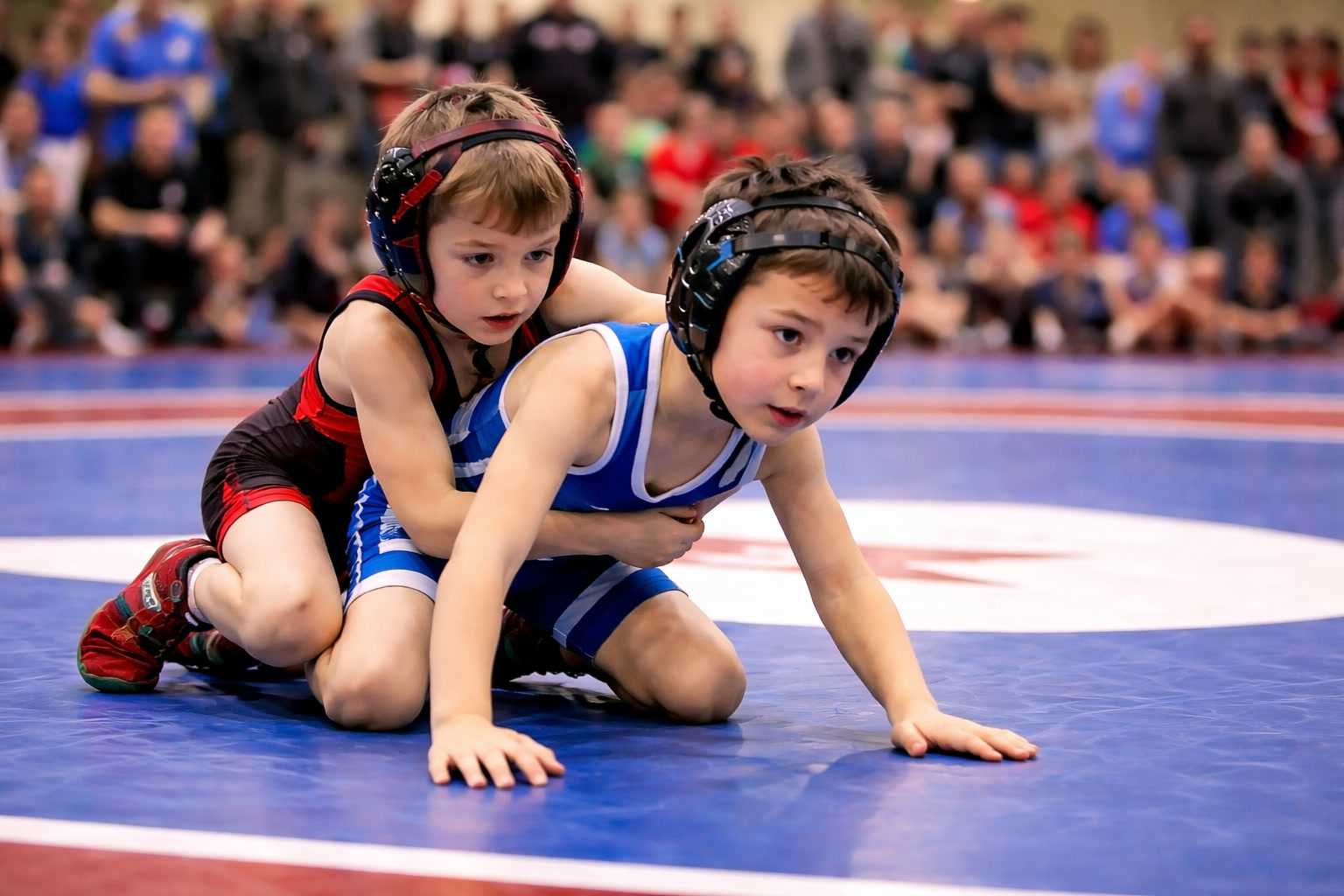
Wrestling’s record-breaking year tells a story that goes beyond one sport. It validates an entire category of athletics.
Grappling sports involve zero repetitive head impacts. No subconcussive collisions. No CTE risk from normal participation. That alone explains a lot of the growth. But it’s not the whole picture.
Parents are drawn to what grappling teaches. A kid who wrestles or trains Brazilian Jiu-Jitsu learns to solve problems under physical pressure. They learn that discomfort is temporary and manageable. They learn that a smaller person can control a larger person through technique and leverage. These are lessons that show up at school, at home, in how a kid handles a bully on the playground or anxiety before a test.
Here in Wisconsin, the trend is loud. Girls’ wrestling grew 60% statewide after the WIAA sanctioned it in 2021-22 . One Madison high school had 19 freshmen sign up for girls’ wrestling in a single season. Grappling is resonating with families here, and the numbers back it up.
Wrestling proves grappling works. BJJ makes it accessible.

I want to be clear: wrestling is a great sport. I have real respect for wrestling coaches and the discipline they build in their athletes. If your kid wrestles and loves it, keep going.
But when parents ask me what grappling sport fits their family best (especially if their kid is young, new to athletics, or if the family needs something sustainable alongside school and other commitments), I point them toward BJJ. Here’s why.
Time commitment
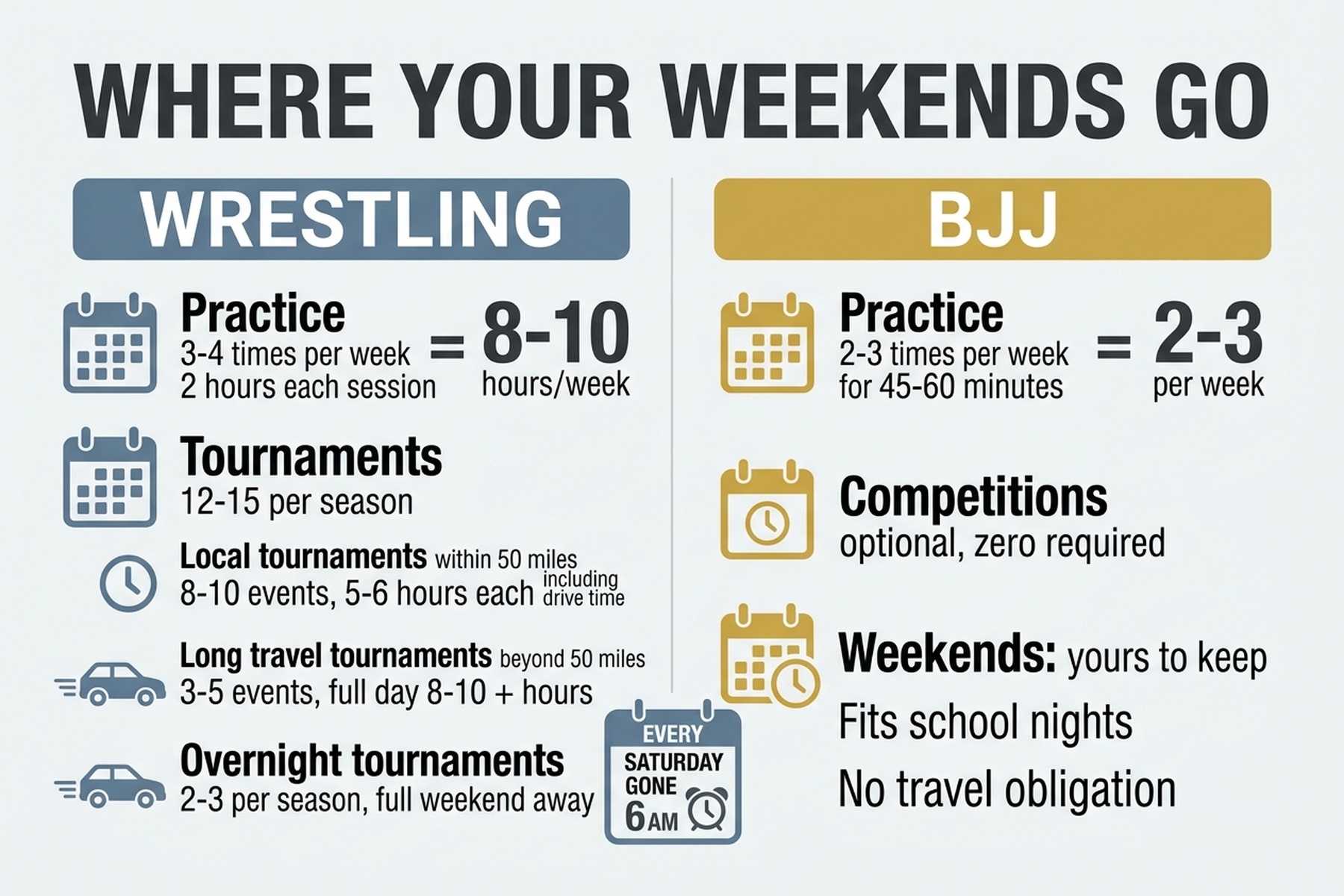
Wrestling practice typically runs 1.5 to 2.5 hours, two to four times per week. A kids’ BJJ class at Journey BJJ in Madison runs 45 to 60 minutes, two to three times per week. That difference matters when you’re juggling homework, bedtime, and everything else on a school-night schedule.
Then there are tournaments. Wrestling tournaments consume entire Saturdays. Weigh-ins at 6 or 7 AM. Competition starts around 9. Your kid wrestles two to five matches with anywhere from 30 minutes to two hours of waiting between each one. The parenting blog PrairieWife in Heels documented spending “6-10 hours at the gym” per tournament day. Tournaments happen nearly every Saturday during the season, and competitive families regularly travel out of town with hotel stays.
BJJ competitions exist, but they’re entirely optional. Many kids earn belt promotions and build confidence without ever stepping on a competition mat. When they do compete, tournaments are less frequent and carry no travel expectation.
Weight cutting
This one bothers me.
A 2021 review published in Frontiers in Sociology found that 25-94% of youth wrestlers engage in rapid weight loss practices: dehydration, caloric restriction, excessive exercise to shed pounds before weigh-ins. In growing kids.
BJJ has no weight cutting culture. Zero. Kids train at their natural body weight. They eat dinner before practice and don’t think twice about it.
Injury rates
A 2019 study in Sports Health measured the overall injury rate in BJJ training at approximately 9.2 per 1,000 exposures. Wrestling injury rates sit around 29.6-30.7 per 1,000 athletic exposures at the high school level. That’s roughly three times higher. Skin infections are another wrestling reality. Studies report that 31-84.7% of wrestlers contract ringworm in a given season.
BJJ still involves close physical contact, and injuries can happen. But the training culture emphasizes control, tapping early, and protecting your training partner. The pace is more technical than wrestling’s explosive scrambles, which translates to fewer acute injuries.
Cost
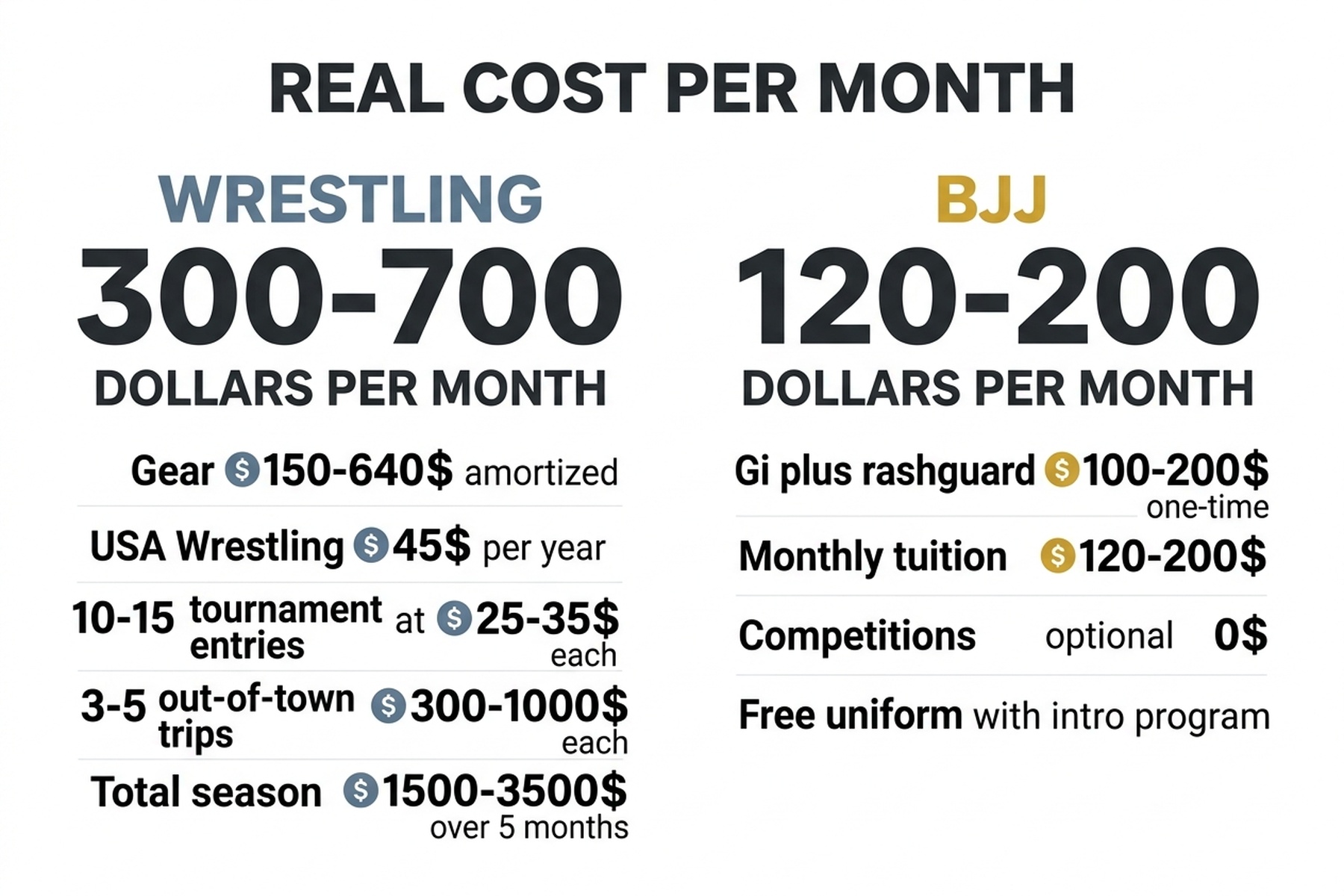
Wrestling looks cheap on paper until you add it up over a season. Gear alone runs $150-$640 (singlet, headgear, wrestling shoes, knee pads, gear bag). Then USA Wrestling membership ($45/year), tournament entry fees ($25-$35 each, and your kid enters 10-15 per season), local travel gas, and 3-5 out-of-town trips with hotels and meals at $300-$1,000 each. A typical wrestling season runs about 5 months (November through March). When you total the gear, fees, and travel, families spend roughly $1,500-$3,500 per season — that’s $300-$700 per month.
BJJ runs $120-$200 per month. Gear is a gi, a rashguard, and a mouthguard ($100-$200 one-time). Competitions are optional, so there’s no tournament travel cost unless your family chooses it. We include a free uniform with our kids intro program at Journey BJJ .
Self-defense and lifelong practice
Wrestling teaches a kid to take someone down and control position. That’s real and valuable. But wrestling-based self-defense has gaps. It doesn’t teach what to do from your back, how to control someone without hurting them, or how to neutralize a larger attacker using submissions and leverage.
BJJ was built specifically to answer those questions. A 60-pound kid who trains BJJ learns techniques that work regardless of size because the entire system was designed for a smaller person to control a bigger one. That’s not a tagline. It’s the origin of the art.
There’s also the longevity factor. Wrestling is structured around a competitive season with a defined endpoint. Most wrestlers stop after high school or college. Look at some of the most famous wrestling coaches in the country — many are broken down and out of shape from decades of wear and tear. The sport takes a physical toll that accumulates. BJJ has no season and no endpoint. The belt system takes a decade or more to complete, and people train well into their 50s, 60s, and beyond. Your kid can start at age 4 or 5 and still be on the mat at 40.
What stays the same
Both sports build discipline, toughness, and the ability to handle adversity. Both teach kids that effort matters more than talent over time. Both are grappling arts with no head strikes, which means no CTE risk from normal training.
The difference is accessibility. BJJ was built around the premise that smaller, less athletic people should be able to defend themselves. The curriculum scales from age 4 through adulthood. Parents train alongside their kids. The belt system provides regular milestones without requiring competition. And class length fits a school-night window.
What we actually see happen

The kid who won’t make eye contact on day one. Who stands in the back. Who flinches when another kid gets close.
That kid is on our mat every week. Six weeks in, they’re drilling with a partner without hesitation. Three months in, they’re the one helping the new kid . Six months in, they sign up for their first competition — not because anyone pushed them, but because they want to test themselves.
We see shy kids become fierce. Kids who were afraid of contact become enthusiastic competitors. Kids who couldn’t handle losing learn to get tapped, slap hands, and start again. That transformation isn’t the exception. It’s the pattern.
Parents notice it at home first. Their kid stands up straighter. Handles conflict differently. Comes home tired instead of wired. Asks to go back.
The national data confirms what these families already figured out: grappling builds strong kids . BJJ makes grappling work for real family life.
If you’re curious
We run a 2-week intro program for kids at Journey BJJ in Madison, WI. It’s $49, includes a free uniform, and gives your family enough time to see whether this is the right fit – no long-term commitment, no pressure.
Start the 2-week kids intro ($49 with free gi)
If you’d rather talk first, book a free consultation and ask me anything. I’ll tell you what a typical week looks like, what to expect in the first month, and whether BJJ makes sense for your kid specifically.
The shift toward grappling isn’t a fad. It’s parents reading the research and choosing accordingly.
- Kids martial arts madison
- Youth sports trends
- Cte prevention
- Wrestling vs bjj
- Madison wi
- Brazilian jiu jitsu madison
Ready to Start Your Journey?
Choose the option that works best for you
Call to book: +1 (608) 416-1140