6 Things Every Parent Worries About Before Their Kid's First BJJ Class
It's 10:47pm. Your kid is asleep. You're in bed with your phone, searching "is BJJ safe for kids" for the third time this week.
You found a school in Madison. The reviews are good. Your kid seemed interested when you mentioned it. But you haven't signed up yet because something is holding you back. Maybe a few somethings.
I talk to parents like you every week. The worries are almost always the same six things. And they're all reasonable. You're not being overprotective. You're doing the math that good parents do before putting their child in a new situation.
So let me walk through each one honestly.
1. "My kid is going to get hurt"

This is the big one. It comes up in almost every conversation I have with a new parent, and I'd be worried if it didn't.
Here's what the data says: the American Academy of Pediatrics published a clinical report on youth martial arts injury rates and found they range from 41 to 133 per 1,000 athletic exposures, depending on the style. That puts martial arts in the same neighborhood as soccer, basketball, and well below football and ice hockey.
But here's where it gets interesting for BJJ specifically. A 2025 analysis of pediatric BJJ injuries published in PMC looked at a decade of emergency department data. The most common injuries were sprains and strains (28.3%) and fractures (20.1%). Concussions accounted for just 5.5% of cases. Compare that to football, where concussions are the leading concern, and you start to see why the AAP actively opposes youth boxing but calls martial arts "a great form of exercise for kids when done safely."
The distinction matters. BJJ is a grappling art. There's no punching. No kicking. No strikes to the head. Kids learn to control positions, apply submissions with gradual pressure, and tap out before anything hurts. It's built around a safety valve that most sports simply don't have.
One more thing: research on youth martial arts athletes found that kids who train fewer than three hours per week had significantly lower injury rates, with no injuries requiring time away from activity. Our kids classes in Madison run two to three sessions per week, right in that safe zone.
2. "It's too aggressive -- I don't want my kid learning to fight"

I understand this one. You've seen UFC clips. Maybe your kid has too, and that's part of what's making you uneasy. The Washington Post ran an investigation a few years ago into unregulated youth MMA, and the images were rough. Parents on Reddit and Quora ask about this constantly: "Is this too violent for my eight-year-old?"
Here's what I want you to see: children's Brazilian Jiu-Jitsu and adult cage fighting are about as similar as tee-ball and Major League Baseball. Technically the same sport family. Functionally, completely different experiences.
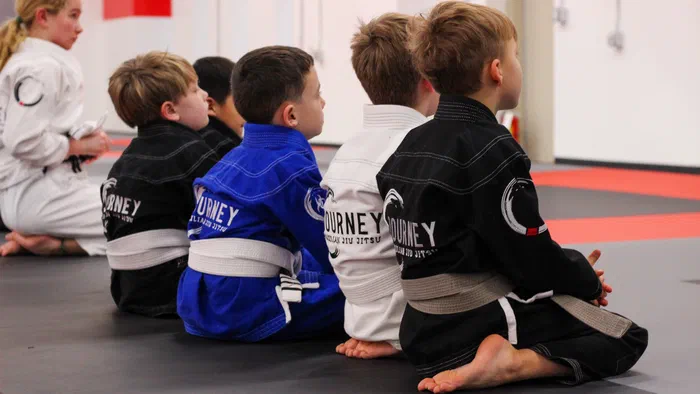
A kids BJJ class looks like this: a structured warmup with animal walks and movement games. Technique instruction where partners take turns practicing specific moves. Then controlled positional rounds where kids work on what they just learned. It's physical, yes. There's grappling and problem-solving under real pressure. But there's no striking, no aggression rewarded, and a coach monitoring every exchange.
The research backs this up. A 2019 study in the European Journal of Sport Science found that youth BJJ practitioners showed decreased aggression over five months, while MMA practitioners showed increased aggressiveness. The researchers attributed the difference to BJJ's philosophical foundation: control over damage, technique over force, patience over explosiveness.
What I see in our kids program doesn't surprise me. The loudest kids on the mat during their first week are usually the quietest by month two. They learn that strength without technique fails, that patience beats impulsiveness, and that the calmest person in the room tends to win. Those lessons follow them to school.
3. "My kid is too shy (or too small, or too young)"

I hear some version of this a lot: "She's really timid. I'm afraid she'll hate it." Or "He's small for his age. Won't the bigger kids just crush him?" Or "She's only five. Should we wait?"
Let me tell you about the kids who do best in BJJ. They're not the biggest. They're not the toughest. They're the ones who keep coming back. And the shy kids, the small kids, the anxious kids -- they often surprise everyone, including themselves.
BJJ is the one sport where size is genuinely less important. The entire art was designed around the premise that a smaller person can control a larger one through technique, leverage, and positioning. Your 55-pound kid isn't at a disadvantage here. They're learning the art the way it was meant to be practiced.
As for shyness: the structure of a BJJ class is actually easier for shy kids than team sports. There's no ball to drop in front of everyone. No moment where the whole team watches you miss the goal. Training happens in pairs. Your child works with one partner at a time, in close proximity, solving problems together. That intimacy builds trust faster than standing on a soccer field with 15 other kids.
And age? The AAP's clinical report on youth martial arts found no evidence that a minimum age is required to begin training in non-contact forms and basic techniques. Most of our kids start between ages 5 and 8. We group them by age and size, and instructors adjust expectations accordingly.
I've watched kids dealing with real anxiety walk in clinging to a parent's leg and, six weeks later, fist-bump their training partner without being asked. You don't need to wait until your child is "ready." The training itself is what gets them there.
4. "We can't afford another expensive activity that they'll quit in three months"

This is a valid concern, and the numbers explain why. The Aspen Institute's 2025 National Youth Sport Survey found that the average family now spends $1,016 per year on a child's primary sport. That's a 46% increase since 2019 -- double the rate of inflation.
And here's the part that stings: 70% of kids quit organized sports by age 13. The average child sticks with a sport for less than three years. So families are spending more money than ever on activities their kids abandon faster than ever.
It gets worse. More than half of parents now feel pressure to specialize their child in one sport. Travel teams, private coaching, year-round club fees. And the research says early specialization doesn't even work: a study of 1,190 young athletes found that highly specialized kids had 2.25 times greater odds of serious overuse injury than multi-sport athletes.
BJJ sidesteps most of this. There are no travel teams demanding weekend tournaments in Milwaukee. No $300 cleats every season. No private coaching upsells required to make the "A team." Your child needs a gi (we include one free with our intro program), and they train right here in Madison.
As for quitting: kids quit sports when the fun disappears. That usually happens through bench time, cuts, coach favoritism, or pressure that squeezes the joy out. BJJ doesn't have benches. Every kid trains every class. There are no tryouts. A shy six-year-old and a confident ten-year-old share the same mat. Progress is individual -- measured in skills learned, not wins against other kids. That structure keeps kids engaged longer than environments built around competition and comparison.
5. "My child is being bullied -- will they learn REAL self-defense?"

Here's something most parents don't think about until it matters: well-adjusted kids don't want to hurt anyone. Your child doesn't want to punch somebody in the face. That's not a weakness. That's a sign you've raised a good kid.
But it creates a problem. If the only self-defense tools your child has involve striking, they're probably never going to use them. Not because the techniques don't work, but because your kid doesn't want to break someone's nose on the playground. So the skills just sit there, unused, while the bully keeps pushing.
Grappling changes the math.
We don't teach kids how to kick or punch at Journey BJJ. We teach them how to control another person. Clinch, takedown, pin. A child who can close the distance, bring someone to the ground, and hold them there can end a confrontation without throwing a single strike. That's not theoretical. That's what grappling is designed to do. And it's the self-defense that actually works in school hallways and on playgrounds, where there are hard floors, backpacks everywhere, and teachers arriving in 30 seconds.
Think about what a flying kick looks like in a crowded cafeteria. Now think about a kid who calmly clinches a bully, puts them on the ground, and pins them until an adult shows up. One of those gets your child suspended. The other gets the situation under control.
The toolset matters because it's one your child will actually reach for. A kid who knows how to grapple has options between "do nothing" and "throw a punch." They can control without injuring. Restrain without escalating. That's a bigger menu of responses, and bigger menus mean better decisions under pressure.
But here's what I've watched happen over and over at our academy, and what surprised me when I first started coaching: most kids who train long enough never have to use any of it.
Not because bullies disappear. Because the kid changes.
A child who has spent months getting pinned, escaping, controlling, and being controlled by training partners carries themselves differently. They've felt what a real physical confrontation is like hundreds of times in a safe environment. When someone gets in their face at school, they don't freeze. They don't panic. They've been there before, on the mat, and they know they can handle it.
That calm reads. Bullies are opportunists. They pick targets who flinch, who look away, who shrink. A kid who makes eye contact and stands their ground, not because someone told them to but because they genuinely aren't afraid, stops being a target worth choosing. Research on bullying prevention backs this up: physical confidence is one of the strongest protective factors, not because kids fight back, but because confident kids change the social equation before it gets physical.
So yes, your child will learn real self-defense. The kind that works in the real situations kids actually face. But the deeper answer is that they'll probably never need to use it, because the confidence that comes from knowing you can control a situation often means you never have to.
6. "I don't know anything about martial arts -- how do I pick the right school?"
Totally fair. If you don't train yourself, every martial arts school in Madison looks roughly the same from the outside. Colored belts, bowing, foreign words. How do you tell what's real?
I wrote an honest guide comparing 20+ martial arts schools in Madison, and the single most important thing I can tell you is this: ask whether kids train against resistance.
In some martial arts schools, your child practices choreographed movements in the air or against a pad that doesn't fight back. They earn belts on a schedule. The coach says "good job" a lot. It feels nice. But none of it transfers to a real situation, and deep down, kids know the difference.
In BJJ, your child practices techniques against another kid who is actively trying to stop them. When a sweep works, your child knows it works, because they felt it succeed against real resistance. That's not just better martial arts training. It's what builds the kind of confidence that transfers to the schoolyard, the classroom, and life.
Here are a few other things to look for when evaluating any school:
- Do they let you watch a class before signing up? (We do. Come sit on the bench anytime.)
- Are kids grouped by age and size?
- What's the instructor-to-student ratio?
- Is there a clear curriculum, or does the instructor wing it?
- Can your child try it before committing to a long contract?
Our 2-week intro program is $49 and includes a free uniform. No long-term commitment required. You'll know within two weeks whether your child lights up or dreads it. Either answer is useful.
The mythbuster section (because the numbers matter)
If you're the kind of parent who wants to see the data before making a decision, here's a quick rundown of what the research actually says.
Concussion concern is real, but misplaced for BJJ. A MedStar Health survey found that 93% of parents now worry about concussions in youth sports, up from roughly half in 2019. That worry makes sense for football and heading-heavy soccer. For BJJ, concussions represent only 5.5% of injuries in the pediatric data. No strikes to the head means dramatically lower head trauma risk.
Martial arts injury rates are comparable to mainstream youth sports. The AAP's clinical report puts martial arts at 41-133 injuries per 1,000 exposures. Soccer sits around 2-13 injuries per 1,000 hours depending on age and competition level. Football and ice hockey rank higher than both. BJJ, as a non-striking grappling art, falls on the lower end of the martial arts spectrum.
Training volume matters more than the sport itself. Kids training fewer than three hours per week in martial arts showed no significant injuries. Our kids classes in Madison are structured around that guideline.
Youth sports spending is out of control. $1,016 per year per child, up 46% in five years. Early specialization doubles injury risk. And 70% of kids still quit by 13. BJJ costs less, doesn't demand travel or equipment upgrades, and has better retention than most youth sports.
The AAP endorses martial arts for kids. They oppose boxing (because of intentional head strikes), but their published position calls martial arts "a great form of exercise for kids when done safely." Non-contact forms and training under qualified instruction carry low risk.
What to do with all of this
Look, I'm not going to pretend your worries will disappear after reading one article. Signing your kid up for something new always involves a leap. But the leap here is smaller than it probably feels at 10:47pm with your phone glowing in the dark.
The injury data says BJJ is as safe or safer than the sports your child's classmates already play. The aggression concern is backward -- BJJ reduces aggression, according to the research. Shy and small kids often thrive here precisely because the art was built for them. The cost is reasonable and the structure keeps kids engaged. And you can evaluate the school by watching a class before spending a dollar.
If you want to talk through any of this with a real person, book a free meeting with your child's coach. We'll answer your specific questions about your specific kid. No sales pitch, just a conversation.
Or if your child is ready to try, our 2-week intro is $49 with a free uniform included. Two weeks is enough to know.
- Kids bjj
- Parent concerns
- Injury prevention
- Madison
- Youth sports safety
Ready to Start Your Journey?
Choose the option that works best for you
Call to book: +1 (608) 416-1140