The Complete Guide to Kids' Martial Arts in Madison, WI (2026)
Your kid comes home from school again with that look. The one where they won't meet your eyes. Maybe they shrug when you ask how their day went. Or maybe they've told you directly: someone pushed them. Called them names. Made them feel small.
You want to do something. You've thought about martial arts. But when you search "kids martial arts Madison," you get two dozen schools, a half-dozen styles, and price ranges from $100 to $200 a month.
Here's the good news: you don't need to become a martial arts expert to make a smart choice. You need to understand one distinction. Just one. It matters more than the name on the building, the color of the belts, or how many years the school has been open.
The Only Question That Matters

Does your child train against resistance, or against air?
Every martial arts school in Madison falls somewhere on a spectrum. On one end, your child practices techniques against a partner who fights back -- who resists, scrambles, and tries to win. On the other end, your child practices movements against pads, bags, or thin air, with a cooperative partner who stands still and lets things happen.
These are not the same thing. They produce different kids.
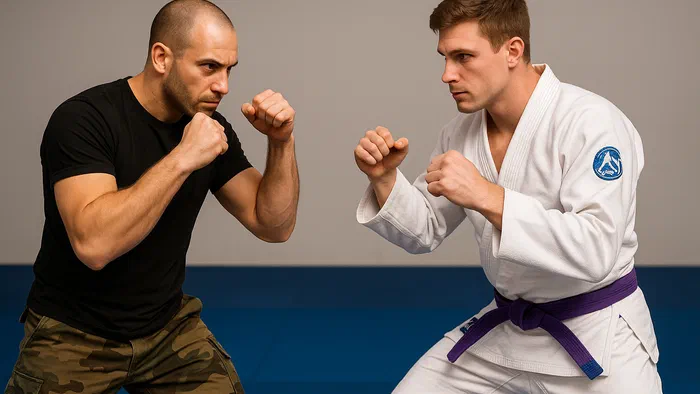
Full-resistance training looks like this: Your child pairs up with another kid their size. They try to execute a technique -- a sweep, a pin, a submission -- while the other kid actively tries to stop them. When something works, your child knows it works. Not because a coach clapped and said "good job," but because they felt the technique succeed against a real person trying to prevent it. When something fails, they adapt in the moment. No script. No choreography. Just problem-solving under pressure.
This is how athletes in every sport develop. Game reps, not just drills.
Compliant training looks like this: Your child punches a pad held by a coach. They perform a choreographed sequence alone or in a group. They "spar" under rules so restrictive that the exchange barely resembles a real confrontation. They break a board that doesn't fight back. The coach tells them they did great. They earn a stripe. But they never test whether any of it actually works against someone trying to stop them.
Both approaches teach movement and gives kids "a sense of accomplishment." Only one builds the confidence that transfers to the schoolyard and real life.
Why This Distinction Matters: The Research

This isn't just coaching philosophy. The science has studied this:
Albert Bandura's foundational research on self-efficacy established something parents should know: the most powerful source of genuine confidence is mastery experience -- succeeding at difficult things through persistent effort. Not a bunch of team chants and high-fives. Not a coach telling you, "you're doing great, tiger." Actually doing it yourself, against real resistance.
Sports science reinforces this. A 2024 paper in Sports Coaching Review applied an ecological dynamics framework to combat sports training, arguing that coaches should design "alive and representative training sessions" where athletes solve real movement problems against real opponents -- not rehearse predetermined solutions. The researchers describe this as "repetition without repetition": your child repeats the process of solving a problem, not the memorized answer. Each training partner, each round, each scramble is different. That variability is what builds adaptive, transferable skill.
A 2019 study in the European Journal of Sport Science by Blomqvist Mickelsson compared youth practitioners of BJJ and MMA over five months. Both groups improved in self-control. But BJJ practitioners showed decreased aggression, while MMA practitioners showed increased aggressiveness. The researchers attributed the difference partly to BJJ's philosophical foundation -- the emphasis on control rather than damage.
A parent survey of 400+ BJJ families found: 96.4% reported improved confidence, 92.8% reported strengthened commitment to goals, 87.5% reported reduced anxiety, and 80% reported improved coordination. These numbers come from parents watching their kids change over months and years of full-resistance training.
What Real Confidence Looks Like (and What Fake Confidence Looks Like)

A child with real confidence:
- Doesn't flinch when someone gets in their face
- Stays calm in uncomfortable situations because they've been in uncomfortable positions hundreds of times on the mat
- Knows from experience -- not from being told -- that they can handle physical confrontation
- Doesn't need to prove anything because they prove it to themselves every day in training
A child with surface-level confidence:
- Has a belt on the wall but freezes when pushed on the playground
- Can perform a beautiful kata but panics when grabbed
- Feels good in class but that feeling evaporates under real pressure
The difference isn't the martial art's name. It's the training method. A karate school with heavy sparring will produce more confident kids than a BJJ school that never rolls. The method matters more than the label.
Where Each Style Falls on the Spectrum

Here's an honest breakdown. Some of these will be uncomfortable.
Mostly Full-Resistance:
- Brazilian Jiu-Jitsu -- Live rolling every class, typically 50-70% of class time. No strikes means kids can safely train at full intensity.
- Wrestling -- Live scrambles and matches every practice. Excellent full-resistance art. Biggest gaps: no submissions, no guard work, and it's seasonal (school sport).
- Judo -- Regular randori (live sparring with throws). Strong resistance training with an emphasis on takedowns.
Mixed (Some Resistance, Some Compliant):
- MMA -- Depends heavily on the gym. Some emphasize live sparring, others are mostly pad work. For kids, training skews toward drills and controlled contact.
- Some karate schools with strong kumite (sparring) programs, especially Kyokushin-style full-contact schools.
Mostly Compliant:
- Traditional karate -- Heavy kata (forms) focus with limited sparring. Most American karate schools fall here.
- Taekwondo -- Forms plus point sparring with restrictive rules. As a student of taekwondo I loved sparring but we only trained it maybe 3x per week on the whole. Modern olympic rulesets make this REALLY not look like fighting.
- Kids Muay Thai -- Pad work is 90%+ of training for non-competitors. Muay Thai itself is a proven, effective fighting art with a serious competitive scene. But for kids who aren't competing, training is almost entirely hitting pads a coach holds for them. Props to the art itself -- the kids' training methodology is the issue.
- Krav Maga -- Scenario drills against cooperative partners. "Brutal techniques" that are trained by adults are generally sanitized for kids programs.
- Aikido -- Partner drills with a cooperative partner (uke) who falls on cue. More art than martial.
A note on fairness: Taekwondo is an Olympic sport with real athletes. Wrestling produces some of the toughest competitors in any sport. Muay Thai fighters at the highest level are among the most skilled strikers alive. The question isn't which art is "best" in the abstract — and if you're comparing BJJ to karate programs specifically, that comparison deserves its own look. The question is: what does your kid's actual training look like, day to day, in that specific school?
Safety: The Striking Problem

The American Academy of Pediatrics has studied injury rates across martial arts. Striking arts like Taekwondo show injury rates as high as 59%, with most injuries to the head, face, nose, and mouth. Grappling arts show significantly lower rates, particularly for head trauma.
This creates a paradox for striking arts: if kids spar hard, they risk head injuries. If they don't spar hard, they don't get full-resistance training. Grappling solves this. No punches, no kicks, no concussions -- but your child still trains at full intensity every single class.
The difference between a bruised ego from getting submitted and a concussion from a kick to the head matters when your 8-year-old is the one training.
Madison Schools by Category
Full-Resistance Grappling Schools:
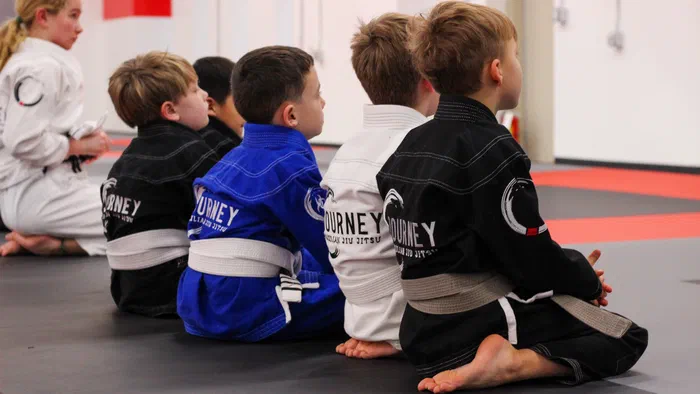
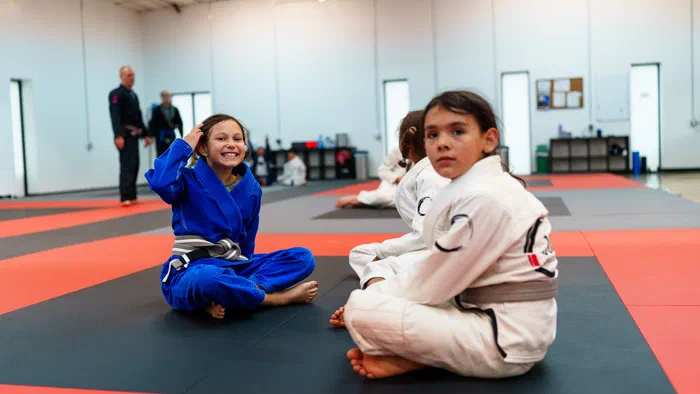
- Journey BJJ Academy -- World-class facility, 2,300+ sq ft of dedicated mat space, air-conditioned. Kids classes (ages 6-12) include full-intensity rolling every session. 5x per week 2 Week trial available.
- Sanctuary Jiu-Jitsu -- Jiu Jitsu Academy of east side. Strong emphasis on self-esteem development for kids. Caio Terra Affiliate & Curriculum. Limited kids class times (3x per week at the time of this writing)
- Alliance BJJ at Twisted Fitness -- Brand-new facility at 711 Rethke Ave. Anti-bullying focus: teaches kids to "control bullying without throwing a punch or kick." Very limited kids schedule at the time of this writing.
- Foundations Jiu Jitsu -- Jiu Jitsu Club, transparent pricing in Madison ($90/mo youth). No contracts, no testing fees. Limited kids schedule at the time of this writing.
Wrestling:
- JJ's Boxing & Wrestling -- USA Wrestling affiliated, grades K-8
- Team Nazar Training Center -- Elite youth wrestling sessions
- Regent Wrestling Club -- Grades 2-8 at West High School
Traditional & Striking Schools:
- Wisconsin Martial Arts & Fitness Center -- 50+ years combined instructor experience. Offers a "Kids BullySafe" BJJ program alongside traditional arts. Adaptive programs for students with disabilities.
- Masaki Martial Arts -- Lineage to 1971. Eastern philosophy blended with Western psychology. Family classes available.
- MadCity Martial Arts -- Blends TKD with karate, boxing, and jiu jitsu
- LVLUP Martial Arts -- Mike Moh's school (if you haven't heard of Mike, he played Bruce Lee in Once Upon a Time in Hollywood) Three locations: Waunakee, East Madison, Verona. Not sure if he owns all of the locations.
- Twisted Fitness / Madison Muay Thai -- Roufusport affiliate. Dutch-style Muay Thai. Also offers kids BJJ.
- Forward Thai Boxing -- Muay Thai and Krav Maga. Welcomes non-competitive students.
- The Blast Muay Thai -- Classes from age 4. $100/month unlimited. Open 7 days.
- Krav Maga Worldwide of Madison -- Adult, women's, and kids classes
- Aikido of Madison Dojo -- Founded 1984. Calm, supportive atmosphere. Adaptive classes twice monthly.
A Special Case: Black Belt America
Black Belt America operates a 29,000 sq ft facility with 30+ years in Madison. Their after-school and summer camp programs serve thousands of families.
But here's what's worth understanding: they teach a proprietary martial arts system created by founders Don and Theresa Wideman. Their website doesn't name a specific martial art -- no "we teach Shotokan karate" or "we teach Taekwondo." It's a branded "family martial arts" system with heavy emphasis on character development and leadership.
That's not inherently bad. But ask: What specific martial art do the instructors practice? A black belt from a named discipline -- Shotokan karate, Taekwondo under the World Taekwondo federation, BJJ under IBJJF -- carries specific technical meaning. A black belt from a proprietary system means whatever that system defines it to mean.
Ask the questions. Watch the classes. Make your own call.
Clubs vs. Academies: You'll see prices ranging from $40/month to $200/month. "Clubs" (wrestling clubs, some niche programs) share space with rec centers, run 2-3 sessions per week, and charge less. "Academies" own dedicated facilities, run 5-7 days per week, and charge $150-200/month. They're not apples-to-apples comparisons -- a club meeting twice weekly for $60/month and an academy open six days for $180/month offer different training experiences.
Questions to Ask Before You Sign Up
Frame every question around the resistance vs. compliant distinction:
- "What percentage of class time is live sparring or rolling?" You want to hear "every class" or a specific number. Be cautious of "when they're ready" or "only at belt tests."
- "Can I watch my child spar against a resisting partner?" Good schools welcome observers. Be wary of schools that won't let you see what happens on the mat.
- "What specific martial art do you teach?" You should get a clear, direct answer. If the answer is vague or branded, dig deeper.
- "What happens when my child loses?" The best coaches treat losses as learning. Your child will lose often in full-resistance training -- that's the point. How the school handles that tells you everything.
- "What's your instructor's background?" Competition experience and teaching certifications matter. Can the instructor demonstrate what they teach at a high level? Are they fit?
- "Do you charge for belt testing?" How often? What does it cost? How do they measure mastery?
- "Can my child try a class before committing?" Most reputable schools offer a trial program. Take advantage of it.
The Case for BJJ
I run a BJJ academy, so take my perspective with that in mind. But here's why I chose to teach BJJ to kids rather than any other style:
The highest ratio of full-resistance training in any martial art. Kids roll (live spar) every class, against partners actively trying to stop them. That's where real confidence comes from.
Safe enough to go 100% every day. No punches, no kicks, no head trauma risk. Your child trains at full intensity without the injury concerns of striking arts.
It addresses what bullying actually looks like. Schoolyard bullying isn't a kung-fu movie. It's grabbing, pushing, shoving, and takedowns. Grappling trains for exactly this -- your child learns to stay calm when grabbed, control a larger person through leverage, and neutralize a threat without throwing punches.
The research supports it. BJJ decreases aggression. It builds self-control. Parents overwhelmingly report improved confidence. And the training method -- full resistance, every class -- aligns with what self-efficacy research says actually builds lasting confidence in children.
It's a lifelong practice. BJJ can be practiced safely into your 60s and 70s. The skills grow with your child — which is why starting early gives kids a measurable developmental head start.
Making Your Choice
Visit schools. Watch the kids' classes. Pay attention to one thing above everything else: is your child training against a real person who is trying to stop them?
If yes, you're probably in the right place -- regardless of what the sign on the door says.
If not, your child might be learning movements. But they won't be building the kind of confidence that holds up when it matters.
Your kid deserves training that actually works.
---
Ready to see full-resistance training in action?
Book a trial program class at Journey BJJ Academy. Watch your child roll. Ask us anything. No pressure, no long-term contracts -- just an honest look at how we train kids.
We serve families throughout Madison, Middleton, Fitchburg, Verona, Waunakee, and Sun Prairie. Kids classes available for ages 4-15.
- Local guide
- School comparison
- Madison
- Self defense
Ready to Start Your Journey?
Choose the option that works best for you
Call to book: +1 (608) 416-1140