Something Changed in Our Kids During the Pandemic. New Research Finally Explains What.
Imagine walking through the park after school when your child spots a classmate across the playground. You see the excitement immediately. "That's Tyler!" A whisper, a grabbed arm, speed-walking toward the swings. But ten feet away, the whole thing stalls. Tyler's right there. Your kid just stands frozen for a moment, then quietly backs up and says, "I don't want to. Let's just go." You end up walking over together, explaining to Tyler's mom: "Really wanted to say hi but couldn't quite get the words out." Now your child is beaming—you broke the ice. But you're thinking: We're eight years old. Why can't we just say hello?
You've been telling yourself they'll grow out of it. That they're just "quirky." That the pandemic was hard on everyone.
Here's the thing: you're not imagining it. And a study published last month finally measured what you've been feeling.
What Researchers Found (And Why It Startled Them)
A team at UC Merced spent years running a simple test with kids. They'd show a child this scenario: Your friend puts a cookie in a blue box, then leaves the room. While she's gone, someone moves the cookie to a red box. When your friend comes back, where will she look for the cookie?
Most adults laugh at this. Obviously the friend will look in the blue box—she doesn't know someone moved it.
But getting this "obvious" answer requires something kids have to develop: the ability to understand that other people can believe something different from what you know is true.
Before the pandemic, 80% of five-year-olds got this right.
After lockdowns? Only 63%.
For kids from lower-income families—who often had less access to pods, Zoom playdates, and outdoor socialization—it dropped to 51%. Basically a coin flip.
The lead researcher, Professor Rose Scott, put it bluntly: "On one of the tasks in my lab, children tested before the pandemic could pass at two and a half years old. Right after the lockdowns, we were seeing five-year-olds not passing it."
Other researchers in her field had the same reaction: "Every time I talk about this, other people say, 'Oh, my gosh, this is it.'"
Why This Matters for Your Kid Right Now
That "blue box, red box" test might seem like a weird brain teaser. But the skill it measures? It's the engine running beneath every social interaction your child has.
Think about what your kid actually needs to do to navigate a school day:
Reading the room. When the teacher's forehead creases and she goes quiet, it means "settle down." Your child needs to see that face and think, "She's getting frustrated, even though she hasn't said anything yet."
Understanding friends. When Emma says "nice haircut" with a certain tone, does she mean it, or is she being sarcastic? Your child has to imagine what Emma is actually thinking behind her words.
Cooperating on projects. When their partner keeps grabbing the markers, are they being bossy, or just excited? Your child needs to read intention, not just action.
Making friends in the first place. That kid sitting alone at lunch—are they sad and want company, or do they prefer eating alone? Your child has to imagine life from inside someone else's head.
Kids who struggle with this aren't being "difficult." They're not shy, exactly, or mean, or socially anxious. They're genuinely missing information that other kids are picking up automatically.
A mom in a parenting group shared something that stuck with me: Her daughter came home from a sleepover convinced the other girls had excluded her all night. She was in tears, devastated. But when the mom talked to the host family, they told a different story—several girls had actually tried to include her daughter in games, but she'd interpreted their attempts as rejection and spent most of the night crying in the corner. The real gut-punch came days later. When her daughter saw the birthday girl at school, instead of smoothing things over, she told her again how bad the sleepover was. The mom said: "My jaw dropped. She's not being mean—she genuinely doesn't understand that you don't tell someone their party was terrible while they're already upset about it. She can't see it from their side."
That's the gap. Not attitude. Not personality. A genuine inability to step into someone else's head and understand what they're feeling.
It's like everyone else has subtitles turned on, and your kid's screen is blank.
The Hard Part: It Didn't Fix Itself
Here's what keeps me up at night about this research.
The team tested kids again in 2023. Schools had been open for years. Kids were playing together, going to parties, back to normal life.
The gap persisted.
Recent polling from Gallup confirms what parents are living: 45% of families with school-age children say the pandemic hurt their child's social skills. For almost half of those families, these struggles are still ongoing in 2025.
The kids who were in elementary school during lockdowns—now middle schoolers—are showing the most persistent effects.
This isn't going away on its own. Time alone isn't the fix.
Why Playdates and Team Sports Aren't Enough
When parents notice their kid struggling socially, the instinct is: more socialization. Sign them up for soccer. Schedule more playdates. Get them around other kids.
That's not wrong. But here's the problem.
Sitting on a soccer bench waiting for your turn at goalie doesn't build this skill. Standing in a cluster at recess while other kids talk doesn't either. Even playdates can turn into two kids playing video games in the same room—parallel play, not actual interaction.
What the research shows actually works: situations where your child has to actively read another person, predict what they're about to do, and adjust in real-time. The same kind of active, embodied engagement that researchers have found dramatically improves executive function in kids with ADHD. Over and over, with immediate feedback when they guess wrong.
That's specific. And most activities don't provide it.
The Unexpected Training Ground
I'm going to be honest with you about something. When parents bring their kids to our BJJ academy, they're usually thinking about confidence, or discipline, or getting them off screens.
Then something else happens.
A mom told me last month: "He finally notices when his sister is upset. He used to just barrel right through her feelings."
A dad said: "Her teacher mentioned she's actually cooperating in group projects now. She used to just do her own thing and ignore her partners."
Another parent: "He came home and told me his training partner was having a rough day, and he helped him feel better. He's never talked about other kids' feelings before."
Here's what's actually happening on the mat.
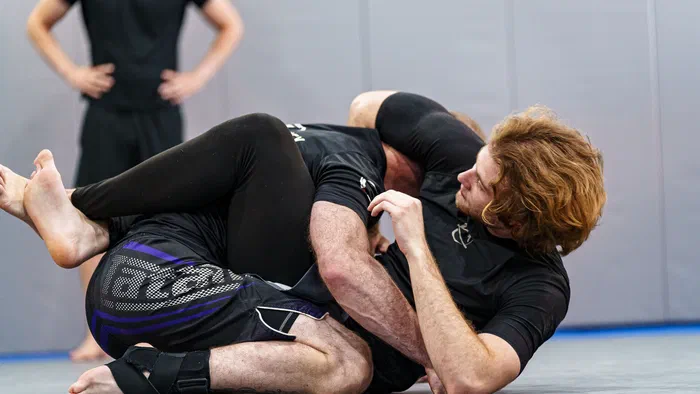
Imagine your kid partnered with another child. They're practicing an escape from a position. To do it right, your kid has to watch their partner's weight shift, notice where they're looking, feel which direction they're leaning—and predict what they're about to try.
Not what they're doing. What they're about to do. What they're planning. What's going on in their head.
Get it wrong? They get swept or stuck. Not painful—just clear feedback. "Okay, I thought she was going left but she went right. What did I miss?"
Then they reset and try again. And again. For forty-five minutes.
Now multiply that by two or three classes a week. Your kid is spending hours doing something they might only get minutes of during a school day: actively reading another person's mind, in real-time, with stakes.
They're not doing this with their best friend who they already understand. They're doing it with a rotating cast of partners—bigger kids, smaller kids, beginners, experienced kids—each one with different habits and patterns. Your child has to adjust constantly.
And there's a coach narrating the whole time. "Watch her hips. See how she's loading up on that side? What do you think she wants to do?" This is exactly what researchers call "scaffolding"—an adult helping a child notice and interpret what's happening in someone else's head.
It's not magic. It's just really, really good conditions for building the exact skill the pandemic disrupted.
The Window Is Still Open
Here's the hope in all this: kids' brains are still growing. These skills can absolutely be developed. The children in the study weren't broken—they were undertrained. And undertrained skills can be built with practice.
But it takes the right kind of practice. Not just being around other kids. Actually engaging with them, reading them, responding to them—over and over, with someone there to help them notice what they're missing. For kids spending hours on screens each day, the research on what that does to social development is sobering.
At Journey BJJ, we've watched kids who started out avoiding eye contact become the ones helping nervous new students feel welcome. Not because we taught them to be nice, but because they got enough practice reading people that they finally saw that nervous kid needed help.
That's the shift. Not performing social skills. Actually seeing what other people are thinking and feeling.
What This Means for Your Family
If your child is struggling—not just shy, but genuinely missing things, misreading situations, getting confused in groups—the pandemic may have disrupted something specific in how their brain processes social information.
It's not their fault. It's not your fault. But it won't fix itself either.
The research points to what helps: intensive, repeated practice at reading and responding to other people. The kind of practice where your child has to predict what someone else is thinking, sees immediately whether they were right, and tries again.
If you want to see what that looks like, we'd love to have your kid try a class. No pressure, no commitment. Just a chance to watch them engage in the kind of environment their developing brain might be hungry for.
---
**Book Your Child's Free Trial Class →**
Journey BJJ is Madison, Wisconsin's family-focused Brazilian Jiu-Jitsu academy. We build confident, capable kids through world-class instruction and a community that actually cares.
---
Sources
- Scott, R. M., et al. (2025). "COVID-19 lockdowns disrupted preschoolers' false-belief understanding." Scientific Reports. UC Merced News Coverage
- Gallup. (2025). "Pandemic Hurt Children's Social Skills, Mental Health." Gallup Poll Results
- Social skills
- Pandemic
- Development
- Research
Ready to Start Your Journey?
Choose the option that works best for you
Call to book: +1 (608) 416-1140